
Discovered on the Body Modifications's web site, these garnments temporarily alter the structure of the wearer's face. They are created by artist Paddy Hartley and Dr Ian Thompson.
Project facade's web site
They cast molten Bioglass© "into shapes up to 5cm long which can then be carved to a required shape and implanted into the face of a patient in need of repair of the nose or eye socket to name but two."

Showing posts with label self mutilation. Show all posts
Showing posts with label self mutilation. Show all posts
Thursday, May 24, 2007
Facial corsetry and bioactive glass implants

Friday, September 08, 2006
The 'moi-peau' and self mutilation
Researching on how haptics can provide a controlled painful stimulus as a treatment for self mutilation, I found an interesting medical research paper on the relationship between personal physical boundaries and self mutilation.
[The "Moi-peau"], Consoli SG, Med Sci (Paris). 2006 Feb ; 22(2): 197-200.
The author reviews the work of Didier Anzieu, pionneer of the 'moi-peau' concept. Certain persons have not yet acquired the 'moi peau', and use defense mechanims: Among other clinical characteristics, they have a "pathology of action" and frequently attack their own skin, paradoxically, in order to test the solidity and reliability of their own limits.
Because dermatologists frequently receive patients suffering from ereutophobia, dysmorphophobia, tattooing, self-mutilation, artefacta dermatitis, the author suggests that Anzieu bridged dermatologists to psychoanalysts.
Abstract of the paper
To construct a coherent identity, humans must distinguish what belongs to the external, perceived world from what belongs to their own inner world and the inner world of other individuals. Based on the theory developed by S. Freud and on work by ethologists, a number of psychoanalysts (J. Bowlby, R.A. Spitz, D.W. Winnicott, etc.) have underlined the importance of early tactile exchanges with the mother if a child is to become an autonomous individual who feels secure within what he or she perceives to be sound and reliable mental and physical boundaries. More recently, other psychoanalysts (E. Bick, W.R. Bion, etc.) have studied the fantasized mental structures that form the limits between an individual's inner mental space and the external world (including other individuals). As part of this theoretical psychoanalytical movement, Didier Anzieu, a French psychoanalyst, started to develop the concept of the "Moi-peau" in 1974. The "Moi-peau" designates a fantasized reality that a child uses during its early development to represent itself as "me", based on its experience of the body surface. The child, enveloped in its mother's care, fantasizes of a skin shared with its mother: on one side the mother (the outer layer of the "Moi-peau"), and on the other side the child (the inner layer of the "Moi-peau"). These two layers must separate gradually if the child is to acquire its own me-skin. D. Anzieu's work allowed dermatologists and other specialists, such as pediatricians, to focus on the quality of early tactile exchanges between a mother and her child, including the child with a chronic skin disorder. It also helped dermatologists to recognize patients with "borderline" states, which are particularly frequent in dermatology (ereutophobia, dysmorphophobia, tattooing, self-mutilation, artefacta dermatitis). These borderline patients are adults who, as a result of their mental conflicts, adopt defense mechanisms derived from both neurotic and psychotic functioning. Their complaints reflect difficulties with the solidity of their mental and physical limits: their real skin is metaphorically linked to the fantasized mental structure that delimits the individual mental space. Among other clinical characteristics, they have a "pathology of action" and frequently attack their own skin, paradoxically, in order to test the solidity and reliability of their own limits. Finally, D. Anzieu's work encouraged dermatologists to use psychotherapeutic approaches in parallel to classical dermatologic approaches, when necessary, and helped them better understand how psychoanalysts work with patients who have not yet acquired their own "Moi-peau". As a result, D. Anzieu was among the first to reconcile dermatologists and psychoanalysts.
In haptic psycho therapy
Tuesday, August 01, 2006
Goth youth subculture. self mutilation. suicide attempts
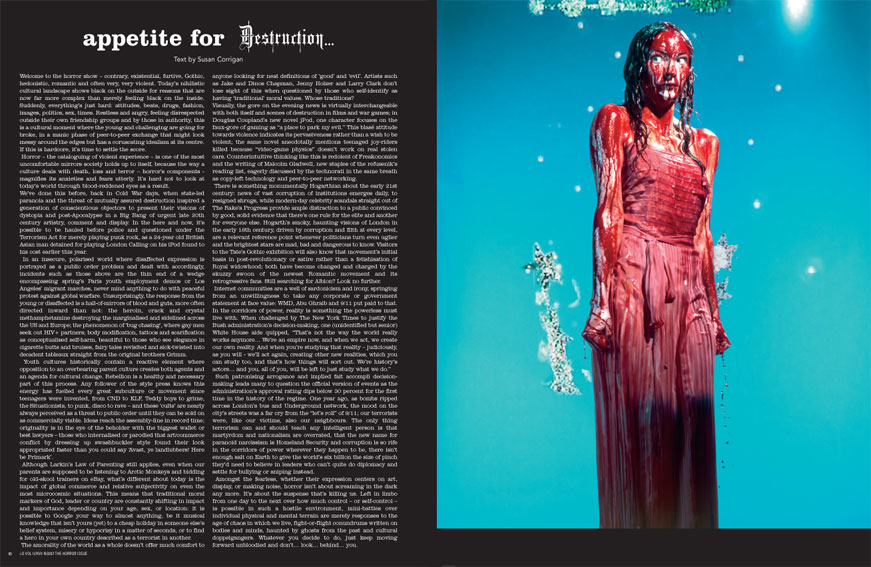
Picture taken from the magazine I-D horror issue of July 2006
A longitudinal cohort study develops on the relationship between goth youth subculture, self mutilation and suicide attempts to understand if deliberate self harm is associated with contemporary Goth youth subculture.
The paper, published in April 2006, is written by Robert Young, Helen Sweeting, and Patrick West: Prevalence of deliberate self harm and attempted suicide within contemporary Goth youth subculture: longitudinal cohort study. It is a study made with 1258 people aged 19, surveyed in 2002-4 and followed-up since age 11 (1994) in Scotland.
Identification as belonging to the Goth subculture was the best predictor of self harm and attempted suicide. Although based on small numbers, additional longitudinal analysis suggests both selection and modelling mechanisms are involved, selection mechanisms possibly being more likely.

One famous female role model is Theda Bara, the 1920s femme fatale known for her dark eyeshadow, curves and smoldering onscreen presence. By Wikipedia about Theda Bara's look being an inspiration for Goth fashion.
Definition of Goth subculture by Wikipedia
Goth is a contemporary subculture prevalent in many countries around the globe. It began in the United Kingdom during the early 1980s in the gothic rock scene, an offshoot of the post-punk genre. The goth subculture is remarkable for its longevity compared with others of the same era. Its imagery and cultural proclivities show influences from nineteenth century Gothic literature, mainly by way of horror movies (particularly cinematic depictions of vampires).
The goth subculture has associated "gothic" tastes in music and fashion. Gothic music encompasses a number of different styles. Common to all is a tendency towards a “dark” sound. Styles of dress within the subculture range from death rock, punk, Victorian, androgyny, some Renaissance style clothes, combinations of the above, and/or lots of black attire, makeup and hair.
Gothic woman, traditional style, with big hair, spikes and piercings

Picture from Wikipedia, the free encyclopedia.
The reviews were also particularly interesting in judging the results of this work. A pertinent one by Mark Taubert, Senior House Officer in Palliative Medicine:
Young’s interesting study (1) claims to find a strong association between Goth subculture and deliberate self-harm before and after adjusting for confounders.
Importantly, it fails to distinguish that the Goth subculture is not easily defined or categorised, spans several continents and has evolved to include a wide range of musical and clothing styles. This contemporaneously includes Mallgoths in the US, Gogans in Australia, Dark in Latin America, Cuervos in Spain and Spooky kids and Neogoths in the UK (2, 3). Young et al should have made it clear in their discussion that any conclusion only relates to a small sample of gothic youth in the Central Clydeside Conurbation. One cannot assume that Goth youths’ subcultural trends, icons and ideals would be similar in other geosocial regions.
Perhaps not all confounders have been taken into consideration given that Young’s study was conducted in Scotland between 2002 and 2004. During this period, a Scot won ‘Pop-Idol’ (Michelle McManus) and another won ‘Fame-Academy’ (David Sneddon). Both these TV programmes were difficult to avoid given the intense media coverage. The study concludes that the causality for Goths self-harming more than, say, Pop-Fans (53% and 7% respectively) remains unclear. The exasperation with current popular cultural trends may have driven one subculture, the Goths, to drastic methods of protest, such as overt self-harming.
Could frequent, involuntary exposure to mass-produced pop music affect the mental health of one youth sub-culture population more than another’s? As Ovid states in Tristia: Est quaedam flere voluptas.
Another point of view on the paper by Andrew J Ashworth, General Practitioner:
The observed association between deliberate self harm and the Goth subculture is seen as most likely to be by self-selection. I propose a physiological basis for that self-selection that is consistent with this and other evidence and offers theraputic possibilities.
The recorded method of deliberate self-harm in this study was “cutting, scratching or scoring”: all activities that might be expected to release endogenous endorphins systemically. Those who have suffered long term trauma can be expected to have higher levels of dynorphins (chronic endogenous antinociceptives), which are opiate kappa agonists, reducing dopamine secretion in the Nucleus Accumbens and causing reduced mood reactivity. “Driving” dopamine secretion through increased opiate mu secretion through physical (eg cutting), psychological (eg taking part in dangerous activity) or drugs (eg Heroin), or by smoking (Nicotine acts directly on Dopaminergic fibres)can rebalance the opiate system by overcoming the inhibitory kappa effect to permit perceived normality. Reactivity of mood mediated by dopamine can thus be subject to behavioural control, including deliberate self-harm by cutting, scratching or scoring.
Finally, the author's reply to the reviews:
The definition of “Goth” is contentious, but covers a wide range of musical tastes, social groupings, and aesthetics. The most relevant distinction here is between contemporary (usually younger) “Baby, Bat or sometimes referred to as Mall (US)” Goths vs. “mature, real or Elder Goths” 1. Our paper, as is clear from the title, refers to younger Goths; the results may not apply to all Goths.
The range of comments in response to our conclusion, that both selection and influence mechanisms may be involve, reflect the lack of evidence on this issue. To highlight this, we drew attention in the press release following publication to the possibility that engagement with Goth subculture could have positive rather than negative consequences for some young people. Our contribution is a first step towards producing an evidence base to test this, rather than relying on media speculation.
Some contributors have suggested that the association between self- harm and Goth subculture may be accounted for by other factors. However this is unlikely, since we adjusted for the strongest and most relevant correlates of self-harm found in other studies of young people. Others have suggested that our results were not valid due to the small numbers involved. We would point out that our paper underwent a formal statistical review before publication. Further, while the media focused on the 25 young people who unambiguously identified as Goth, nearly 8% of our representative sample had identified with Goth subculture, in varying degrees of intensity, and were 3-4 times more likely to self-harm, than the other participants.
It has also been suggested that by adopting a quantitive approach we may have missed contextual factors (this is obviously true of any non- qualitative study), and that the high rate of self-harm found among Goths is a form of decoration, analogous to body modification. We dispute this on two grounds. Firstly, since those who self-harmed were asked why, we know that the majority, regardless of youth subculture did so to relieve anxiety, anger and other negative emotions. Secondly, while cutting could be interpreted as some form of subcultural display, such an argument is difficult to sustain in relation to attempted suicide.
Finally, on a hopeful note, the I-D horror issue that I bought this July 06 seems to offer a nice come back into the Goth world ...


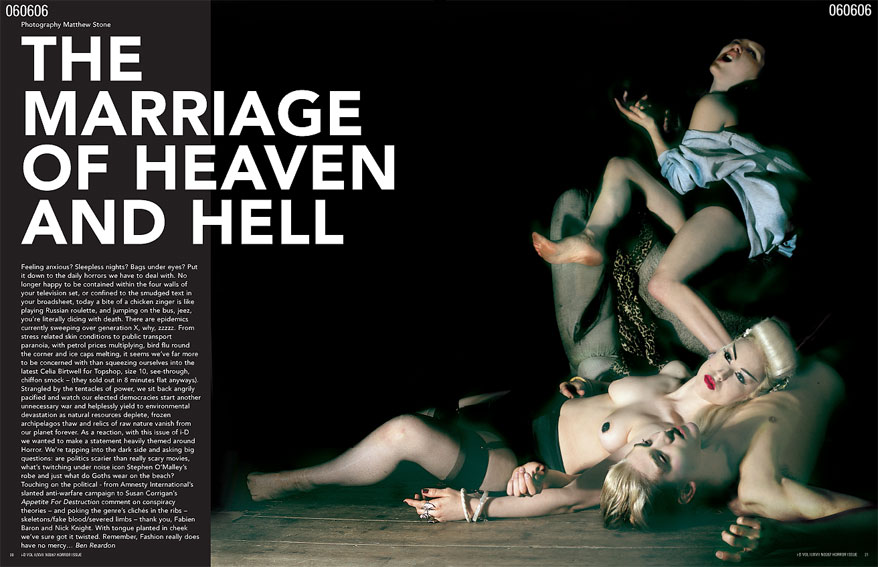



In self mutilation and fashion
Subscribe to:
Posts (Atom)
