


A landscape designed for the body. These livingstones, "les coussins galets" created by French designer Stephanie Marin, remind me of Ernesto Neto's work. I stumbled upon these and I love them. I can now embrace my furniture, discover the spaces inside, around and between my body!
See also the felt rocks by Molo!
Posted by Cati Vaucelle
♥ Architectradure
.............................................
Showing posts with label sensory therapy. Show all posts
Showing posts with label sensory therapy. Show all posts
Thursday, January 24, 2008
Hugging my furniture

Sunday, January 06, 2008
Therapeutic objects
Having researched and designed haptic devices to support psychotherapeutic treatments, I am fascinated by French designer :) Mathieu Lehanneur's work on therapeutic objects he conceived with psychiatric consultants: Bernard Lachaux, Patrick Lemoine and model makers: Alban Danguy des Deserts. These objects are part of the permanent collection of the MOMA, NYC.
He proposes a series of objects not only as an attempt to bring design into the medical sphere, but essentially to design medications from the perspective of the patient and his/her illness relationship.
His scenario envisions: the placebo effect, a participation of the patient in his/her treatment, making the medication a communicative and sensory object, debating on the mechanistic approach of modern pharmacology, playing on emotions of attraction, desire, fear and repulsion towards a device or a particular form using gestures, usage practices and rituals.
Therapeutic felt-tip pen, 2001.
This analgesic for chronic pain is a systemic medication, which acts on all symptoms together. All that is required is to write on the painful area of the body each day and to remove the used cartridge at the end of each day. This transdermal product is coupled with a user-friendly ink that disappears after several minutes.
The Third Lung, 2001.
This project consists of a base treatment for asthma. The patient who refuses to accept his illness will reject even more the idea of taking medication unnecessary. The idea behind this therapeutic object is to establish a relationship of dependence.
But in this case the medication is dependent on the patient. Between two doses, the volume of the medication increases, this displaying its own physiological problem and indicating to the patient the urgency of taking the medication. Once the dose is administered, the volume decreases and returns to its normal level, only to expand once again until the next dose is administered.
The First Mouthful
Posted by Cati Vaucelle
♥ Architectradure
Thursday, August 30, 2007
Cooling down or heating up the body
At MIT, Tangible Media Research Group, we created Cool Me Down, a flexible fabric wrap with electronic heat pumps and metallic sinks that generates a cooling sensation. we originally designed the system for the treatment of schizophrenia within a care-giving facility. Conducting case studies at a local hospital, we discovered that this technology could be used to accompany usual treatment for other mental conditions. 
Throughout the research I explored ways of heat synchronization with the body instead of triggering artificial heat independently from the body. I recently found a fascinating product CoreControl developed by researchers Dennis Grahn and H. Craig Heller.
Problem: "Overheating is a serious concern when exercising in hot environments, wearing insulative clothing, or during high intensity activity. CoreControl can be used to effectively remove heat from the body in a variety of settings."
Solution: "CoreControl TM powered by RTX cools you quickly and safely from the inside out. With patented, cutting-edge technology, it rapidly cools your body core first, unlike ice packs, vests, and misting fans, which cool you from the outside in. CoreControl enables you to consistently perform at your peak."
CoreControl diagram by Nigel Holmes, from Just Cool It's article in Stanford Magazine.
CoreControl's web site
Thursday, July 19, 2007
Scarf with electrically operated massager
Scarf with electrically operated massager United States Patent 6537235, by Connor, Clara (Fountain Valley, CA, US) and Busto, Ernest J. (Cypress, CA, US), March 2003.
A combination massager and scarf assembly having a number of electrical motors secured in a flexible casing, which flexible casing is removably secured in the interior of the scarf. The scarf is wrapped around the flexible casing and the motors in the casing are electrically connected to a control box having an A.C. or D.C. power supply to actuate the electrical motors. The control box includes a knob to regulate the speed of vibration of the motors.

Tuesday, April 17, 2007
A Robotic Companion

There currently exists a growing body of research indicating the diverse benefits that companion animals offer people. Studies have shown that animals are capable of lowering stress, reducing heart and respiratory rate, showing positive changes in hormonal levels, mood elevation, and increased social facilitation. Given these health and social benefits, animal assisted therapy is commonly used to benefit hospitalized children, the elderly, and other people in need. Unfortunately these animals are not always available to patients due to allergies, risk of disease, restricted visiting schedules, or other reasons.
To provide health and social benefits when therapy animals are not available, robot-assisted therapy applications have recently attracted the attention of robotics researchers.
The Huggable is a new kind of robotic pet surrogate for pet therapy applications in children's hospitals and nursing homes where pets are not always available. Much research has explored the benefits of pets in lowering stress and elevating positive mood. We are designing a robotic teddy bear with full-body sensate skin and smooth, quiet voice coil actuators that is able to relate to people through touch. The Huggable features a series of temperature, electric field, and force sensors which it uses to sense the interactions that people have with it. This information is then processed for its affective content, such as, for example, whether the Huggable is being petted, tickled, or patted; the bear then responds appropriately. We recently demoed the Huggable at SIGGRAPH 2006 in Boston, and it was a recent winner of the 2006 Robots at Play Award. It is funded in part by a Microsoft iCampus student grant.
Project from the MIT Media Lab by Cynthia Breazeal, Walter Dan Stiehl, Jeff Lieberman, Matt Berlin, Jesse Gray, Kuk-Hyun Han (Samsung), Levi Lalla, Allan Maymin, Jonathan Salinas, Daniel Fuentes, Robert Toscano, Cheng Hau Tong, Aseem Kishore, Louis Basel and Roshni Cooper
Web site
Tuesday, January 16, 2007
Touch · Sensitive Apparel

What if objects that people carry with them and even carry on them could offer this sensory comfort that they seem to seek?
Together with Yas I have codevelopped a touch-sensitive apparel for massage and sensory therapy. The research focuses on the material - how the structure and the embedded components of the garment participate in pushing its function to become an envelope or cocoon for one's well-being.
Touch·Sensitive is a haptic apparel that allows massage therapy to be diffused, customized and controlled by people while on the move. Made of modular garments, it applies personalized stimuli. Touch·Sensitive aims to provide individuals with a sensory cocoon, a comforting and alerting apparel with a feedback system. Our design for the Touch·Sensitive apparel comes from the observation that people need to sooth their body to protect themselves from everyday aggressions. Touch·Sensitive is a matrix made of clothing elements that allows diffusion of tactile information through heat sensors, mechanically-driven textural sensation and liquid diffusion.
The following is a series of our Low-Fidelity prototypes.
LOW-FIDELITY PROTOTYPE #1 
This wired apparel alerts the user by mechanically shrinking the fabric onto specific points of tensions on the body.
LOW-FIDELITY PROTOTYPE #2
The second low-fidelity prototype of Touch·Sensitive is made of buttons with silicone.
LOW-FIDELITY PROTOTYPE #3
Manually inflatable vinyl pockets can be used to receive a comforting pressure
LOW-FIDELITY PROTOTYPE #4
Structure flex
Touch·Sensitive allows the diffusion of tactile information through computational and mechanical technologies. It is a computerized touch therapy apparel whose modular pieces can be integrated within the clothing. We have taken advantage of the growing miniaturization of computational components to integrate them seamlessly within the fabric.
Keep tuned!
-------------------------------------------------------
Touch · Sensitive Apparel work-in-progress 6 pages paper has been accepted to CHI 2007. Come see Yas and I in Saint Jose from April 28-May 3 2007!
Abstract
Touch·Sensitive is a haptic apparel that allows massage therapy to be diffused, customized and controlled by people while on the move. It provides individuals with a sensory cocoon. Made of modular garments, Touch·Sensitive applies personalized stimuli. We present the design process and a series of low fidelity prototypes that lead us to the Touch·Sensitive Apparel.
Download pdf of the paper
Thursday, November 30, 2006
Effects of a Snoezelen on self-injury and aggression

Attribution: Photo of a snoezelroom at Het Balanske, Halensebaan 2, 3390 Tielt-Winge, Belgium by Michaël RY Laurent, Belgium.
Snoezelen or controlled multisensory stimulation is used for people with (severe) mental disabilities, and involves exposing them to a soothing and stimulating environment, the "snoezelen room". These rooms are specially designed to deliver stimuli to various senses, using lighting effects, color, sounds, music, scents, etc. The combination of different materials on a wall may be explored using tactile senses, and the floor may be adjusted to stimulate the sense of balance.by Wikipedia
Originally developed in the Netherlands in the 1970s, snoezelen rooms have been established in institutions all over the world (like in Germany, where more than 1200 exist).
Snoezelen might be beneficial to people with autism and other developmental disabilities, dementia, and brain injury. However, research on these matters is scarce, with variable study designs.[1] [2]
References
[1]Chung JCC, Lai CKY. Snoezelen for dementia. The Cochrane Database of Systematic Reviews 2002, Issue 4. Art.
[2]Lancioni GE, Cuvo AJ, O'Reilly MF. Snoezelen: an overview of research with people with developmental disabilities and dementia. Disabil Rehabil. 2002; 24: 175-84.
Effects of Snoezelen room, Activities of Daily Living skills training, and Vocational skills training on aggression and self-injury by adults with mental retardation and mental illness. Res Dev Disabil. 2004 May-Jun;25(3):285-93. By Singh NN,
Lancioni GE, Winton AS, Molina EJ, Sage M, Brown S, Groeneweg J.
Abstract Multi-sensory stimulation provided in a Snoezelen room is being used increasingly for individuals with mental retardation and mental illness to facilitate relaxation, provide enjoyment, and inhibit behavioral challenges. We observed aggressive and self-injurious behavior in three groups of 15 individuals with severe or profound mental retardation and mental illness before, during, and after being in a Snoezelen room. All participants were receiving psychotropic medication for their mental illness and function-derived behavioral interventions for aggression, self-injury, or both. Using a repeated measures counterbalanced design, each group of participants was rotated through three experimental conditions: Activities of Daily Living (ADL) skills training, Snoezelen, and Vocational skills training. All other treatment and training activities specified in each individual's person-centered plan were continued during the 10-week observational period. Both aggression and self-injury were lowest when the individuals were in a Snoezelen room, followed by Vocational skills training and ADL skills training. The levels in the Snoezelen room were significantly lower than in both the other conditions for aggression but only in ADL skills training for self-injury. The difference in levels before and after Snoezelen were statistically significant with self-injury but not with aggression. The order of conditions showed no significant effect on either behavior. Snoezelen may provide an effective context for reducing the occurrence of self-injury and aggression.
PMID: 15134793 [PubMed - indexed for MEDLINE]
Wednesday, November 15, 2006
Seamless-sensory Interventions
Based on my previous work on haptics for psychotherapy, I am now designing Seamless Sensory Interventions for the treatment of mental and neurological disorders.
My current research proposes haptics as the key to bringing treatment into the social sphere through devices, and providing new ways to mediate between the patient and the therapist both in and outside of therapy. Self-mutilation is a perfect test-case, because of the definitive “physicality” of the symptoms. However, the broader solutions that I am proposing have implications for diseases as diverse as autism, depression, and schizophrenia.
Wednesday, November 08, 2006
Fashion garments
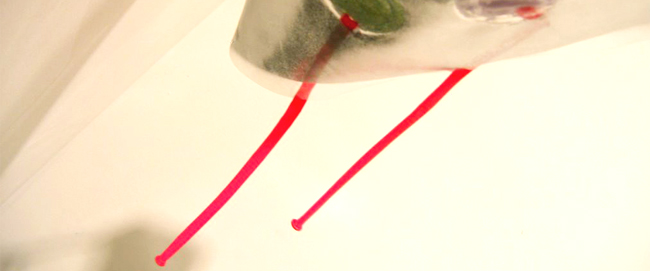
Picture of our X-mode project
Creating, discussing, sharing, building with Yaz on fashion garments (statement coming soon). A few sketches of our nurturing ideas ...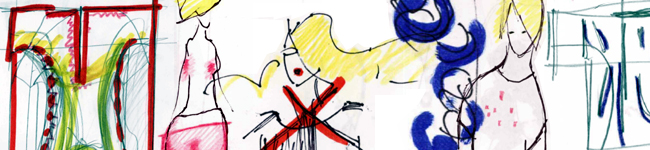
More pictures
Friday, September 08, 2006
The 'moi-peau' and self mutilation
Researching on how haptics can provide a controlled painful stimulus as a treatment for self mutilation, I found an interesting medical research paper on the relationship between personal physical boundaries and self mutilation.
[The "Moi-peau"], Consoli SG, Med Sci (Paris). 2006 Feb ; 22(2): 197-200.
The author reviews the work of Didier Anzieu, pionneer of the 'moi-peau' concept. Certain persons have not yet acquired the 'moi peau', and use defense mechanims: Among other clinical characteristics, they have a "pathology of action" and frequently attack their own skin, paradoxically, in order to test the solidity and reliability of their own limits.
Because dermatologists frequently receive patients suffering from ereutophobia, dysmorphophobia, tattooing, self-mutilation, artefacta dermatitis, the author suggests that Anzieu bridged dermatologists to psychoanalysts.
Abstract of the paper
To construct a coherent identity, humans must distinguish what belongs to the external, perceived world from what belongs to their own inner world and the inner world of other individuals. Based on the theory developed by S. Freud and on work by ethologists, a number of psychoanalysts (J. Bowlby, R.A. Spitz, D.W. Winnicott, etc.) have underlined the importance of early tactile exchanges with the mother if a child is to become an autonomous individual who feels secure within what he or she perceives to be sound and reliable mental and physical boundaries. More recently, other psychoanalysts (E. Bick, W.R. Bion, etc.) have studied the fantasized mental structures that form the limits between an individual's inner mental space and the external world (including other individuals). As part of this theoretical psychoanalytical movement, Didier Anzieu, a French psychoanalyst, started to develop the concept of the "Moi-peau" in 1974. The "Moi-peau" designates a fantasized reality that a child uses during its early development to represent itself as "me", based on its experience of the body surface. The child, enveloped in its mother's care, fantasizes of a skin shared with its mother: on one side the mother (the outer layer of the "Moi-peau"), and on the other side the child (the inner layer of the "Moi-peau"). These two layers must separate gradually if the child is to acquire its own me-skin. D. Anzieu's work allowed dermatologists and other specialists, such as pediatricians, to focus on the quality of early tactile exchanges between a mother and her child, including the child with a chronic skin disorder. It also helped dermatologists to recognize patients with "borderline" states, which are particularly frequent in dermatology (ereutophobia, dysmorphophobia, tattooing, self-mutilation, artefacta dermatitis). These borderline patients are adults who, as a result of their mental conflicts, adopt defense mechanisms derived from both neurotic and psychotic functioning. Their complaints reflect difficulties with the solidity of their mental and physical limits: their real skin is metaphorically linked to the fantasized mental structure that delimits the individual mental space. Among other clinical characteristics, they have a "pathology of action" and frequently attack their own skin, paradoxically, in order to test the solidity and reliability of their own limits. Finally, D. Anzieu's work encouraged dermatologists to use psychotherapeutic approaches in parallel to classical dermatologic approaches, when necessary, and helped them better understand how psychoanalysts work with patients who have not yet acquired their own "Moi-peau". As a result, D. Anzieu was among the first to reconcile dermatologists and psychoanalysts.
In haptic psycho therapy
Thursday, April 13, 2006
Sensory clock

I have found various designed clock such as the 'designer time machine' with its own time-telling technique.
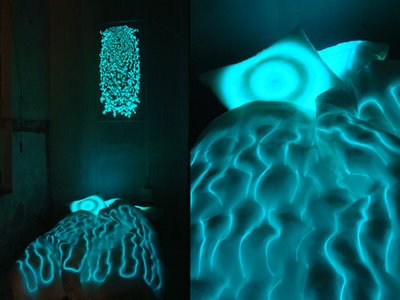
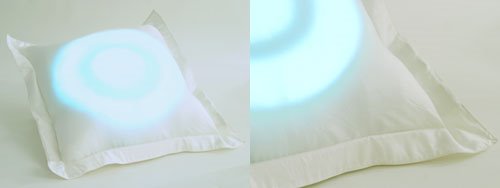
The most intriguing one to me so far is the silent alarm clock by Rachel Wingfield and Mathias Gmachl. Currently researching on haptics for sensory therapy, I find this bedding a poetic and transparent manner to support patients with SAD.
The following is a quote about the research on relationship between light and the body internal clock.
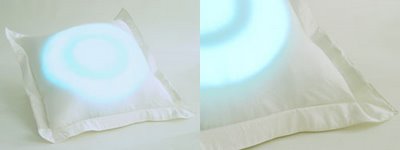
The most intriguing one to me so far is the silent alarm clock by Rachel Wingfield and Mathias Gmachl. Currently researching on haptics for sensory therapy, I find this bedding a poetic and transparent manner to support patients with SAD.

Light Sleeper is an illuminating, personalised alarm integrated into bedding that gently wakes in the most natural way. Ever since the beginning of time light has controlled our body clock telling us when to sleep and when to wake. As lifestyles are rapidly changing with increased travel and demands on our time, people's natural body clocks are out of sync (...) The bedding aims to treat sufferers of seasonal affective disorder (SAD) where insufficient levels of daylight cause medical conditions caused by a hormonal imbalance ranging from depression to loss of energy, pre-menstrual syndrome, weight gain and migraines. It is recognised by most scientists that SAD and other sleep/ mood disorders are linked to a shift in the suprachaismatic nucleus or circadian rhythm and often referred to as the ‘body clock’
The following is a quote about the research on relationship between light and the body internal clock.
Research shows that the body’s internal clock only responds to bright light at certain times of day. This peak time in normal people occurs when the circadian rhythm is in R.E.M sleep, which is approximately 1 to 2 hours before waking. This promotes the use of Light Sleeper Bedding and proves it to be one of the most effective products for treating SAD and improving well being as it synchronises our body clock each morning
In sensory design
Saturday, April 01, 2006
Birgitta Cappelen's furniture
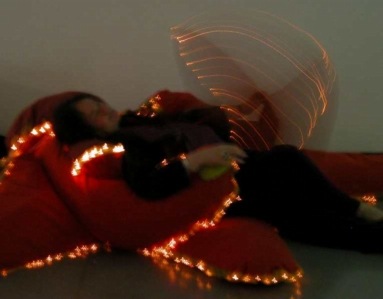
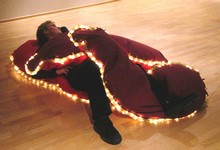
In the area of furniture that responds to your body movements, form, and needs, I met product designer and researcher Birgitta Cappelen at the Collaborative Artefacts Interactive Furniture (CAIF) workshop in 2005. She presented and discussed her collaborative work: 'unfoldings. The furniture is filled with bending sensors, sensors, speakers. One can hug, sit, and relax on the furniture and the motions are reciprocated with music, moving images and light.

Unfoldings is an interactive audio-tactile field, open to potential movements that are reciprocated with music, moving images and light. Unfoldings is like a piece of furniture, a cross between cushion, armchair and travelling rug, to sit or lie on or use as a shawl or blanket. The individual interacts with the field by sitting down, moving or speaking - to one self or to others - to create one's own or together with others.More info about unfoldings
Wednesday, March 29, 2006
Health care and product design : Sleep & Recovery Enhancer by André Kongevold

SRE - Sleep & Recovery Enhancer by André Kongevold
Today, stress-related sleeping problems are increasingly common. More and more people experience difficulties falling asleep at bedtime. The SRE will guide the user through autogenous exercises to lower the stress-level and reduce time to fall asleep. This in turn will improve sleep quality and minimize daytime effects.
More info
The Hug by Sohui Won

When you chat with your friend or family, you can feel their touch as well. Just hug "the hug."
" "The Hug" is communicator to feel touch. It has two main functions.
- Sending / Saving / Receiving messages
- Sending / Saving / Receiving touches
Have you wanted to convey your touch to your lover or children? Trough this device, you can transmit your touch with a message to another device that my pal has. When you leave a message, you can hug and touch "The Hug" to transmit your touch. So the movement of your touch can be conveyed to your mate's device through heat-line and vibration."
More detail about the project
The Hug : interaction design

The Hug is A visionary robotic product concept developped by Carl DiSalvo, Carl DiSalvo, Francine Gemperle, Willy Yonkers, Elliott Montgomery, and Jamie Divine.
The Hug is a soft, huggable product that uses sensing technology and wireless telephony to provide social and emotional support for distant family members. Thisrobotic product uses verbal communications along with touch and physical interaction to create a sense of presence. The Hug uses technology in a way that profoundly addresses an observed human need -- the need for a sense of presence during intimate communication.
descriptive paper and technical details published at RO-MAN (IEEE International Workshop on Robots and Human Interactive Communication), another one on the design form, and a case sketch.
More info
Monday, March 27, 2006
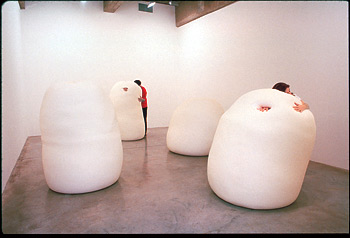
Ernesto Neto : huggable sculptures
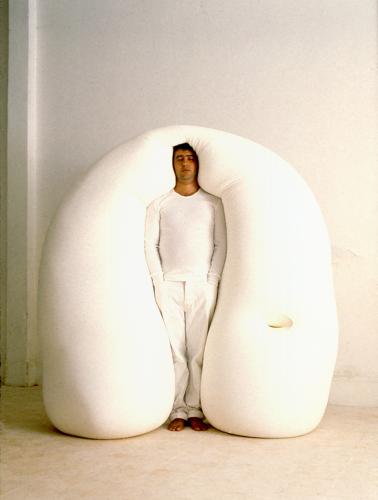
I love Ernesto Neto's soft "huggable" sculptures.
Exhibited in Hirshhorn Museum, Washington, USA in March 2002. Neto's sculptures and installations are indeed singular in contemporary art," says curator Viso. "His works, which he describes as a 'kind of body/space/landscape,' not only arrest us visually but also make us keenly aware of the spaces inside, around and between our bodies. We become voyagers in sensorial odysseys
Ernesto Neto (Brazilian, born 1966), "The Ovaloids Meeting" (1998). Courtesy of the artist and Tanya Bonakdar Gallery, New York.
Saturday, February 18, 2006
Product design for relaxing
A need to be comforted?
I found this very interesting entry on Pasta and Vinegar:
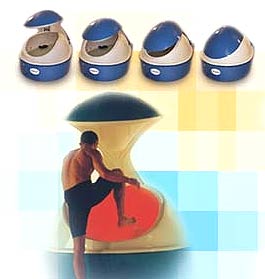
The Flotarium concept is a spaceship-looking sensory deprivation capsule full of water and salts to create optimal buoyancy so that people can float and relax.
The napmosphere
via a modular system meant to be like a cocoon providing a place of shelter.
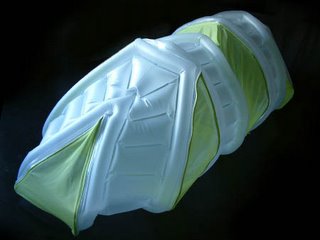
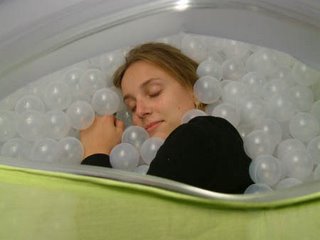
The napshell, the sleeping capsule, is also very interesting. It's powerful shape acts as eyecatcher that attracts attention to itself. A modular system allows different Areas of use: A simple variant of the object is designed for outdoor areas. The robust construction could be used within parks or in open places as public furniture. This would allow the object to reach a broad audience.
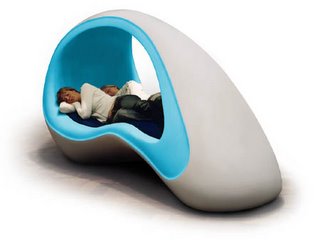
Power-Napping ...
I found this very interesting entry on Pasta and Vinegar:
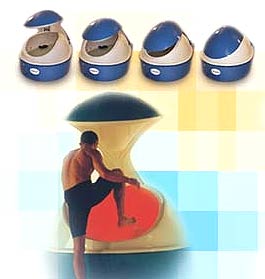
The Flotarium concept is a spaceship-looking sensory deprivation capsule full of water and salts to create optimal buoyancy so that people can float and relax.
The napmosphere
via a modular system meant to be like a cocoon providing a place of shelter.
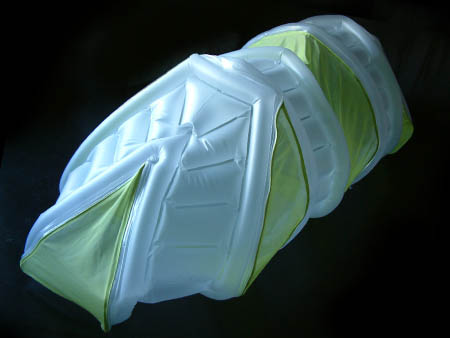

The napshell, the sleeping capsule, is also very interesting. It's powerful shape acts as eyecatcher that attracts attention to itself. A modular system allows different Areas of use: A simple variant of the object is designed for outdoor areas. The robust construction could be used within parks or in open places as public furniture. This would allow the object to reach a broad audience.

Power-Napping ...
By Cati in Research
Thursday, November 17, 2005
Touching memories

Touch is at the heart of intimate relationship. It is also a powerful trigger of past emotions. Touching memories is a system that detects and records a touch by a loved one. Be it a stroke, a pat, a hug, or a rub, the system will store the touch and play it back to you whenever you need it
This project is in its conceptual phase.
By Cati in affective design
Subscribe to:
Posts (Atom)
