Showing posts with label installation. Show all posts

Monday, February 23, 2009

The WoW pod at Mixer in New York!!!

After receiving three grants: from the Council for the Arts at MIT, SHASS’s Peter de Florez Fund for Humor and from Eyebeam, the WoW Pod will be exhibited during the MIXER event in New York!


Cati Vaucelle, Steve Shada, Marisa Jahn's WoW Pod is an immersive architectural space that provides and anticipates all life needs of the World of Warcraft player. Outfitted with toilet throne, hydration system, and meals at the ready, the WoW Pod makes daily human function possible without ever stepping away from the game. In addition, these tasty meals are cooked via a cookset that connects a hotplate to the computer, allowing the player to let their World of Warcraft avatar know when the meal is ready to eat.


The official call!

MIXER: EXPO
Eyebeam presents an alternate "World's Fair" with airborne surveillance balloons, guerilla media towers, and computerized prayer booths. A temporary village occupied by a dozen creatively engineered pavilions, performances, and DJ sets by Tim Sweeney and Juan Maclean.

Friday, March 6 & Saturday, March 7, 2009
9PM - 2AM
Tickets: $15 per night in advance; $30 for both nights in advance at www.eyebeam.org; $20 per night at the door.
Eyebeam 540 W. 21st St. (btw 10th and 11th Aves.)
Limited press passes available: RSVP: rebecca@eyebeam.org
Installations will remain on view at Eyebeam, Saturday, March 7, Noon - 6PM, with free entry.

New York City, February 20, 2009 - MIXER, Eyebeam's quarterly event series dedicated to showcasing leading artists in the fields of live audiovisual performance, interactive and participatory art, will present its fifth iteration on Friday, March 6 - Saturday, March 7, 2009. Using the World's Fair as the framework, Eyebeam will transform its rugged warehouse space into a temporary village of utopian pavilions for a two-night extravaganza called MIXER: EXPO.

Both evenings will include musical guests: Tim Sweeney (Friday, Midnight - 2AM) and Juan Maclean (Saturday, Midnight - 2AM); multimedia pavilions by Angela Co + Aeolab, Anakin Koenig, Chris Jordan, and Caspar Stracke, and Not An Alternative; interactive installations by Taeyoon Choi and Cheon pyo Lee, The Institute for Faith-Based Technology, Mark Shepard, Cati Vaucelle, Steve Shada, and Marisa Jahn; and fashion performances by Di Mainstone.


MIXER: EXPO - Background

From London in 1851 to Chicago in 1893 and New York in 1939, the World's Fair has been an influential cultural spectacle that promised a utopian "world of tomorrow" while packaging and promoting the national and corporate agendas of the day.

MIXER: EXPO is an alternate take on "World's Fair" expositions, a faded cultural phenomenon that set the tone for urban planning in the 19th and 20th centuries. The World's Fair also championed the philosophy of better living through technology, presenting innovative strategies that continue to resonate through contemporary life and leisure - from shopping malls and theme parks to natural history and science museums; broadcast media and exhibit display to sell consumer products, technological innovations, and nationalistic ideologies.

Like the best science fiction and social satire, MIXER: EXPO constructs a fictitious place in order to examine a world that might have been, that has come to be, or that might be on the horizon.

Musical Acts
Friday, Midnight - 2AM
Tim Sweeney (Beats in Space) is a respected international club DJ, remixer, and host of Beats In Space, a weekly radio show mixed live every Tuesday night on WNYU. Sweeney rocks the party with a mix of electro, disco and No Wave.
http://www.beatsinspace.net/

Saturday, Midnight - 2AM
Juan Maclean (DFA Records) first garnered attention in the early 90s as the guitarist/keyboardist for electro-punk band Six Finger Satellite, but has gone on to wider acclaim in the last decade as a solo artist on DFA Records (founded by James Murphy of LCD Soundsystem). Maclean's recordings combine his multi-instrumental virtuosity with tight beat production inspired by house, techno, and funk classics. His DJ sets dig deeply into the same vault of musical riches.
http://www.myspace.com/thejuanmaclean

Installations / Participating Artists
Taeyoon Choi and Cheon pyo Lee's sculptural installation and performance,
Grey Belt tells the story of an undiscovered nation located in a demilitarized zone. The land of Grey Zone is the world's purest natural site, secretly inhabited by mutant animals, abandoned war machines and the exiled living in a zero-gravity landscape.
http://www.tyshow.org

Angela Co + Aeolab's Weather Making Balloon utilizes NASA materials technology for its own "Space Mission". The metalized thermoplastic skin of the Balloon functions as a mirrored surface through which attendees can be monitored and captured on film. Playful interaction with the responsive surface of the puffy, cloud-like Balloon masks its primary function as a surveillance tool.
http://www.studio-co.com
http://www.aeolab.com

The Institute of Faith-Based Technology, or InFaBat™, was founded in 2006 by techno-theologists Aaron Meyers and Jeff Crouse to bring religion into the digital age. Praying@Home is the name of a suite of technologies developed by InFaBat™ and installed for use at Eyebeam, which is designed to broadcast a worshipper's "Prayer Signature" directly to God. Unlike humans, who need to take breaks from praying to fulfill biological needs, computers need no breaks, resulting in 24/7 prayer output. Praying@Home represents a revolutionary breakthrough in the field of Digital Prayer Technology.
http://www.ifbt.info

Media artists Anakin Koenig, Chris Jordan, Caspar Stracke pay tribute to the "retro-futurist" utopian dwellings of the 20th Century with TripleFlow, a large-scale inflatable architectural structure. Referencing Buckminster Fuller's geodesic dome, the three-chamber biomorphic dwelling creates a fluid, immerse experience through responsive lighting, and live audio and video performance by Jordan and Stracke.
http://www.dennisdelzotto.com/
http://www.seej.net
http://www.videokasbah.net/

The nomadic-citizen of the world is never lost because she is always at home. Di Mainstone's SHAREWEAR questions this utopian ideal, through a performance that incorporates a set of modular dresses that explore our desire for a connection to "home" in an increasingly transient world. Referencing familiar icons of the home, such as the armrest on our favorite sofa, SHAREWARE is comprised of a pair of modular electronic dresses housed in crates that are unpacked, assembled on each performer's body, and then physically slotted to one another, unleashing the potential for intimate interactions.
http://sharewear.projects.v2.nl
http://uk.youtube.com/watch?v=7kc41dKjA1c

The Subsumption Machine by activist collective Not An Alternative is a skeletal multi-level media tower hacked with video projections, TV monitors, billboards, stage sets, live video feeds, and surveillance cameras. As the audience walks through the chaotic architectural structure, they are captured on camera and unwittingly inserted into the media stream. The Subsumption Machine represents the postmodern dystopian world as a biopolitical "prison house of language", and in a Warholian gesture, flattens all images into a non-hierarchical supersaturated mix.
http://eyebeammixer.pbwiki.com/Proposed-Pavilion

Hertzian Rain is a wireless audio broadcast system designed by Mark Shepard that responds to bodily movement. Just as land and water are limited resources, Hertzian Rain demonstrates the limits of the electromagnetic spectrum. Wearing wireless headphones and carrying an umbrella covered with electromagnetic-shielding fabric, users walk around the exhibition space tuning into an audio broadcast of a live music performance while creating interference into the audio broadcast signal with the umbrella, and as a result destroy the shared resource. Live performances will be provided by Doug Barret, Craig Shepard, Daniel Perlin, Al Laufeld and others.
http://www.andinc.org/v3/hertzianrain

Cati Vaucelle, Steve Shada, Marisa Jahn's WoW Pod is an immersive architectural space that provides and anticipates all life needs of the World of Warcraft player. Outfitted with toilet throne, hydration system, and meals at the ready, the WoW Pod makes daily human function possible without ever stepping away from the game. In addition, these tasty meals are cooked via a cookset that connects a hotplate to the computer, allowing the player to let their World of Warcraft avatar know when the meal is ready to eat.
www.marisajahn.com
www.steveshada.com
http://www.architectradure.com

Tickets: $15 per night in advance; $30 for both nights in advance; $20 per night at the door. For more info and to purchase tickets visit www.eyebeam.org.

###

Founded in 1997, Eyebeam is an art and technology center that provides a fertile context and state-of-the-art tools for digital experimentation. It is a lively incubator of creativity and thought, where artists and technologists actively engage with the larger culture, addressing the issues and concerns of our time. Eyebeam challenges convention, celebrates the hack, educates the next generation, encourages collaboration, freely offers its output to the community, and invites the public to share in a spirit of openness: open source, open content and open distribution.


More info

Posted by Cati Vaucelle @ Architectradure

Wednesday, February 06, 2008

Digital carpet


This December, ENESS stopped the public in their gift grabbing tracks with an alternative celebration of light at Melbourne’s QV square. A digital carpet took over the square after dark and compel interactive connectivity between friends and strangers. Abstract messages and images that overlay the surface responded to activity and the public was responsible for designing the space with colorful particles of light as they play through the square.


Posted by Cati Vaucelle
Architectradure
.............................................

Monday, November 19, 2007

Firebird


Contrasting delicate silhouettes with a massive robotic construction, this moving sculpture retro-projects goth-looking birds. Work by Jonathan Schipper and Amelia Biewald.

Wednesday, July 25, 2007

Abstract by Joëlle Bitton


Abstract is the upcoming interaction installation by Joëlle Bitton at Gallery EF in Tokyo.

On the theme of waiting and the perception of the time passing-by: inviting visitors in a space where the body and its movement play the role of interfaces. From a point of view on the Japanese garden and its vision on the surrounding, aesthetic and philosophical world, this project is inspired by the tension between elements intentionally thought here in a contradictory dialog: abstraction and texture, concealment and disclosure, empty space and framed space. This installation places the visitor on the razor's edge: always on the border, between two worlds, passing from one to the other. This is the experience of difference and of a fragile balance, of what is called in the Japanese culture, the impermanence of things. The latter is then staged in a relationship to the cycle of time, to the emotions that the expectation of something to happen can generate.
Joëlle's portfolio

Friday, April 06, 2007

Eness


Everlab's 1 hour circle by Eness

I recently had the pleasure to meet Nimrod Weis, co-founder of Eness.


I discovered his Pixile work, an interactive digital sculpture which transforms a series of static objects into an interactive illusion giving this powerful illusion of real-life objects spinning, changing and responding to each other.


I love Virsual, their digital rocking horse, a wireless, ride-on rocking horse equipped with its own motion sensor device. As riders saddle up a 3D game is activated and displayed on screen. I definitely can tell how much children would love this.


Their latest installation commissioned by Audi to exhibit at the New Audi TT launch in Sydney next week. So if you are in Sydney, check it out!
Video.

A series of four translucent screens, each representing a solid cross section of time and space, Three dimensional objects rapidly passing through. These sections deflect, ricochet and manipulate thousands of virtual particles contained in these cross sections. The high impact point of collision between space and matter create an endless amount of esthetical beautiful iconic formations. The gravity of the particles are effected by camera tracking, meaning that the particles direction and velocity change depending on the position of the viewer.

More on Eness' web site

Monday, March 05, 2007

Moore Pattern


Inspired by the wooden kinetic work of David Roy, Jeff Lieberman just created Moore Pattern a kinetic sculpture that overlays patterns on top of one another using two counter-rotating bead-blasted aluminum disks, driven from a single motor below with a belt drive mechanism.

Watch the video to witness the moiré effect.

Do strangers meet?


Drawing and Tag cloud I made for the Kendall T Band

Looking for a site to show Charles Goldman when he is in town, I finally picked the famous Kendall Band - Kepler, Pythagoras, Galileo designed, fabricated and installed by Paul Matisse.
In 1987, Paul Matisse installed in Cambridge, Kendall T Station, the The Kendall Band a musical sculpture. Passengers can move handles located on each platform and will activate hammers that strike the bells. The instruments are suspended in arches between the tracks. Made of aluminum, teak, steel, the band consists of :
· Kepler a 55-inch aluminium ring that hums for five minutes after it is struck by the large teak hammer above it.
· Galileo a sheet of stainless steel that imitates a train roaring in when a train roars in.
· Pythagoras twin sets of eight bells of the type of the new memorial bell in Washington.

The Kendall Sculptures are very much the thing I love to show to a tourist in town. Being a student at MIT, I am not afraid of technical objects, I find them sexy. Bringing technicality into the T station where it is full of machines and the metallic sound resonating with its own voice: the sound of the train, the aluminum as a metal and the reverberation of the vibrato into the station, is exciting. It is definitely unique and as Paul Matisse says: “it is MIT’s baby”.

Social challenge: talk to strangers
It seems contradictory to what my grand ma told me: do not talk to strangers. Well, artists are different, they want things to be different. Paul Matisse wants strangers to talk to each others and maybe meet. He also thinks music can help that to happen. Passengers waiting for their trains can play with the sculpture. Sometimes, strangers can meet: can look at each others, can smile, maybe play together? I believe that one can cut herself from the visuals, but it is harder to do with sounds. So one can notice the change of sounds. Because propagating the sounds throughout the entire station is not directed towards one person, people can then feel free to respond or ignore the gesture. The inside is invaded, but somehow no pressure is put on bringing it outside. One can choose. And sometimes strangers can meet.

Music
The Kepler strikes an F sharp to go with the B minor of the Pythagoras.

Pictures
No picture for this post so you can then fully discover it when you are in Boston!

For more info, read the article Kendall Sculptures Bring Music, Talk to Strangers, The Tech, Volume 115, Number 66, 1996.

Sunday, March 04, 2007

Reflections


The artist Devorah Sperber recreates paintings by assembling spools of thread. Reflections is a permanent Installation at the Centro Medico Train Station, San Juan, Puerto Rico. The artist used 60,000 spools of thread and 23 convex mirrors for the installation.

"Reflections" is a site-specific work, constructed from 60,000 spools of thread, which coalesce into a photo-realistic image when seen reflected in convex mirrors mounted on an opposing wall. My intention was to utilize the element of surprise to create a brief interruption in the lives of people as they move through the Centro Medico Train Station (...) Because people will be in motion, the images seen in the mirrors continuously change. As people step onto the escalator and descend to the lower platform, the reflections in the mirrors gradually dissolve from seascape to the neutral gray ceiling and blue skies seen through clear glass skylights above.


Detail

I discovered the work of Deborah Sperber on V magazine.
Two days after I posted on the work of Deborah, I found out via cool hunting that the Pulse art fair in NYC last week showed a large number of pixelized works.
Andy Diaz Hope uses gel-caps for creating images of people in front of their medicine cabinets.


The occupation 2006, archival photographs, gel capsules, acrylic, 18 W x 15" H

William Betts recreate surveillance camera pictures using acrylic paint. This reminds me of Gerhard Richter's Akt auf einer Treppe. Emma – Nu dans un escalier. 1966 in which the boundaries between painting and photography are blurred and through which comes a new form of expression in the arts.


Carlos Estrada-Vega combines pixel-constructivism of digital media practices to paint and wood dowels within the canvas.


Dona Clara, 2005. Margaret Thatcher Projects

In the Middle of the End, Isidro Blasco uses 2D photos and later turns the them into a 3d experience using board mounted architectural structures.


The Middle of The End

Knitoscope Testimonies by Turbulence, are surprising animations created using "Knitoscope" software, a program that translates digital video into a knitted animation.
Video


erica

An excellent interview on Turbulence featuring Jo-Anne Green by Régine Debatty on we-make-money-not-art

Reconstruction shown at Artefact 2007 is a matric of LEDs that projects shadows and lights of passerby in a pixelized fashion. More can be read on the show and project on multimedialab


reconstruction

Monumental ceramic pixel art found on coolfinds.
Pixel art by Swedish artist Maria Ängquist Klyvare. The artist has worked with mosaics since the eighties. More on her web site.


A child's face on Etsarbron near Gullmarsplan in Stockholm.

Thursday, May 11, 2006

Kendall Roses


Leonardo Bonanni and I were finalists in the Kendall interactive design competition with Kendall Roses. The competition Kendall Square Interactive Design competition was organized by Lyme Properties.

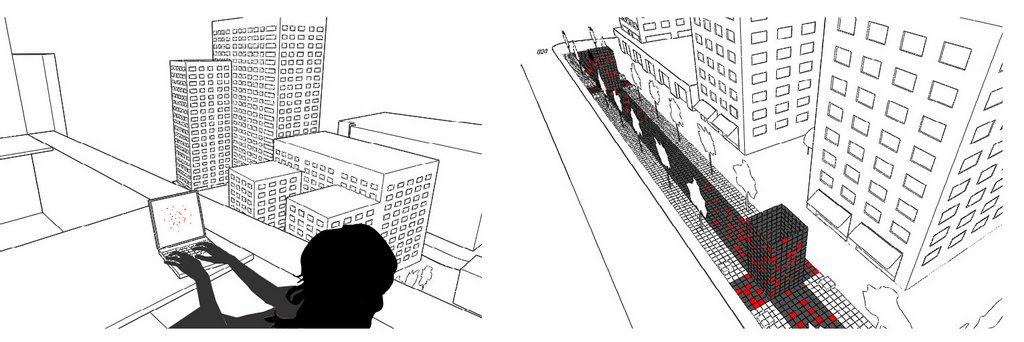
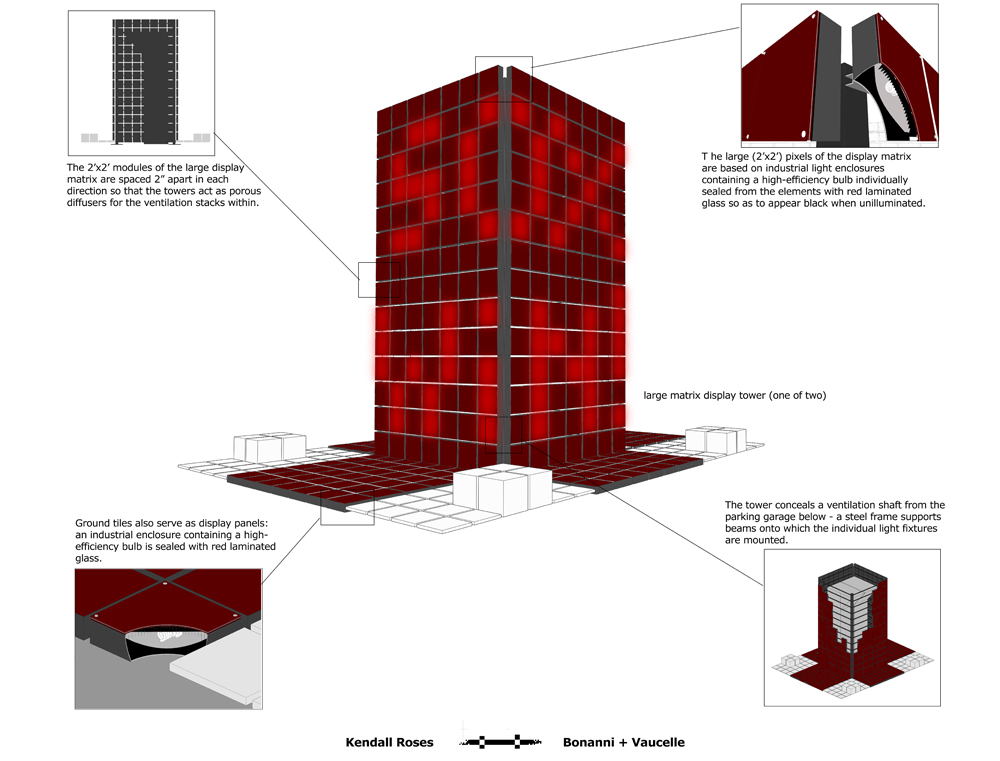
Based on my previous research Passing Glances (2002-2004), the Kendall Roses are designed to be an autonomous art installation that brings added value to the Kendall Square community. Bright, inexpensive daytime displays on two towers and the ground fulfill the role of the roses to provide compass directions to local attractions through graphics and text on billboards and the ground.
Data to the Roses is entirely wireless: SMS, internet and a local database are streamed to a wireless server inside each tower from local hotels, businesses, residents and the World Wide Web. In addition to useful information about local businesses, sports and attractions, the Kendall Roses offer opportunities for families and children to play on an interactive ground display that can project a variety of games. After an initial investment and potential partnership with local businesses and telcos for promoting SMS messaging, the towers will generate income primarily through advertisement for local businesses and as a tax credit for displaying public service announcements relevant to the community.

Some screenshots of the Kendall Roses interaction movie:


Details of the architecture


Plans of the Kendall Roses site


A movie of our entry


If it does not appear above, clic here
In personal work

Monday, March 27, 2006

Ernesto Neto : huggable sculptures


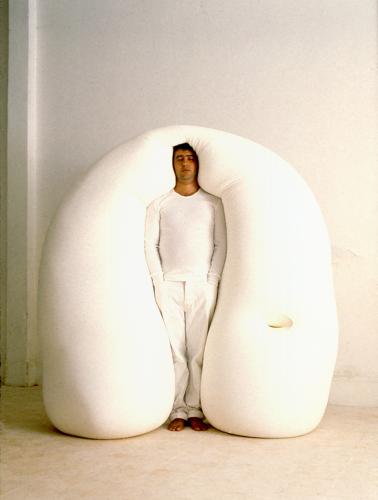
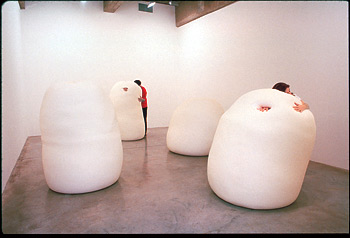
I love Ernesto Neto's soft "huggable" sculptures.

Exhibited in Hirshhorn Museum, Washington, USA in March 2002. Neto's sculptures and installations are indeed singular in contemporary art," says curator Viso. "His works, which he describes as a 'kind of body/space/landscape,' not only arrest us visually but also make us keenly aware of the spaces inside, around and between our bodies. We become voyagers in sensorial odysseys


Ernesto Neto (Brazilian, born 1966), "The Ovaloids Meeting" (1998). Courtesy of the artist and Tanya Bonakdar Gallery, New York.


Saturday, December 03, 2005

The ambient peacock explorer

The Ambient Peacock Explorer
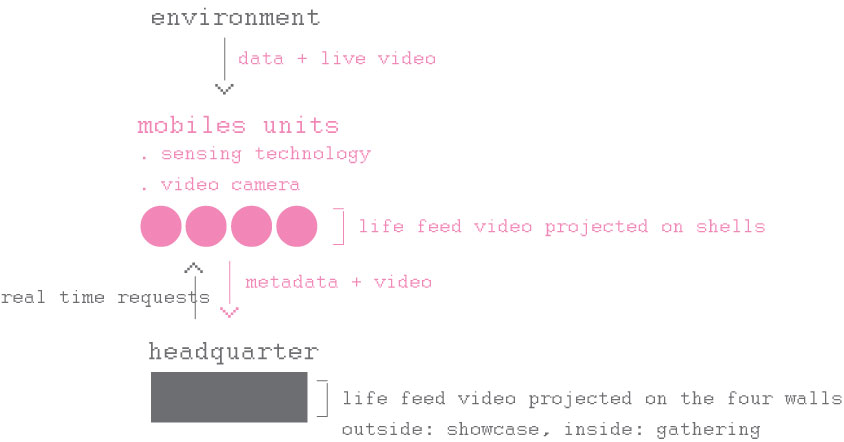
I developed the Ambient Peacock Explorer as a framework for mobile units to document on their environment and report back to a central hub

I believe that new work in this area can physically substantiate the documentation through tagging, the incorporation of physical communities or other conceptual redefinitions of the environment one seeks to capture.

structure mobiles units + headquarter

mobile units independent from the headquarter
One shell per context of exploration. Shell inflated on top of the structure to indicate where the mobile unit is going.
Context based shells per unit
Water: Jelly Fish Organic Shell
Countryside: Wooden structure
City: Inflatable Concrete
Air: Blimp

headquater
Is composed of four gathering areas: the air, the countryside, the city and the water area, a studio and an editing room. Each wall receives life feed from the mobile units based on each unit context. Environmental data from sensing mobile units are also projected on the walls as meta information. The headquarter itself retro-project on its roof the life feed of its environment and on the external walls displays the video from mobiles units. The production center also invites to discuss the documentaries and environmental issues and by that is also a showcase building.

technology specs
Live feed video camera from mobile units to headquarter. Each mobile unit is composed of one video camera connected via satellite to the headquarter. The life feed video camera is sent to the headquarter and projected onto the contextual area outside wall and inside wall (as part of the cafeteria gathering) area.

Video recording and metadata from mobile units to headquarter. Each mobile unit documents by recording visual environmental elements and use sensing technologies to combine video recorded and environmental data for later post production video retrieval. For instance GPS technology for location data retrieval, temperature, wind information and so forth. The production companies will retrieve video recordings of the mobile units and metadata associated to them.

Live feed video camera from mobile units onto mobile units. Each mobile unit would retro project their life feed footage onto their semi-transparent fabric structure to melt within its environment.

Headquarter data exchange with mobile units. Information and request coming from headquarter to define what to explore by real time exchange video footage. Scenario: if the mobile unit is in the air and crosses a bird migration, the headquarter could visualize it and request more detailed footage or more sensing environmental data coming from the bird migration.

communication system diagram


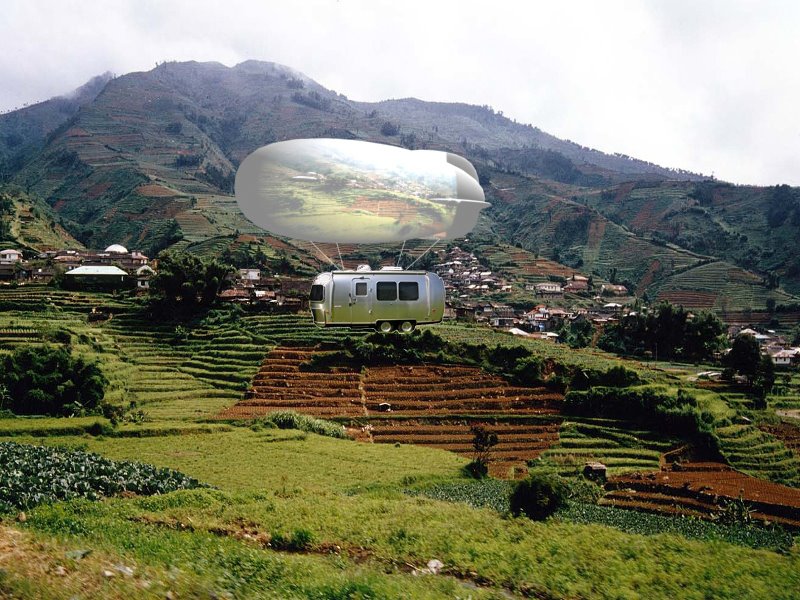
visual scenario of the ambient peacock explorer


the blimp
the air mobile unit.
The shell inflated on top of the structure indicates the mobile unit is going to document from above and in the air.


the mobile unit
common to all contexts is controlled by two people. It has real time contact with the headquarter via satellite. One person controls the mobile unit and one gathers data, exchanges information, and prepare the unit to its environmental use. The unit consists of the inflatable blimp on top, the floatation device including the organic shell at the bottom, a projector to display environmental data inside each shell.


the mobile unit going into water.

The compressor is used for the floatation device and an organic semi transparent shell is added around the structure. The environmental life feed video is projected on the shell. The mobile unit is waterproof.


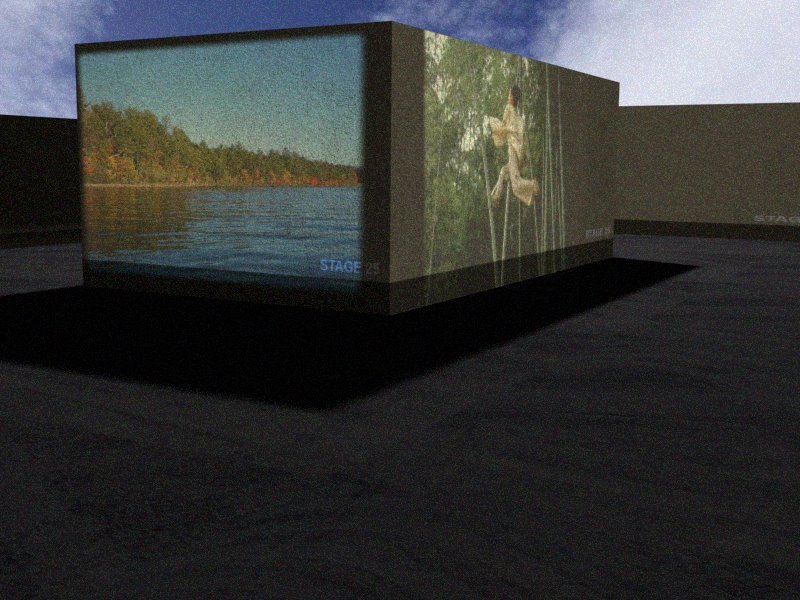
external view of the headquarter as a showcase.

Four walls: the air, the countryside, the city and the water. Each wall receives life feed from the mobile units based on each unit context.

The Ambient peacock explorer is a project I made with Philip Vriend for the Kinetic Architecture class, Assignment 2, November 2005.

By Cati in kinetic architecture

The Ambient peacock explorer poster


By Cati for Kinetic Architecture, Assignment 2, November 2005

Saturday, November 19, 2005

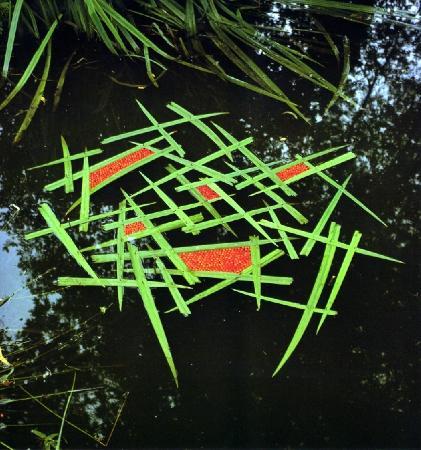
Andy Goldsworthy


I have just watched the River and Tides documentary on Andy Goldsworthy. I feel so regenerated but with a hurge to go back to nature. Such perception in sculpture is fascinating.


By Cati in personal