Showing posts with label Kinetic architecture. Show all posts

Thursday, September 06, 2007

More on Theo Jansen

I recently posted on Theo Jansen for his giant kinetic sculptures, always elegant, massive and impressive with their ability to be eco friendly at the same time than resembling apocalyptic robots. Yesterday, Laura Galloway, from the TED conference, offered me to exhibit the 8 min video Theo Jansen's talk at the TED conference. The video is a must see.


Theo Jansen
From TED2007

Talk summary
Dutch artist Theo Jansen demonstrates his amazingly lifelike kinetic sculptures, built from plastic tubes and lemonade bottles. His "Strandbeests" (Beach Creatures) are built to move and even survive on their own.

Bio
Dutch artist Theo Jansen has been working for 16 years to create sculptures that move on their own in eerily lifelike ways. Each generation of his "Strandbeests" is subject to the forces of evolution, with successful forms moving forward into new designs. Jansen's vision and long-term commitment to his wooden menagerie is as fascinating to observe as the beasts themselves. His newest creatures walk without assistance on the beaches of Holland, powered by wind, captured by gossamer wings that flap and pump air into old lemonade bottles that in turn power the creatures' many plastic spindly legs. The walking sculptures look alive as they move, each leg articulating in such a way that the body is steady and level. They even incorporate primitive logic gates that are used to reverse the machine's direction if it senses dangerous water or loose sand where it might get stuck.

Tuesday, July 24, 2007

Transformable Toys


It started with transformable sculptures: The “expanding geodesic dome” from 1991 at the Liberty Science Center in New Jersey - Via Pingmag

Last time I visited her in San Francisco, my friend Kimiko Ryokai gave me this awesome toy. A ball that changes its shape and color when flipped in the air! This tricky toy was invented by the famous kinetic sculptor Chuck Hoberman. An interview on Pingmag recently covers his background, creations and inspirations.


Switch Pitch by Chuck Hoberman. Image from Educational Innovations

Thursday, July 19, 2007

Eco-friendly robots


Picture of Theo Jansen work found on Myninjaplease.

I am fascinated by the giant kinetic sculptures of Dutch artist Theo Jansen, always elegant, massive and impressive with their ability to be eco friendly at the same time than resembling apocalyptic robots.

Monday, March 05, 2007

Moore Pattern


Inspired by the wooden kinetic work of David Roy, Jeff Lieberman just created Moore Pattern a kinetic sculpture that overlays patterns on top of one another using two counter-rotating bead-blasted aluminum disks, driven from a single motor below with a belt drive mechanism.

Watch the video to witness the moiré effect.

Do strangers meet?


Drawing and Tag cloud I made for the Kendall T Band

Looking for a site to show Charles Goldman when he is in town, I finally picked the famous Kendall Band - Kepler, Pythagoras, Galileo designed, fabricated and installed by Paul Matisse.
In 1987, Paul Matisse installed in Cambridge, Kendall T Station, the The Kendall Band a musical sculpture. Passengers can move handles located on each platform and will activate hammers that strike the bells. The instruments are suspended in arches between the tracks. Made of aluminum, teak, steel, the band consists of :
· Kepler a 55-inch aluminium ring that hums for five minutes after it is struck by the large teak hammer above it.
· Galileo a sheet of stainless steel that imitates a train roaring in when a train roars in.
· Pythagoras twin sets of eight bells of the type of the new memorial bell in Washington.

The Kendall Sculptures are very much the thing I love to show to a tourist in town. Being a student at MIT, I am not afraid of technical objects, I find them sexy. Bringing technicality into the T station where it is full of machines and the metallic sound resonating with its own voice: the sound of the train, the aluminum as a metal and the reverberation of the vibrato into the station, is exciting. It is definitely unique and as Paul Matisse says: “it is MIT’s baby”.

Social challenge: talk to strangers
It seems contradictory to what my grand ma told me: do not talk to strangers. Well, artists are different, they want things to be different. Paul Matisse wants strangers to talk to each others and maybe meet. He also thinks music can help that to happen. Passengers waiting for their trains can play with the sculpture. Sometimes, strangers can meet: can look at each others, can smile, maybe play together? I believe that one can cut herself from the visuals, but it is harder to do with sounds. So one can notice the change of sounds. Because propagating the sounds throughout the entire station is not directed towards one person, people can then feel free to respond or ignore the gesture. The inside is invaded, but somehow no pressure is put on bringing it outside. One can choose. And sometimes strangers can meet.

Music
The Kepler strikes an F sharp to go with the B minor of the Pythagoras.

Pictures
No picture for this post so you can then fully discover it when you are in Boston!

For more info, read the article Kendall Sculptures Bring Music, Talk to Strangers, The Tech, Volume 115, Number 66, 1996.

Friday, March 02, 2007

Robotic furniture design


Woojuin


Woojuin magazine table

Designer Victor Vetterlein works on robotic furniture. His Woojuin (2007) is a light fixture inspired by pod architecture & robotics. In the Woojuin magazine table, the reference to robotic is clear, and proposes a critique on automated lives in a digital age.


More pictures on Moco Loco and Archinect

Thursday, November 23, 2006

The shadows of objects

Playing with light and shadows, artist can give sens to a magma of clothing, metal, clouds and so forth.
Simple elements of design, yet strong impact. Playing with our expectations of what an object can and/or cannot do, artists can impress us. I discovered the work of Fred Eerdekens on the blog of Etienne Mineur.


Life itself is not enough, 1999, Clothing, glass, steel, light projectors, 700 x 120 x 90 cm by Fred Eerdekens


Thursday, October 26, 2006

Volume and Light


Three states

This semester I follow a sculpture class taught by Helen Mirra at Harvard University, VES.
I am a big fan of light, from perceptive to illusory, such as in the work of James Turell. For my second assignment I integrated the playful intervention of light within my sculpture. It also integrates the three numbers that define my volume as stated in the assignment.

scenario


I calculated my volume to determine the number of boxes and shadows.

I installed light boxes made out of brown paper in a cubic room. I controlled the direction of the light sources to build consistent shadows around the boxes and bring the light in and out of the boxes.
Out of the three boxes, the third box moves to create different cubic light patterns on the walls, e.g. from three to two patterns.


Material: brown paper, wooden sticks, strings.

In volume, light and sculpture

Wednesday, August 02, 2006

Auto-Vision

p
A still picture made out of the Texture of Light system

Today at Siggraph I presented my second research poster session on 'The Texture of Light' which is research on lighting principles and the exploration of life feed video metamorphosis in the public space using reflection of light on transparent materials.

My poster


I chatted with Kenneth Brecher, professor of Astronomy and Physics, Director, Science and Mathematics Education Center at Boston University.
He is the author of Project Lite that is about light inquiry through experiments. We discussed longely my Texture of Light project and we shared some exciting experiment results.
He mentioned the work of Karl Gerstner «Auto-Vision» who experimented with plexiglas sheets and images coming from TV.


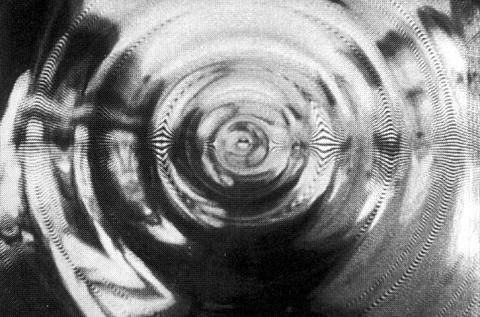
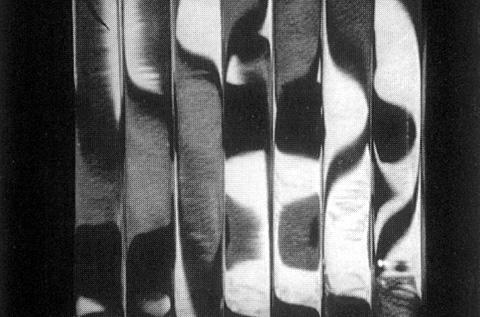
Between 1962 and 1963, Gerstner made his first attempts at optically distorting television images with lenses made of Plexiglas. In 1964, he exhibited his results for the first time in an installation that used 12 television sets, each one shown wearing a different pair of so-called «glasses». ( Exhibition: «Crazy Berlin» at Haus am Lützowplatz, Berlin) Also from 1964 comes the oldest existing version of «Auto-Vision» for a single television set. A new housing for the black-and-white TV set closes at the front, with a square television, and can accommodate six differently formed Plexiglas lenses, with everything meticulously packed in a crate for its transport. In this form, the perfection of design and presentation makes Gerstner’s «Auto-Vision» function as the prototype for a possible serial production. (...) «The name identifies the difference from television. The aim is not to broadcast programs, but to create programs directly. For this we use daily television programs that are abstracted through a ‹pair of spectacles,› and alienated to the point of being non-representational,» is Gerstner's comment on the process(1) These Perspex ‹spectacles› have something in common with Op Art. They can be swapped around, and each pair creates a different effect.
By Media Art Net

(1) Cited in Johannes Gfeller, «Frühes Video in der Schweiz,» in Georges-Bloch Jahrbuch des Kunstgeschichtlichen Seminars der Universität Zürich, 1997, pp. 224f. Gfeller provides a comprehensively researched account of Gerstner's TV works.


In Tangible Vision

Monday, June 05, 2006

The Texture of Light at Siggraph 2006


My research poster The Texture of Light has been accepted at Siggraph 2006. The reviews are very encouraging and I have been recommended to suggest it to a Emergency Technology session . It will be part of the Art and Design tools category.

Abstract : The Texture of Light is research on lighting principles and the exploration of life feed video metamorphosis in the public space using reflection of light on transparent materials. The Texture of Light is an attempt to fight the boredom of everyday life. This project employs the simple use of chemistry, Plexiglas, and plastic patterns to form a reconstruction of reality, giving it a texture and expressive form. The transformation of life feed video comes from physical, plastic circles that act as different masks of reality. These masks can be moved around and swapped by the public, enabling collective expression. This metamorphosis of the public space is presented in real time as a moving painting and is projected on city walls. The public can record video clips of their 'moving painting' and project them back on different city locations.

I plan to develop it on a larger scale such as building-size panels the public could mechanically control using remote devices. Each panel will be pattern and transparent material specific. Two Plexiglas sheets could embed a water-fall, or viscous transparent material the user could distribute along his/her selected point of view. The software will allow media distribution among cities so that the outcomes of the public performances could be exposed on the panels of other cities ...

More about the project by Regine Debatty.


In tangible video in the public space

Tuesday, January 24, 2006

Research on Light as a Material


The Texture of Light is research on the lighting principles for life feed video metamorphosis in public space using the reflection of light on transparent materials.

Material Background

Research on light properties on transparent materials.

The first property of light we consider is reflection from a surface, such as that of a mirror. When light is reflected off any surface, the angle of incidence is always equal to the angle of reflection. The angles are always measured with respect to the normal to the surface. This can give us a modification in the geometry of a represented image if the normal is twisted.


I also researched on color transformation and color density of an image through transparent materials. Refraction is the bending of light as it passes between materials of different optical density. The formula of the index of Refraction of a material is the ratio of the speed of light in vacuum to the speed of light in that material: n = c/v where v is the speed of light in the material.
The more dense the material, the slower the speed of light in that material. In Texture of Light a extra piece of transparent material on top of the Plexiglas lense makes the speed of light in that material slower, then less bright. That explains the opacity of the final colors. Also the change in speed and wavelength at the boundary between two materials causes light to change direction.

I have looked at the diffraction phenomena to transform light passing through transparent materials. Diffraction is the apparent "bending" of light waves around obstacles in its path.

Diffraction of waves through a slit.

This bending is due to Huygen's principle, which states that all points along a wave front act as if they were point sources. Thus, when a wave comes against a barrier with a small opening, all but one of the effective point sources are blocked, and the light coming through the opening behaves as a single point source, so that the light emerges in all directions, instead of just passing straight through the slit.

Concept
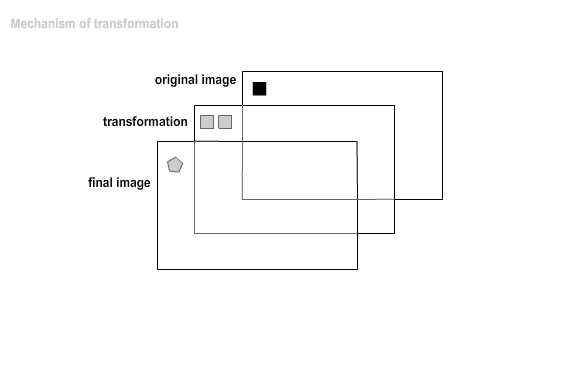
My original idea was to transform a picture by applying different transparent sheets between the captured image and the projected final image.


Inspiring research

Dr Saul Griffith who graduated from the MIT Media Lab has reconstructed magnifying lenses using liquid plastic.
Movie presenting his implementation

This work is used by the Low Cost Eyeglasses enterprise whose goal is to design eyeglass systems that make eyeglasses inexpensive and easy to purchase.
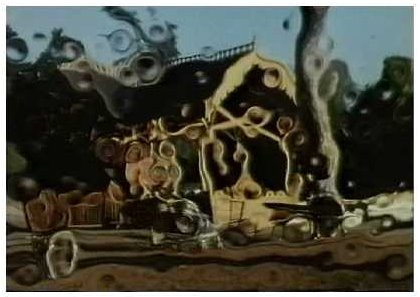
Movie maker Patrick Bokanowski seems to have used water, oil, glass material on his movies experiments as seen in Au Bord du Lac (1993). I believe that cinema offers an interpretation, a point of view of reality. What if this point of view was due to light transformation? Bokanowski experimental cinema work has inspired me to analyze this type of imagery that presents a distortion of light and offers a possible reinterpretation of its meaning.


Screenshot of Au Bord du Lac (1993) by Patrick Bokanowski.

Experimentations with transparent materials
To instantly transform light on life feed video into the public space, I had the choice of applying mathematical formulas onto the captured digital visuals or re-discovering the direct use of light. The tangible potential of direct use of light onto Plexiglas lenses and transparent materials offers two main options that are key in this project. One is the collaboration in the public space facilitated by tangible means. The other one is the improvisation and experimentation space offered by such tangible and mechanical system.I also had to decide if I wanted to work on still or moving visual captures. I have realized that transforming a still image is not as powerful as the moving image metamorphosis. One can easily recompose the still image by understanding its light distortions. However, by applying lighting principles on a moving image, the mental re-composition is difficult thus the re-interpretation of the unknown is very fascinating. The reality becomes a painting, a moving painting.
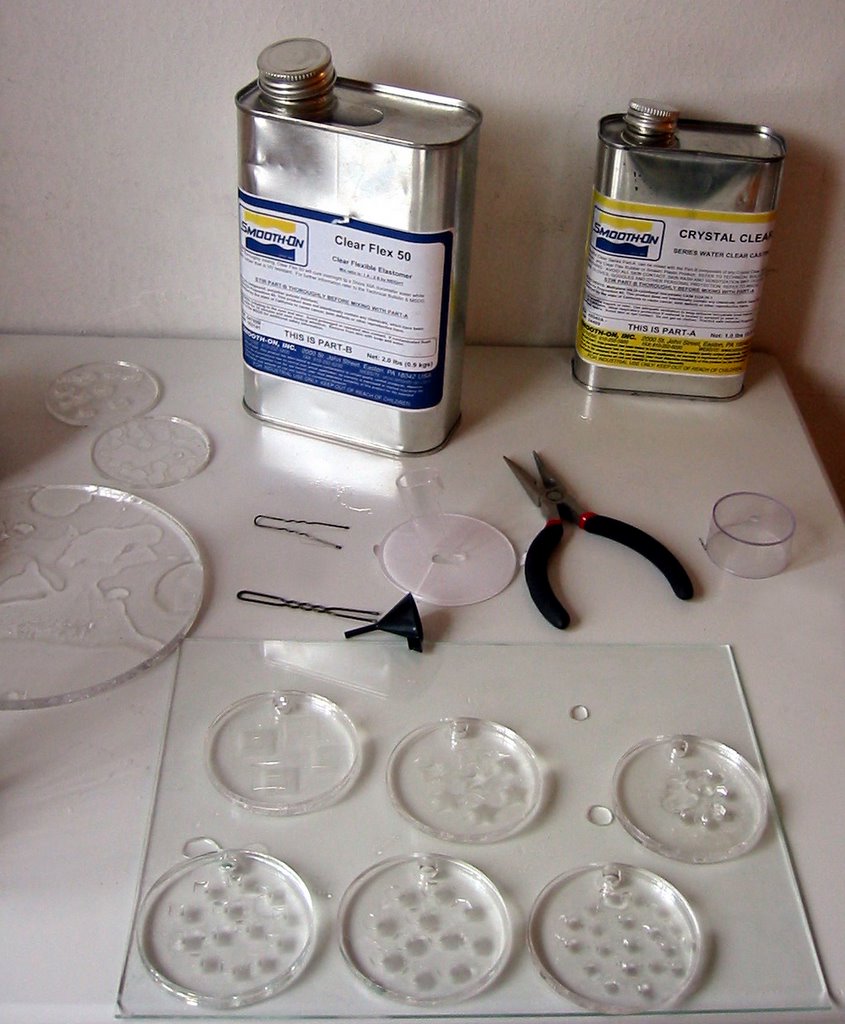
A series of experiments with transparent materials allows me to analyze video metamorphosis. During these experiments, I have used water on clear plastic, shower gel, polyoptic 1410 clear plastic, crystal clear flex: clear flexible, material that melts on high temperature and dries quickly within average temperature.
The following are screenshots of videos documenting a selection of material tests.

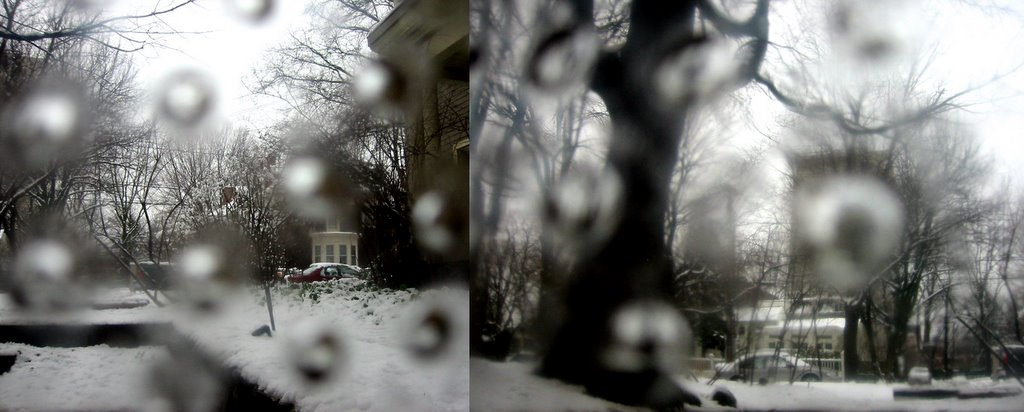
A drop of water onto a clear rigid plastic sheet

The video camera is still, the drop of water is moving

Transparent shower gel onto a clear rigid plastic sheet

The video camera is still, the rigid clear plastic sheet moves, the shower gel stays still

Transparent shower gel onto a clear rigid plastic sheet

The video camera moves with the rigid clear plastic sheet

Polyoptic 1410 clear plastic onto a clear rigid plastic sheet

The video camera moves with the rigid clear plastic sheet

Results
The shower gel has a life on its own: moves, changes texture & density over time. This particularity allows more irregularity in the transformed image thus the final transformed image resembles a painting. Also, the mapping between the original image and its final transformation is harder to perceive. This allows more attempts in interpreting the visuals.The material that melts on high temperature and dries under an average temperature can be sculpted easily and used as silicon. However as it dries, the density of the material is so high that it is difficult to see through.The clear plastic on the other hand is more difficult to sculpt and does not allow much improvisation after being fabricated. To allow more control over light transformation, I have decided to use clear plastic molds and Plexiglas lenses. I have used Crystal Clear & Clear Flex for the patterns and lenses. I used transparent Plexiglas for the structure of the lenses.

Design of the lenses

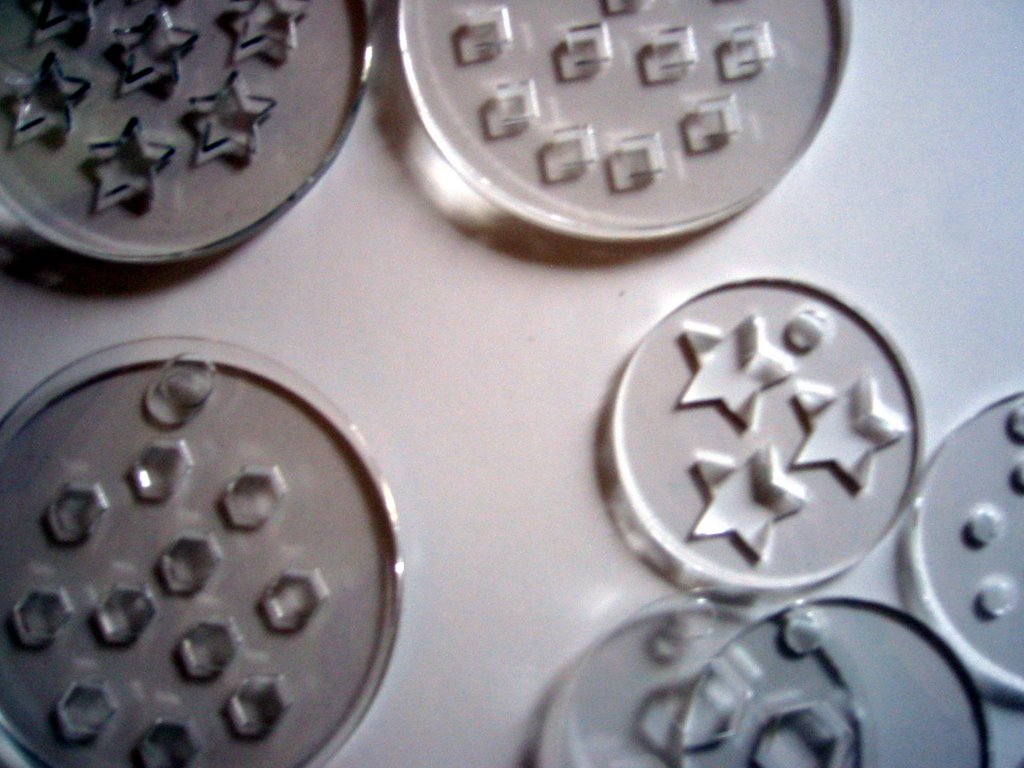
Laser cut Plexiglas lenses as clear plastic molds
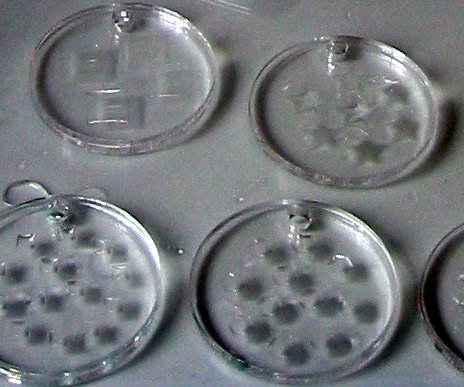
I have designed different lenses sizes, each with different pattern shapes and pattern sizes. In addition, I have used flat lenses on which I have created clear plastic patterns, e.g. drops of clear plastic, rows of lines.


Regular patterns laser cut into transparent Plexiglas


After many chemical attempts, final choice: Crystal Clear & Clear Flex


Plexiglas lenses filled with Crystal Clear & Clear Flex mix (1A:2B)


Lense with irregular patterns positioned at 2cm from the video camera
This is the research conducted to create my final project: The Texture of Lightfor the Smart Materials course taught by Michelle Addington

Paper about the project (12mb)

More links

Very interesting related research Gate Vision, found on we-make-money-not-art (blog that is part of the best european ones). The results of this project are kaleidoscopics and the mechanism is digital rather than mechanical.
I particularly liked the circular metaphor of the visuals and reminded me of one of my favorite experimental movie Lapis by James Whitney (1966)an abstract art film composed of images produced by an analog computer.


Sunday, January 22, 2006

The Texture of Light

Description
The Texture of Light is research on lighting principles and the exploration of life feed video metamorphosis in the public space using reflection of light on transparent materials. The Texture of Light is an attempt to fight the boredom of everyday life. By reconstructing reality, giving it a texture, an expressive form, this project deploys the simple use of chemistry, plexiglas, and plastic patterns. The transformation of life feed video comes from the physical plastic circles that act as different masks of reality. These masks can be moved around and swap by the public enabling collective expressions. This metamorphosis of the public space is presented in real time as a moving painting and is projected on city walls. The public can record video clips of their 'moving painting' and project them back on different city locations.

Model

The final model is composed of a set of lenses, an iSight video camera, a rotary knob and a computer. For the purpose of this project I have conceived and implemented a software piece that links the life feed video to a projection screen. This application is controlled by the rotary knob and by pressing more than two seconds the knob, the software records a video clip coming from the life feed video. By pressing on the knob, the software plays back the recorded clip and projects it onto the screen. By turning the knob, the software returns in life feed mode. The video clips are collected onto a server and can be accessed by other computers from different cities. This instantly creates a canvas of multiple transformed city video clips controlled and created by the dwellers in each city.

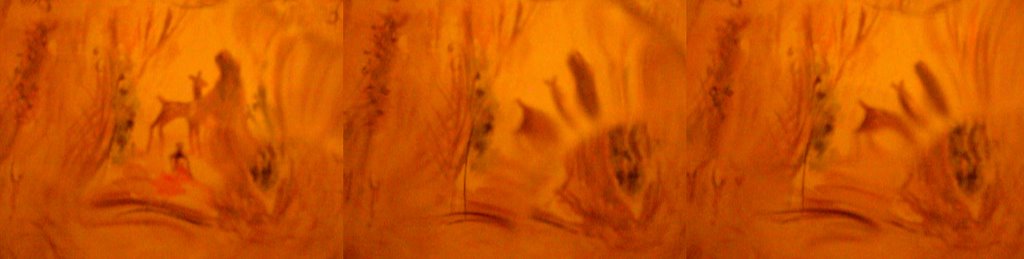
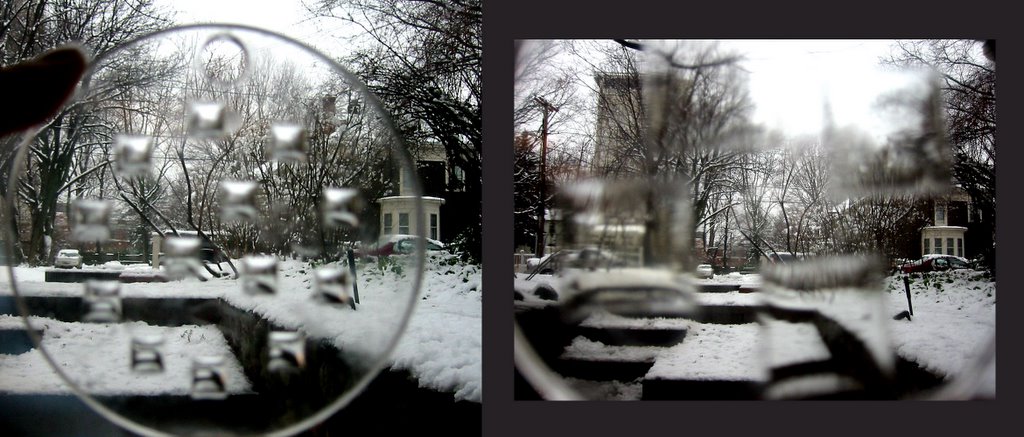
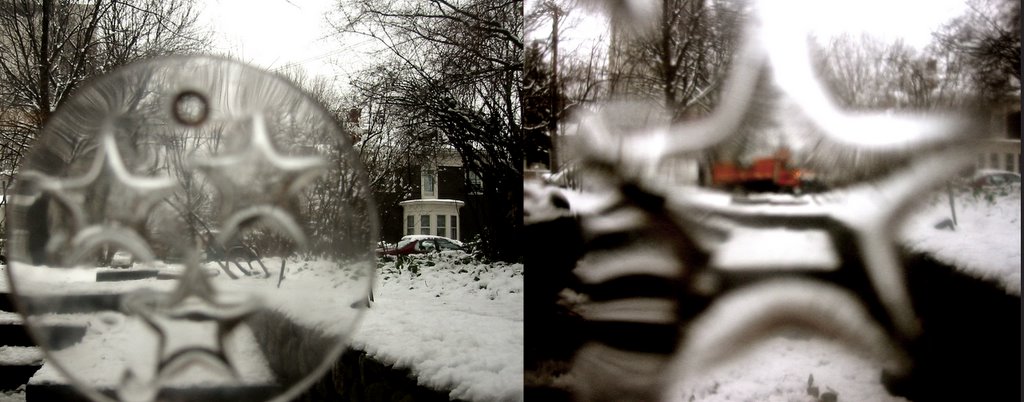
Excerpts of life feed video metamorphosis Clic on the picture for a hi-res view

Small-squares large lense


Small-circles small lense


Medium-hexagons large lense


Large-stars small lense

Future outlook for Texture of Light
I envision this project on a larger scale such as building-size panels the public could mechanically control using remote devices. Each panels will be patterns and transparent material specific. For instance, two Plexiglas sheets could embed a water fall, or viscous transparent material the user could distribute along his/her selected point of views. The software will allow media distribution among cities so that the outcomes of the public performances could be exposed on the panels of other cities.

This is my final project for the Smart Materials course taught by Michelle Addington. Some information about the research and tests involved in this project.

More about the project
. Paper about the project (12mb).
. The Texture of Light on We Make Money Not art.
. auto vision
. Publication: The Texture of Light Vaucelle, C. In Art and Design Tools. Published in the Proceedings of SIGGRAPH'06, Boston, USA. Abstract from publisher: ACM Press.
download pdf

Saturday, December 03, 2005

The ambient peacock explorer

The Ambient Peacock Explorer
I developed the Ambient Peacock Explorer as a framework for mobile units to document on their environment and report back to a central hub

I believe that new work in this area can physically substantiate the documentation through tagging, the incorporation of physical communities or other conceptual redefinitions of the environment one seeks to capture.

structure mobiles units + headquarter

mobile units independent from the headquarter
One shell per context of exploration. Shell inflated on top of the structure to indicate where the mobile unit is going.
Context based shells per unit
Water: Jelly Fish Organic Shell
Countryside: Wooden structure
City: Inflatable Concrete
Air: Blimp

headquater
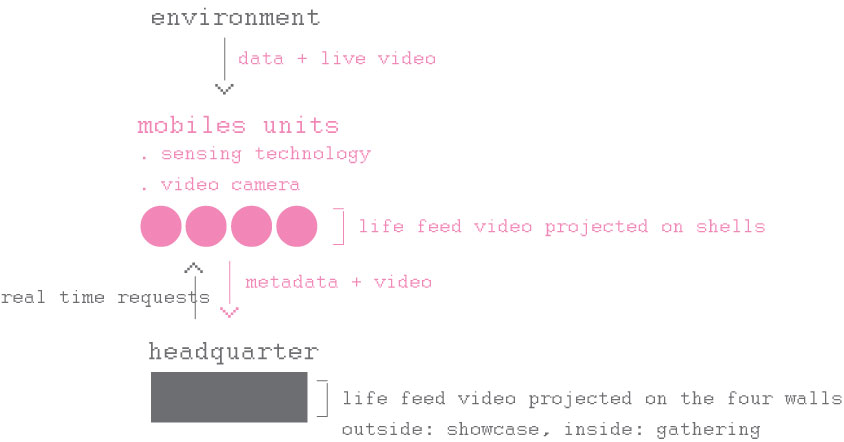
Is composed of four gathering areas: the air, the countryside, the city and the water area, a studio and an editing room. Each wall receives life feed from the mobile units based on each unit context. Environmental data from sensing mobile units are also projected on the walls as meta information. The headquarter itself retro-project on its roof the life feed of its environment and on the external walls displays the video from mobiles units. The production center also invites to discuss the documentaries and environmental issues and by that is also a showcase building.

technology specs
Live feed video camera from mobile units to headquarter. Each mobile unit is composed of one video camera connected via satellite to the headquarter. The life feed video camera is sent to the headquarter and projected onto the contextual area outside wall and inside wall (as part of the cafeteria gathering) area.

Video recording and metadata from mobile units to headquarter. Each mobile unit documents by recording visual environmental elements and use sensing technologies to combine video recorded and environmental data for later post production video retrieval. For instance GPS technology for location data retrieval, temperature, wind information and so forth. The production companies will retrieve video recordings of the mobile units and metadata associated to them.
Live feed video camera from mobile units onto mobile units. Each mobile unit would retro project their life feed footage onto their semi-transparent fabric structure to melt within its environment.

Headquarter data exchange with mobile units. Information and request coming from headquarter to define what to explore by real time exchange video footage. Scenario: if the mobile unit is in the air and crosses a bird migration, the headquarter could visualize it and request more detailed footage or more sensing environmental data coming from the bird migration.

communication system diagram


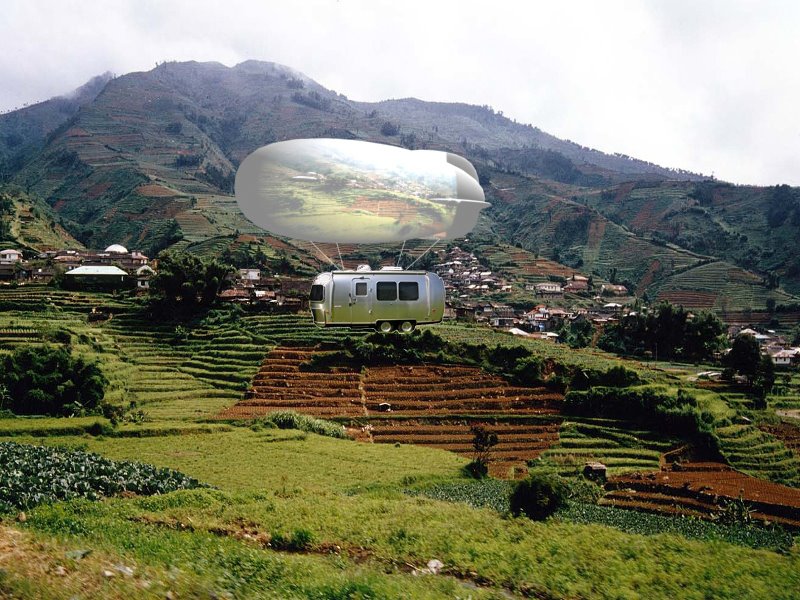
visual scenario of the ambient peacock explorer


the blimp
the air mobile unit.
The shell inflated on top of the structure indicates the mobile unit is going to document from above and in the air.


the mobile unit
common to all contexts is controlled by two people. It has real time contact with the headquarter via satellite. One person controls the mobile unit and one gathers data, exchanges information, and prepare the unit to its environmental use. The unit consists of the inflatable blimp on top, the floatation device including the organic shell at the bottom, a projector to display environmental data inside each shell.


the mobile unit going into water.

The compressor is used for the floatation device and an organic semi transparent shell is added around the structure. The environmental life feed video is projected on the shell. The mobile unit is waterproof.


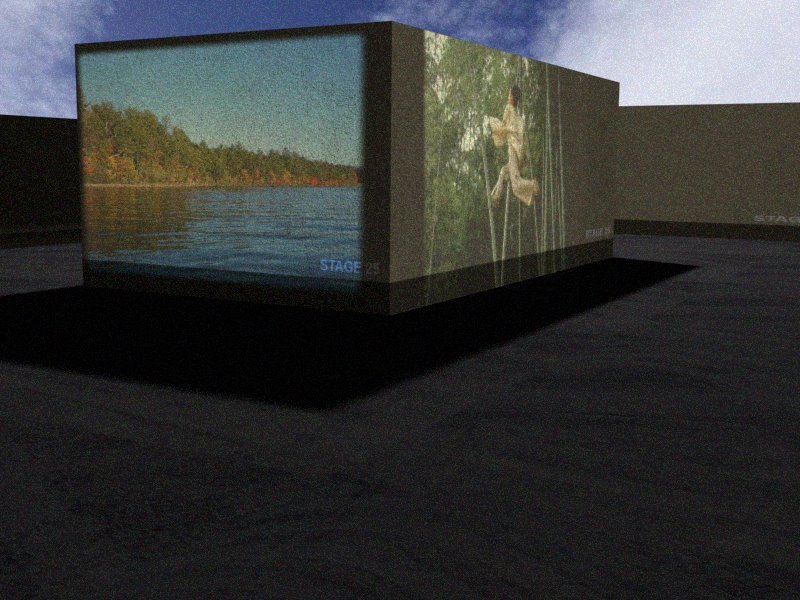
external view of the headquarter as a showcase.

Four walls: the air, the countryside, the city and the water. Each wall receives life feed from the mobile units based on each unit context.

The Ambient peacock explorer is a project I made with Philip Vriend for the Kinetic Architecture class, Assignment 2, November 2005.

By Cati in kinetic architecture