


These pictures are part of an awesome book Core Memory: A Visual Survey of Vintage Computers by by John Alderman.
Today with my three fellows from the media lab - Nan Wei, Amit and Seth - I just passed my final physics 123 exam at Harvard University.
I am now qualified to connect the world of analog electronics to the digital one using... a beautifully vintage 8051!!! If you want an easiest way to make things talk, Tom Igoe's book might be the way to go!
Don't forget to check the computer history museum and the post by 37signals showing outstanding computer pictures. We never get enough of seeing all their buttons and the magic of their mechanics.
Posted by Cati Vaucelle
♥ Architectradure
.............................................
Showing posts with label physics. Show all posts
Showing posts with label physics. Show all posts
Tuesday, January 22, 2008
Tell me a story about computers ...

Thursday, June 07, 2007
wireless power transfer
In last few years, our society experienced a silent, but quite dramatic, revolution in terms of the number of autonomous electronic devices (e.g. laptops, palm pilots, digatal cameras, household robots, etc.) that we use in our everyday lives. Currently, most of these devices are powered by batteries, which need to be recharged very often.
This fact motivated us to think whether there exist physical principles that could enable wireless powering of these and similar devices. Results of our research on the feasibility of using resonant objects, strongly coupled through the tails of their non-radiative modes, for mid-range (i.e. a few meters: e.g. within a room, or a factory pavillion) wireless power transfer applications seem to be quite encouraging.
Research by Marin Soljačić at MIT
A recent article mentions his work on "how to wirelessly illuminate an unplugged light bulb from seven feet away" which reminds me of the beautiful wireless lightbulb of Jeff Lieberman.
Wednesday, August 02, 2006
Auto-Vision
p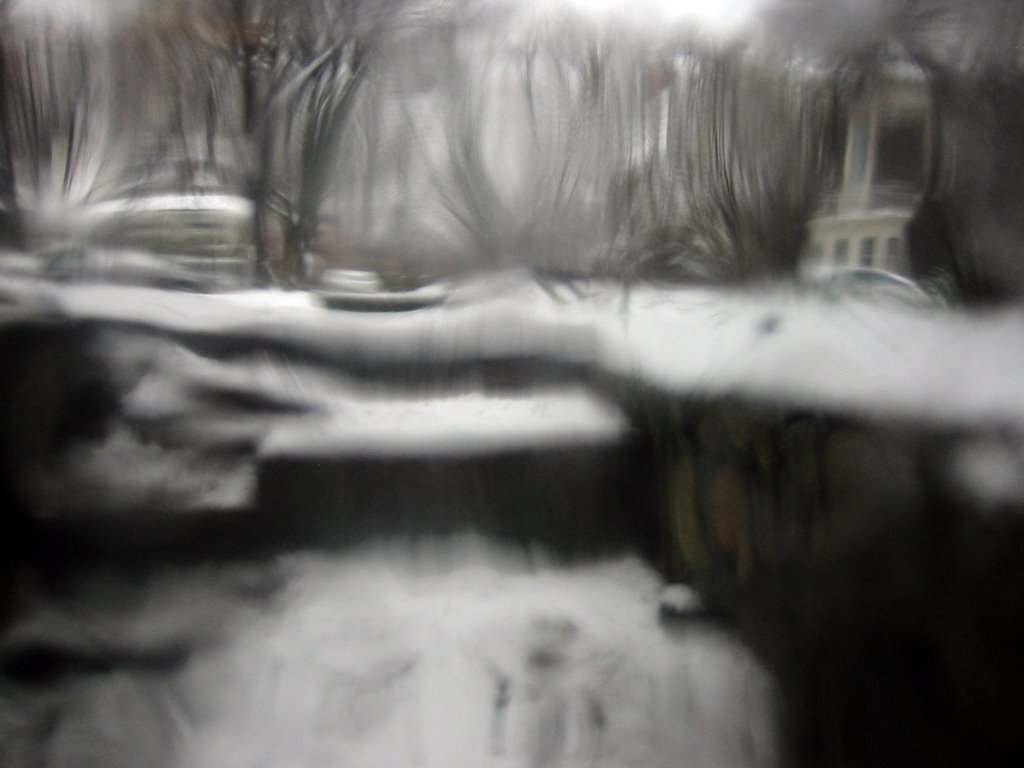
A still picture made out of the Texture of Light system
Today at Siggraph I presented my second research poster session on 'The Texture of Light' which is research on lighting principles and the exploration of life feed video metamorphosis in the public space using reflection of light on transparent materials.
My poster
I chatted with Kenneth Brecher, professor of Astronomy and Physics, Director, Science and Mathematics Education Center at Boston University.
He is the author of Project Lite that is about light inquiry through experiments. We discussed longely my Texture of Light project and we shared some exciting experiment results.
He mentioned the work of Karl Gerstner «Auto-Vision» who experimented with plexiglas sheets and images coming from TV.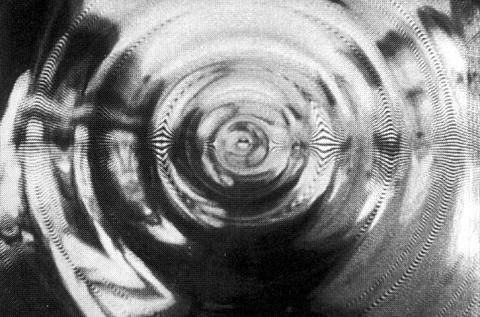
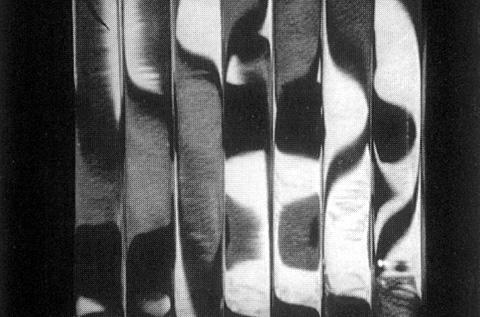
Between 1962 and 1963, Gerstner made his first attempts at optically distorting television images with lenses made of Plexiglas. In 1964, he exhibited his results for the first time in an installation that used 12 television sets, each one shown wearing a different pair of so-called «glasses». ( Exhibition: «Crazy Berlin» at Haus am Lützowplatz, Berlin) Also from 1964 comes the oldest existing version of «Auto-Vision» for a single television set. A new housing for the black-and-white TV set closes at the front, with a square television, and can accommodate six differently formed Plexiglas lenses, with everything meticulously packed in a crate for its transport. In this form, the perfection of design and presentation makes Gerstner’s «Auto-Vision» function as the prototype for a possible serial production. (...) «The name identifies the difference from television. The aim is not to broadcast programs, but to create programs directly. For this we use daily television programs that are abstracted through a ‹pair of spectacles,› and alienated to the point of being non-representational,» is Gerstner's comment on the process(1) These Perspex ‹spectacles› have something in common with Op Art. They can be swapped around, and each pair creates a different effect.By Media Art Net
(1) Cited in Johannes Gfeller, «Frühes Video in der Schweiz,» in Georges-Bloch Jahrbuch des Kunstgeschichtlichen Seminars der Universität Zürich, 1997, pp. 224f. Gfeller provides a comprehensively researched account of Gerstner's TV works.
In Tangible Vision
Monday, June 05, 2006
The Texture of Light at Siggraph 2006

My research poster The Texture of Light has been accepted at Siggraph 2006. The reviews are very encouraging and I have been recommended to suggest it to a Emergency Technology session . It will be part of the Art and Design tools category.
Abstract : The Texture of Light is research on lighting principles and the exploration of life feed video metamorphosis in the public space using reflection of light on transparent materials. The Texture of Light is an attempt to fight the boredom of everyday life. This project employs the simple use of chemistry, Plexiglas, and plastic patterns to form a reconstruction of reality, giving it a texture and expressive form. The transformation of life feed video comes from physical, plastic circles that act as different masks of reality. These masks can be moved around and swapped by the public, enabling collective expression. This metamorphosis of the public space is presented in real time as a moving painting and is projected on city walls. The public can record video clips of their 'moving painting' and project them back on different city locations.
I plan to develop it on a larger scale such as building-size panels the public could mechanically control using remote devices. Each panel will be pattern and transparent material specific. Two Plexiglas sheets could embed a water-fall, or viscous transparent material the user could distribute along his/her selected point of view. The software will allow media distribution among cities so that the outcomes of the public performances could be exposed on the panels of other cities ...
More about the project by Regine Debatty.

In tangible video in the public space
Subscribe to:
Posts (Atom)
