I love this series Flight of The Conchords given to me by Aurelius. I especially loved the Foux de fa fa episode on French impersonation. It is not meant to be an accurate reflection of French. It's a representation of the public school child's exposure to French culture via outdated textbooks, 1970's film reels and Serge Gainsbourg disco era.
Showing posts with label television. Show all posts
Showing posts with label television. Show all posts
Wednesday, October 03, 2007
Foux de fa fa

Monday, June 25, 2007
Science Fiction movies and HCI

Forbidden Planet (1956): the “thought analyzer” is a device inherited from the planets former inhabitants, displays a 3 dimensional image.
Human Computer Interaction in Science Fiction Movies by Michael Schmitz in CS Seminar “Instrumented Spaces” SS 2003 A. Butz, C. Endres, W. Wahlster.
I was recently talking about the influence of HCI over science fiction movies but also the reverse situation on how science fiction movies and books can inspire researchers in HCI. This paper, available online, proposes an analysis of several science fiction movie examples related to HCI.
Abstract: Science Fiction movies have been a source for speculation about the future of technology and human computer interaction. This paper presents a survey of different kinds of interaction designs in movies during the past decades and relates the techniques of the films to existing technologies and prototypes where possible. The interactions will be categorized with respect to their domain of real-life applications and also evaluated in regard to results of current research in human computer interaction.
Minority report (2002)
Wednesday, August 02, 2006
Auto-Vision
p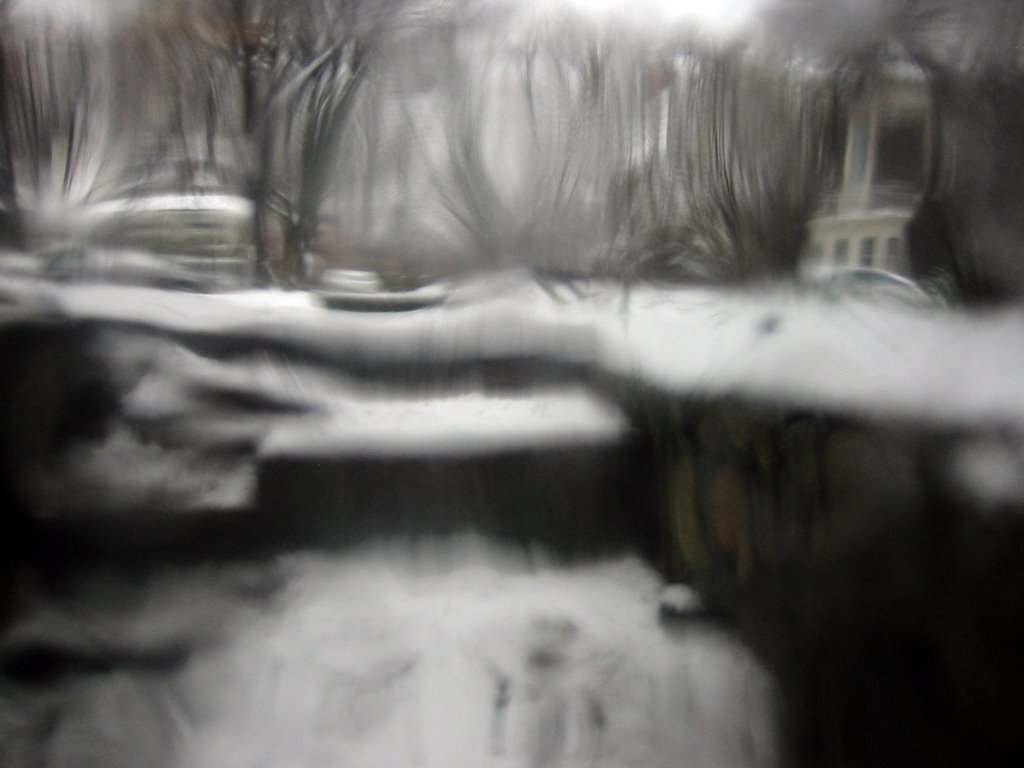
A still picture made out of the Texture of Light system
Today at Siggraph I presented my second research poster session on 'The Texture of Light' which is research on lighting principles and the exploration of life feed video metamorphosis in the public space using reflection of light on transparent materials.
My poster
I chatted with Kenneth Brecher, professor of Astronomy and Physics, Director, Science and Mathematics Education Center at Boston University.
He is the author of Project Lite that is about light inquiry through experiments. We discussed longely my Texture of Light project and we shared some exciting experiment results.
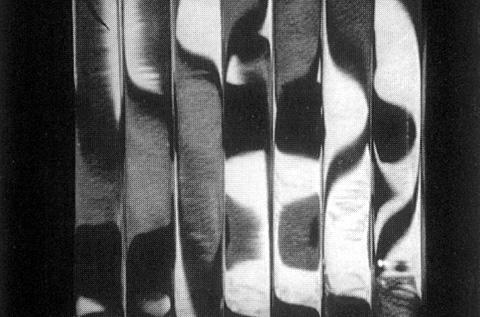
He mentioned the work of Karl Gerstner «Auto-Vision» who experimented with plexiglas sheets and images coming from TV.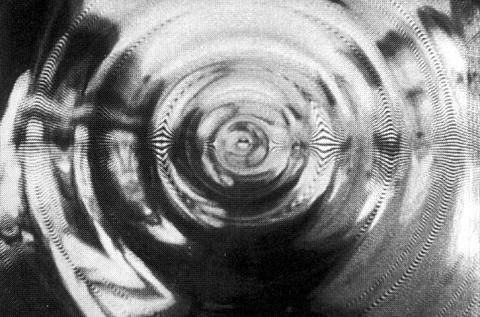
Between 1962 and 1963, Gerstner made his first attempts at optically distorting television images with lenses made of Plexiglas. In 1964, he exhibited his results for the first time in an installation that used 12 television sets, each one shown wearing a different pair of so-called «glasses». ( Exhibition: «Crazy Berlin» at Haus am Lützowplatz, Berlin) Also from 1964 comes the oldest existing version of «Auto-Vision» for a single television set. A new housing for the black-and-white TV set closes at the front, with a square television, and can accommodate six differently formed Plexiglas lenses, with everything meticulously packed in a crate for its transport. In this form, the perfection of design and presentation makes Gerstner’s «Auto-Vision» function as the prototype for a possible serial production. (...) «The name identifies the difference from television. The aim is not to broadcast programs, but to create programs directly. For this we use daily television programs that are abstracted through a ‹pair of spectacles,› and alienated to the point of being non-representational,» is Gerstner's comment on the process(1) These Perspex ‹spectacles› have something in common with Op Art. They can be swapped around, and each pair creates a different effect.By Media Art Net
(1) Cited in Johannes Gfeller, «Frühes Video in der Schweiz,» in Georges-Bloch Jahrbuch des Kunstgeschichtlichen Seminars der Universität Zürich, 1997, pp. 224f. Gfeller provides a comprehensively researched account of Gerstner's TV works.
In Tangible Vision
Saturday, December 03, 2005
The ambient peacock explorer
The Ambient Peacock Explorer
I believe that new work in this area can physically substantiate the documentation through tagging, the incorporation of physical communities or other conceptual redefinitions of the environment one seeks to capture.
structure mobiles units + headquarter
mobile units independent from the headquarter
One shell per context of exploration. Shell inflated on top of the structure to indicate where the mobile unit is going.
Context based shells per unit
Water: Jelly Fish Organic Shell
Countryside: Wooden structure
City: Inflatable Concrete
Air: Blimp
headquater
Is composed of four gathering areas: the air, the countryside, the city and the water area, a studio and an editing room. Each wall receives life feed from the mobile units based on each unit context. Environmental data from sensing mobile units are also projected on the walls as meta information. The headquarter itself retro-project on its roof the life feed of its environment and on the external walls displays the video from mobiles units. The production center also invites to discuss the documentaries and environmental issues and by that is also a showcase building.
technology specs
Live feed video camera from mobile units to headquarter. Each mobile unit is composed of one video camera connected via satellite to the headquarter. The life feed video camera is sent to the headquarter and projected onto the contextual area outside wall and inside wall (as part of the cafeteria gathering) area.
Video recording and metadata from mobile units to headquarter. Each mobile unit documents by recording visual environmental elements and use sensing technologies to combine video recorded and environmental data for later post production video retrieval. For instance GPS technology for location data retrieval, temperature, wind information and so forth. The production companies will retrieve video recordings of the mobile units and metadata associated to them.
Live feed video camera from mobile units onto mobile units. Each mobile unit would retro project their life feed footage onto their semi-transparent fabric structure to melt within its environment.
Headquarter data exchange with mobile units. Information and request coming from headquarter to define what to explore by real time exchange video footage. Scenario: if the mobile unit is in the air and crosses a bird migration, the headquarter could visualize it and request more detailed footage or more sensing environmental data coming from the bird migration.
communication system diagram
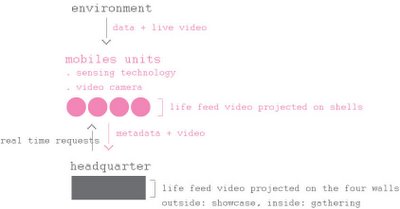
visual scenario of the ambient peacock explorer
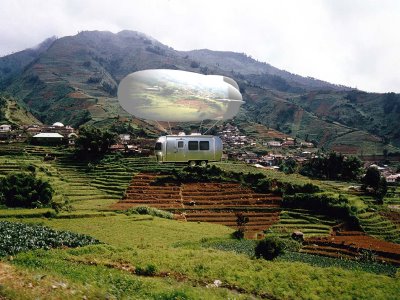
the blimp the air mobile unit.
The shell inflated on top of the structure indicates the mobile unit is going to document from above and in the air.
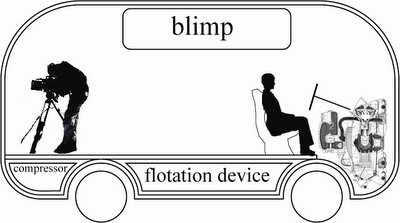
the mobile unit common to all contexts is controlled by two people. It has real time contact with the headquarter via satellite. One person controls the mobile unit and one gathers data, exchanges information, and prepare the unit to its environmental use. The unit consists of the inflatable blimp on top, the floatation device including the organic shell at the bottom, a projector to display environmental data inside each shell.
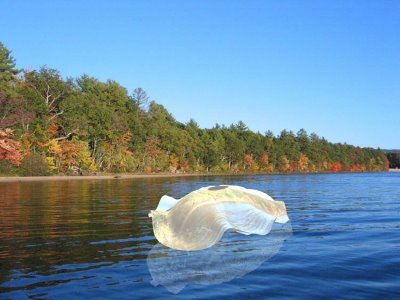
the mobile unit going into water.
The compressor is used for the floatation device and an organic semi transparent shell is added around the structure. The environmental life feed video is projected on the shell. The mobile unit is waterproof.
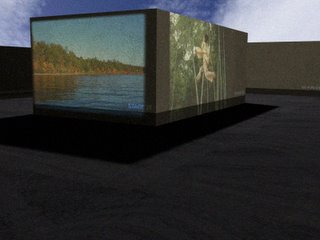
external view of the headquarter as a showcase.
Four walls: the air, the countryside, the city and the water. Each wall receives life feed from the mobile units based on each unit context.
The Ambient peacock explorer is a project I made with Philip Vriend for the Kinetic Architecture class, Assignment 2, November 2005.
I developed the Ambient Peacock Explorer as a framework for mobile units to document on their environment and report back to a central hub
I believe that new work in this area can physically substantiate the documentation through tagging, the incorporation of physical communities or other conceptual redefinitions of the environment one seeks to capture.
structure mobiles units + headquarter
mobile units independent from the headquarter
One shell per context of exploration. Shell inflated on top of the structure to indicate where the mobile unit is going.
Context based shells per unit
Water: Jelly Fish Organic Shell
Countryside: Wooden structure
City: Inflatable Concrete
Air: Blimp
headquater
Is composed of four gathering areas: the air, the countryside, the city and the water area, a studio and an editing room. Each wall receives life feed from the mobile units based on each unit context. Environmental data from sensing mobile units are also projected on the walls as meta information. The headquarter itself retro-project on its roof the life feed of its environment and on the external walls displays the video from mobiles units. The production center also invites to discuss the documentaries and environmental issues and by that is also a showcase building.
technology specs
Live feed video camera from mobile units to headquarter. Each mobile unit is composed of one video camera connected via satellite to the headquarter. The life feed video camera is sent to the headquarter and projected onto the contextual area outside wall and inside wall (as part of the cafeteria gathering) area.
Video recording and metadata from mobile units to headquarter. Each mobile unit documents by recording visual environmental elements and use sensing technologies to combine video recorded and environmental data for later post production video retrieval. For instance GPS technology for location data retrieval, temperature, wind information and so forth. The production companies will retrieve video recordings of the mobile units and metadata associated to them.
Live feed video camera from mobile units onto mobile units. Each mobile unit would retro project their life feed footage onto their semi-transparent fabric structure to melt within its environment.
Headquarter data exchange with mobile units. Information and request coming from headquarter to define what to explore by real time exchange video footage. Scenario: if the mobile unit is in the air and crosses a bird migration, the headquarter could visualize it and request more detailed footage or more sensing environmental data coming from the bird migration.
communication system diagram
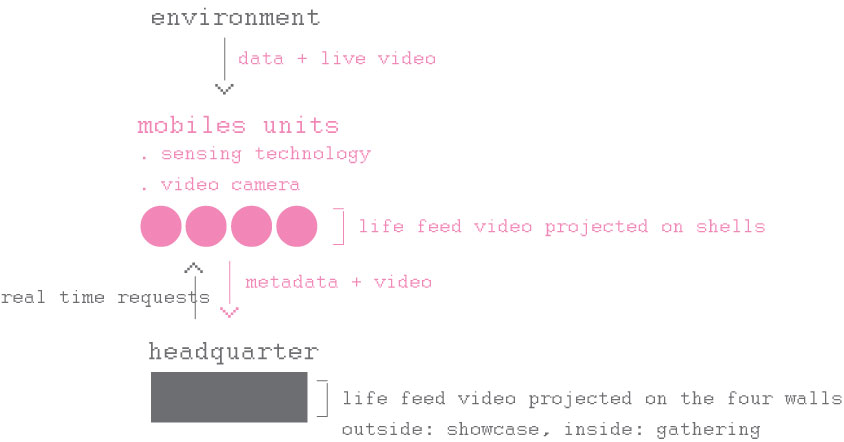
visual scenario of the ambient peacock explorer
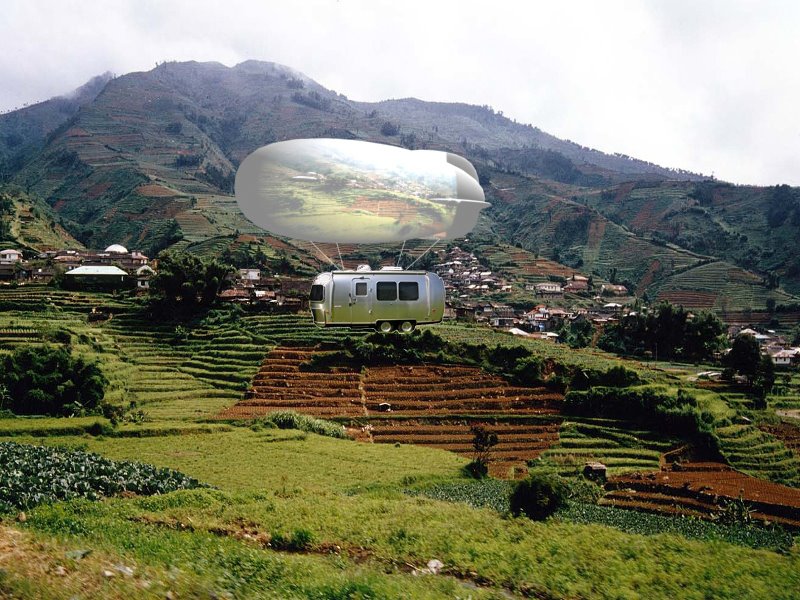
the blimp the air mobile unit.
The shell inflated on top of the structure indicates the mobile unit is going to document from above and in the air.

the mobile unit common to all contexts is controlled by two people. It has real time contact with the headquarter via satellite. One person controls the mobile unit and one gathers data, exchanges information, and prepare the unit to its environmental use. The unit consists of the inflatable blimp on top, the floatation device including the organic shell at the bottom, a projector to display environmental data inside each shell.

the mobile unit going into water.
The compressor is used for the floatation device and an organic semi transparent shell is added around the structure. The environmental life feed video is projected on the shell. The mobile unit is waterproof.
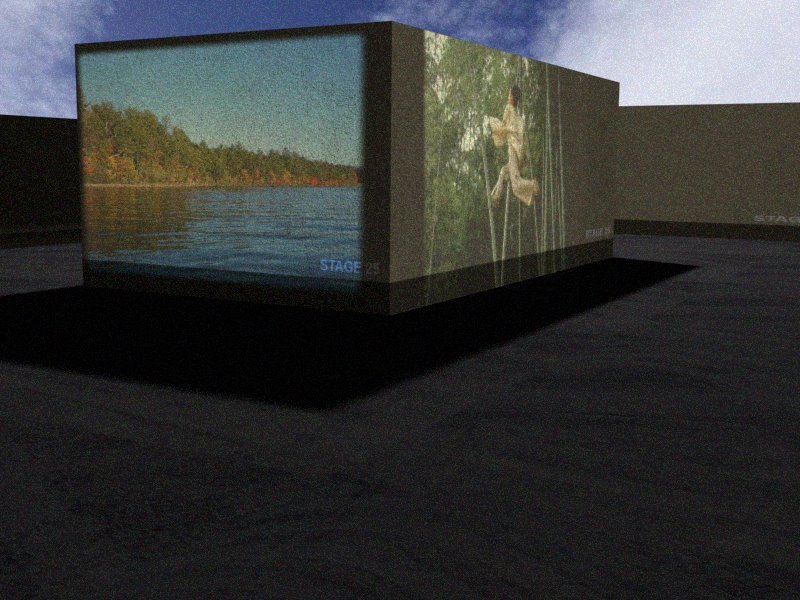
external view of the headquarter as a showcase.
Four walls: the air, the countryside, the city and the water. Each wall receives life feed from the mobile units based on each unit context.
The Ambient peacock explorer is a project I made with Philip Vriend for the Kinetic Architecture class, Assignment 2, November 2005.
By Cati in kinetic architecture

Subscribe to:
Posts (Atom)
