
Transgenesis
In 2000 I had the chance to meet Pavel Smetana at Avignon Numérique, in France, and interact with his Room of Desires that he created in 1995. In this project I was connected to brainwave and heart-rate sensors in an empty room, with video projections of pretty relaxing pictures and music. As soon as I would become excited with an image, the system would generate new images and sounds, based on my biofeedback. The audience could witness these changes and understand what imagery would trigger a certain kind of emotions. After a while I would be able to control the system, in a way "controlling my emotions" and also what the audience would see as a result.
Recently Pavel Smetana in collaboration with Ivor Diosi and Ivan Acher revisited this past work and created transgenesis, a set of virtual environments the audio and the visual parts of which are changing in real-time in dependence on data received form sensors capturing brain and heart activity of viewers. Each viewer enters those and only those virtual landscapes which his or her physical and mental states lead to. Landscapes vary in audiovisual styles ranging from horror-like hyper-realistic atmosphere up to geometric or organic abstractions.
.............................................................................................
Blog Jouons 
Monday, March 10, 2008
Transgenesis

Thursday, January 31, 2008
Twirl the reactive skirt

Twirl, created by Megan Galbraith, is a dynamic and reactive skirt that is controlled using a fuzzy logic reasoning algorithm, and programmed with a fuzzy logic controller, dixit Megan. This skirt has a bend sensor embedded along the seam of the back side, and it thus detects when the wearer is standing up straight, sitting down, or bending over. The sprinning flourishes alter their behavior based on the posture of the wearer.
Posted by Cati Vaucelle
♥ Architectradure
.............................................
Wednesday, July 25, 2007
Abstract by Joëlle Bitton

Abstract is the upcoming interaction installation by Joëlle Bitton at Gallery EF in Tokyo.
On the theme of waiting and the perception of the time passing-by: inviting visitors in a space where the body and its movement play the role of interfaces. From a point of view on the Japanese garden and its vision on the surrounding, aesthetic and philosophical world, this project is inspired by the tension between elements intentionally thought here in a contradictory dialog: abstraction and texture, concealment and disclosure, empty space and framed space. This installation places the visitor on the razor's edge: always on the border, between two worlds, passing from one to the other. This is the experience of difference and of a fragile balance, of what is called in the Japanese culture, the impermanence of things. The latter is then staged in a relationship to the cycle of time, to the emotions that the expectation of something to happen can generate.
Joëlle's portfolio
Tuesday, June 12, 2007
Playground for all ages

The company Lappset designed Smart Us, a technological playground to connect all age users. Even though it is a very interesting concept and I cannot wait to try the interactive playground, I could not determine how it can really connect users of all ages, especially ederly. Thank you Susanne Jacobson for introducing me to this innovative Finish company!
SmartUs is a product concept developed by Lappset that uses technology to link the playground and its users. SmartUs offers interactive games for all age groups. The users can create games and applications based on images, sounds and text that support learning on the playground. The SmartUs product concept can be made use of in learning through play, playing computer games physically and in different kinds of well-being applications for special groups.
Among the four games available, the conquistador is a game of conquest, which gets people moving. Conquistador is played over the whole SmartUs field and players compete to be the first player or team to gain a specified number of different territories within the field. Territorial conquest is achieved by getting to the iPosts message poles and showing your iTag ID at the pole’s identification point. "It is especially suitable for players who are agile and alert. On the field, each player tries to conquer his/her own part of the game's fantasy world, and helps his/her team towards a common goal. The game develops tactical ability and teamwork skills."

Players carry on the iTag with them. The iTag sensor, distributed to users of the SmartUs environment is a key-sized sensor, that can be carried as a wrist watch or at a key chain.

Thursday, June 07, 2007
Interactive fabric patented
Conductive compositions have been developed for various purposes including facilitating electrostatic discharge and as a current transfer medium on printed circuit boards. Recently, conductive compositions have been used, instead of conventional wires, as part of an electrical system for conducting current from a power source to various current operated circuit components on a variety of objects such as wearing apparel, children's toys and books.
In 2001, a US patent is filled on interactive fabric articles that have conductive composition used as a portion of a switch in an electrical system.
A fabric article including a design arranged on the outer surface of such fabric article and having conductive composition arranged in registration with the design and with a printed circuit pattern is disclosed. The conductive composition effectively forms part of the electrical system of the interactive fabric article.
Full text of the patent
Wednesday, May 23, 2007
Motion mapping
Enlighted by Marc Downie's work at the MIT Media Lab, I just checked his company Openended Group where he co-creates digital artworks for stage, screen, gallery, museum and public spaces.
His PhD thesis (459 pages) on choreographing the extended agent is available for download online.
I selected this quote that I find particularly interesting regarding my current research ...
If you cast your mind back to childhood, you will soon discover our topic – motion-mapping – most clearly and imaginatively revealed. There in the games and pursuits of your earliest years you can distinguish this phenomenon in its three most basic forms. You can also follow each form forward in time to find out what they grew into -- forms of art.
You might start by bringing back the movement games you played so ardently as a child – in particular the games of imitation and mimicry, like Copycat, Follow the leader, Charades, Simon Says, and the innumerable variants you and your friends would improvise. These games had you map the movements of others onto your own body, sometimes in the simplest one-to-one transformations (as when you followed the leader), but sometimes more intricately, as when you mimicked a lion, or a horse, or a gladiator...
Monday, May 07, 2007
The Viscous Display

The Viscous Display created by Lily Shirvanee and Glorianna Davenport is a transient adaptive interface for collective play in public space.
Grounded on Henri Lefevre analysis of production of space as a social phenomenon, the viscous display proposes a space with transient meanings by exhanging social information through adaptive public interfaces.
Abstract: The Viscous Display explores the exchange of social information through transient public interfaces. Shaped by principles of ‘underground public art’, the Viscous Display is conceived as a novel mobile communication medium, where messages can be shared in public spaces. Inspired by biological learning systems; the Viscous Display learns sensorial information that form along traces of a participant’s touch and maps this information onto a flexible display.
Because it is made up of inexpensive materials, the Viscous Display is also a disposable artifact that may be collected in public spaces. It combines multi-modal sensing, learning algorithms, and a pliable silicone display.
Paper
Viscous display's web site
Thursday, May 03, 2007
Emotive type
Typography requires distinct design metrics with which to evaluate and understand its aesthetic and semantic effect. As such, the attributes of each letterform can be discretely mapped to various meanings that they represent.
Emotive type
I chatted more with Daniela K. Rosner at Chi'07 today. She showed me some of her work, and I particularly loved her work on emotive type using text transformation to convey emotions. She also did user test the concept.
In experiments one and two, users viewed a series of 30 kinetic text animations chosen at random from four emotion-animation mappings; they were asked to report whether they felt the emotion evoked by the animation was similar to or different from the name of the emotion represented. In the third experiment, users viewed a series of 32 varying animations of the word “information.” They were asked to select the emotion from the list of 15 that they felt conveyed same emotions as the animation. (...) Based on the results of both the second and third experiments, positive animations were more than twice as likely to be reported by users as highly correlated. Although users reported correlations of varying consistency among animation-emotion pairs, animations that involved less graphic complexity also ranked higher than those that did not. Interestingly, the emotion-animation pairs that ranked highest in their user’s reported correlation value also made more explicit use of metaphor than those that did not.
Sunday, April 22, 2007
Refreshing ads

Nice for the summer! Via frederik samuel
In the Ibirapuera Park, there were vaporizers placed to refresh visitors. On the sides of these vaporizers, there is a place designed to propagate publicity. They used visuals of people coughing and sneezing with the message that “the flu is in the air”. Agency: QG, Brazil; Copywriter: Edu Marques; Art Director: Luis Tauffer
Friday, April 06, 2007
Eness

Everlab's 1 hour circle by Eness
I recently had the pleasure to meet Nimrod Weis, co-founder of Eness. 
I discovered his Pixile work, an interactive digital sculpture which transforms a series of static objects into an interactive illusion giving this powerful illusion of real-life objects spinning, changing and responding to each other.
I love Virsual, their digital rocking horse, a wireless, ride-on rocking horse equipped with its own motion sensor device. As riders saddle up a 3D game is activated and displayed on screen. I definitely can tell how much children would love this. 
Their latest installation commissioned by Audi to exhibit at the New Audi TT launch in Sydney next week. So if you are in Sydney, check it out!
Video.
A series of four translucent screens, each representing a solid cross section of time and space, Three dimensional objects rapidly passing through. These sections deflect, ricochet and manipulate thousands of virtual particles contained in these cross sections. The high impact point of collision between space and matter create an endless amount of esthetical beautiful iconic formations. The gravity of the particles are effected by camera tracking, meaning that the particles direction and velocity change depending on the position of the viewer.
More on Eness' web site

Friday, March 16, 2007
An history on interactive design

Etienne Mineur was my graphic design professor at Paris VIII, now he is swimming in praise!
He just finished the interactive graphic piece for Issey Miyake and now he is about to travel around the world with his family to document on graphic designers, game designers, fashion designers. His focus will be Asia, so if you are extremely talented in design, live in Asia, and willing to spend some time with French people, you should contact him.
He regularly presents an history on interactive design. The last one was for les arts deco de Paris, l'ENSAD. I think he should be in this presentation, but in any case it is a very interesting document that he shares online.
Pdf of the presentation
Monday, March 05, 2007
Moore Pattern

Inspired by the wooden kinetic work of David Roy, Jeff Lieberman just created Moore Pattern a kinetic sculpture that overlays patterns on top of one another using two counter-rotating bead-blasted aluminum disks, driven from a single motor below with a belt drive mechanism.
Watch the video to witness the moiré effect.
Do strangers meet?

Drawing and Tag cloud I made for the Kendall T Band
Looking for a site to show Charles Goldman when he is in town, I finally picked the famous Kendall Band - Kepler, Pythagoras, Galileo designed, fabricated and installed by Paul Matisse.
In 1987, Paul Matisse installed in Cambridge, Kendall T Station, the The Kendall Band a musical sculpture. Passengers can move handles located on each platform and will activate hammers that strike the bells. The instruments are suspended in arches between the tracks. Made of aluminum, teak, steel, the band consists of :
· Kepler a 55-inch aluminium ring that hums for five minutes after it is struck by the large teak hammer above it.
· Galileo a sheet of stainless steel that imitates a train roaring in when a train roars in.
· Pythagoras twin sets of eight bells of the type of the new memorial bell in Washington.
The Kendall Sculptures are very much the thing I love to show to a tourist in town. Being a student at MIT, I am not afraid of technical objects, I find them sexy. Bringing technicality into the T station where it is full of machines and the metallic sound resonating with its own voice: the sound of the train, the aluminum as a metal and the reverberation of the vibrato into the station, is exciting. It is definitely unique and as Paul Matisse says: “it is MIT’s baby”.
Social challenge: talk to strangers
It seems contradictory to what my grand ma told me: do not talk to strangers. Well, artists are different, they want things to be different. Paul Matisse wants strangers to talk to each others and maybe meet. He also thinks music can help that to happen. Passengers waiting for their trains can play with the sculpture. Sometimes, strangers can meet: can look at each others, can smile, maybe play together? I believe that one can cut herself from the visuals, but it is harder to do with sounds. So one can notice the change of sounds. Because propagating the sounds throughout the entire station is not directed towards one person, people can then feel free to respond or ignore the gesture. The inside is invaded, but somehow no pressure is put on bringing it outside. One can choose. And sometimes strangers can meet.
Music
The Kepler strikes an F sharp to go with the B minor of the Pythagoras.
Pictures
No picture for this post so you can then fully discover it when you are in Boston!
For more info, read the article Kendall Sculptures Bring Music, Talk to Strangers, The Tech, Volume 115, Number 66, 1996.
Sunday, March 04, 2007
Reflections

The artist Devorah Sperber recreates paintings by assembling spools of thread. Reflections is a permanent Installation at the Centro Medico Train Station, San Juan, Puerto Rico. The artist used 60,000 spools of thread and 23 convex mirrors for the installation.
"Reflections" is a site-specific work, constructed from 60,000 spools of thread, which coalesce into a photo-realistic image when seen reflected in convex mirrors mounted on an opposing wall. My intention was to utilize the element of surprise to create a brief interruption in the lives of people as they move through the Centro Medico Train Station (...) Because people will be in motion, the images seen in the mirrors continuously change. As people step onto the escalator and descend to the lower platform, the reflections in the mirrors gradually dissolve from seascape to the neutral gray ceiling and blue skies seen through clear glass skylights above.

Detail
I discovered the work of Deborah Sperber on V magazine.
Two days after I posted on the work of Deborah, I found out via cool hunting that the Pulse art fair in NYC last week showed a large number of pixelized works.
Andy Diaz Hope uses gel-caps for creating images of people in front of their medicine cabinets.

The occupation 2006, archival photographs, gel capsules, acrylic, 18 W x 15" H
William Betts recreate surveillance camera pictures using acrylic paint. This reminds me of Gerhard Richter's Akt auf einer Treppe. Emma – Nu dans un escalier. 1966 in which the boundaries between painting and photography are blurred and through which comes a new form of expression in the arts.

Carlos Estrada-Vega combines pixel-constructivism of digital media practices to paint and wood dowels within the canvas.

Dona Clara, 2005. Margaret Thatcher Projects
In the Middle of the End, Isidro Blasco uses 2D photos and later turns the them into a 3d experience using board mounted architectural structures.

The Middle of The End
Knitoscope Testimonies by Turbulence, are surprising animations created using "Knitoscope" software, a program that translates digital video into a knitted animation.
Video

erica
An excellent interview on Turbulence featuring Jo-Anne Green by Régine Debatty on we-make-money-not-art
Reconstruction shown at Artefact 2007 is a matric of LEDs that projects shadows and lights of passerby in a pixelized fashion. More can be read on the show and project on multimedialab

reconstruction
Monumental ceramic pixel art found on coolfinds.
Pixel art by Swedish artist Maria Ängquist Klyvare. The artist has worked with mosaics since the eighties. More on her web site.

A child's face on Etsarbron near Gullmarsplan in Stockholm.
Saturday, March 03, 2007
Sculpting Behavior

Hayes Raffle not only just had two full academic papers accepted to the first class conference IDC 2007: Interaction design and Children but he is also a talented sculptor and designer. His Super Cilia Skin reflects his aesthetic sensibility and his ongoing passion for kinetic sculpture.
Video
Super Cilia Skin
After co-creating and designing the award-winning ZOOB® building system, Hayes joined the Tangible Media Group at the MIT Media Laboratory and created Topobo, a 3D constructive assembly system with kinetic memory and the ability to record and playback physical motion.
Video
a ZOOB® creature
a Topobo creature
If you happen to be in the bay area, don't miss Hayes' talk, open to the public, that he is giving at the Berkeley Institute of Design, UC Berkeley, March 6th, from 1 to 2pm.
Information about his talk.
During the talk, he will explain how with Topobo children can assemble sculptures that dance and walk. He will present Fuzzmail a program that allow children to write a message that unfolds in time. He will show how with Jabberstamp children can embed stories, sounds and voices in their original drawings.
Thursday, May 11, 2006
Kendall Roses

Leonardo Bonanni and I were finalists in the Kendall interactive design competition with Kendall Roses. The competition Kendall Square Interactive Design competition was organized by Lyme Properties.
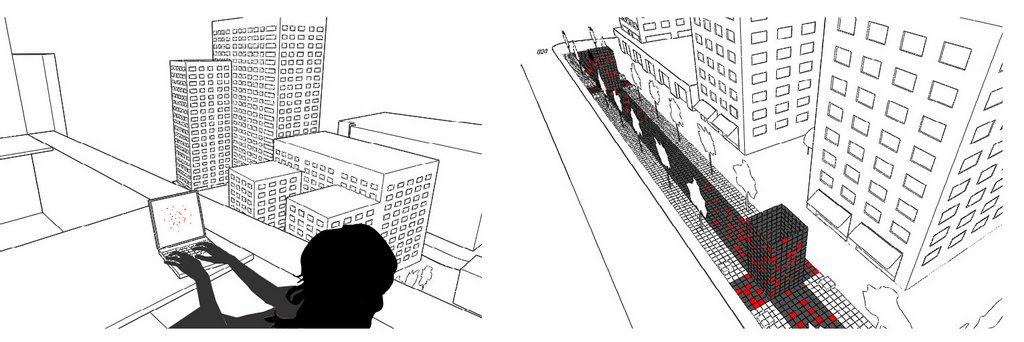
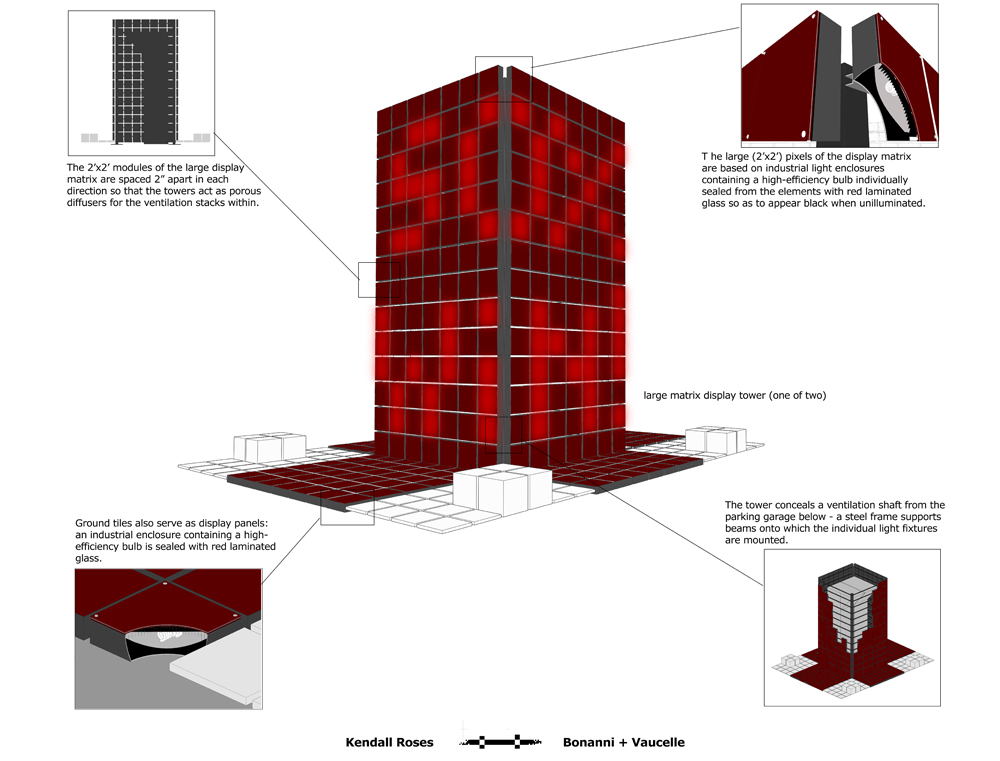
Based on my previous research Passing Glances (2002-2004), the Kendall Roses are designed to be an autonomous art installation that brings added value to the Kendall Square community. Bright, inexpensive daytime displays on two towers and the ground fulfill the role of the roses to provide compass directions to local attractions through graphics and text on billboards and the ground.
Data to the Roses is entirely wireless: SMS, internet and a local database are streamed to a wireless server inside each tower from local hotels, businesses, residents and the World Wide Web. In addition to useful information about local businesses, sports and attractions, the Kendall Roses offer opportunities for families and children to play on an interactive ground display that can project a variety of games. After an initial investment and potential partnership with local businesses and telcos for promoting SMS messaging, the towers will generate income primarily through advertisement for local businesses and as a tax credit for displaying public service announcements relevant to the community.
Some screenshots of the Kendall Roses interaction movie:




Details of the architecture
Plans of the Kendall Roses site

A movie of our entry
If it does not appear above, clic here
Saturday, December 03, 2005
The ambient peacock explorer
I developed the Ambient Peacock Explorer as a framework for mobile units to document on their environment and report back to a central hub
I believe that new work in this area can physically substantiate the documentation through tagging, the incorporation of physical communities or other conceptual redefinitions of the environment one seeks to capture.
structure mobiles units + headquarter
mobile units independent from the headquarter
One shell per context of exploration. Shell inflated on top of the structure to indicate where the mobile unit is going.
Context based shells per unit
Water: Jelly Fish Organic Shell
Countryside: Wooden structure
City: Inflatable Concrete
Air: Blimp
headquater
Is composed of four gathering areas: the air, the countryside, the city and the water area, a studio and an editing room. Each wall receives life feed from the mobile units based on each unit context. Environmental data from sensing mobile units are also projected on the walls as meta information. The headquarter itself retro-project on its roof the life feed of its environment and on the external walls displays the video from mobiles units. The production center also invites to discuss the documentaries and environmental issues and by that is also a showcase building.
technology specs
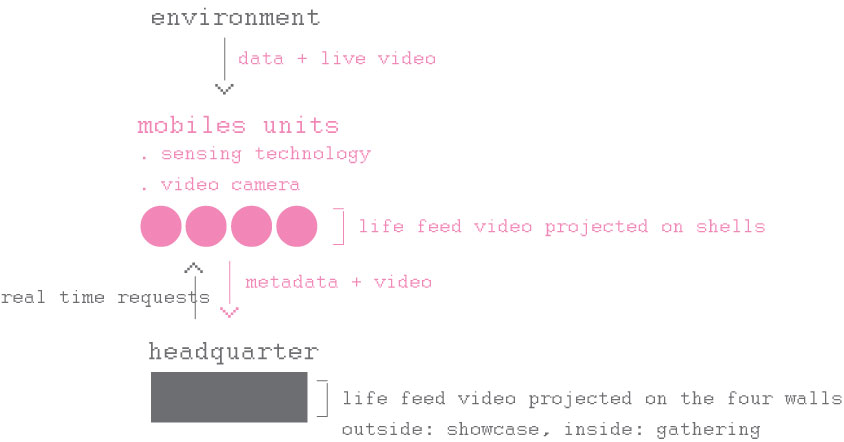
Live feed video camera from mobile units to headquarter. Each mobile unit is composed of one video camera connected via satellite to the headquarter. The life feed video camera is sent to the headquarter and projected onto the contextual area outside wall and inside wall (as part of the cafeteria gathering) area.
Video recording and metadata from mobile units to headquarter. Each mobile unit documents by recording visual environmental elements and use sensing technologies to combine video recorded and environmental data for later post production video retrieval. For instance GPS technology for location data retrieval, temperature, wind information and so forth. The production companies will retrieve video recordings of the mobile units and metadata associated to them.
Live feed video camera from mobile units onto mobile units. Each mobile unit would retro project their life feed footage onto their semi-transparent fabric structure to melt within its environment.
Headquarter data exchange with mobile units. Information and request coming from headquarter to define what to explore by real time exchange video footage. Scenario: if the mobile unit is in the air and crosses a bird migration, the headquarter could visualize it and request more detailed footage or more sensing environmental data coming from the bird migration.
communication system diagram
visual scenario of the ambient peacock explorer
the blimp the air mobile unit.
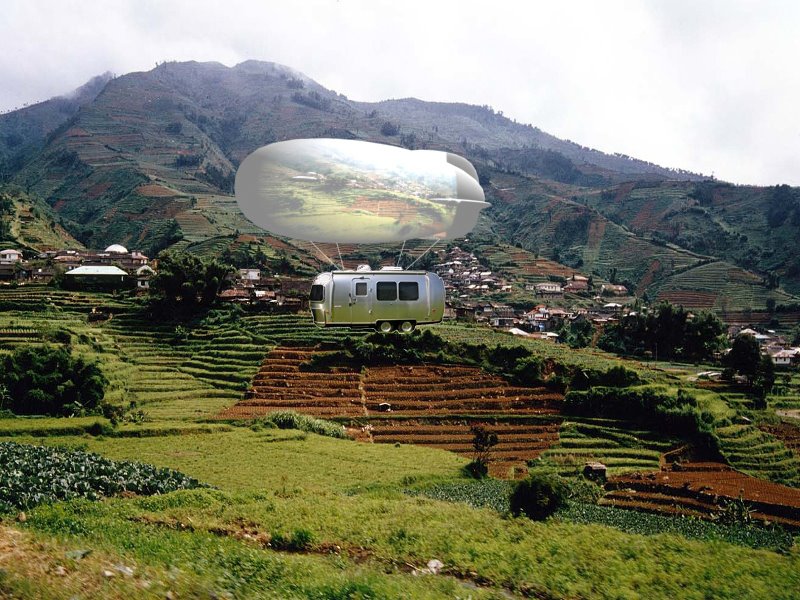
The shell inflated on top of the structure indicates the mobile unit is going to document from above and in the air.

the mobile unit common to all contexts is controlled by two people. It has real time contact with the headquarter via satellite. One person controls the mobile unit and one gathers data, exchanges information, and prepare the unit to its environmental use. The unit consists of the inflatable blimp on top, the floatation device including the organic shell at the bottom, a projector to display environmental data inside each shell.

the mobile unit going into water.
The compressor is used for the floatation device and an organic semi transparent shell is added around the structure. The environmental life feed video is projected on the shell. The mobile unit is waterproof.
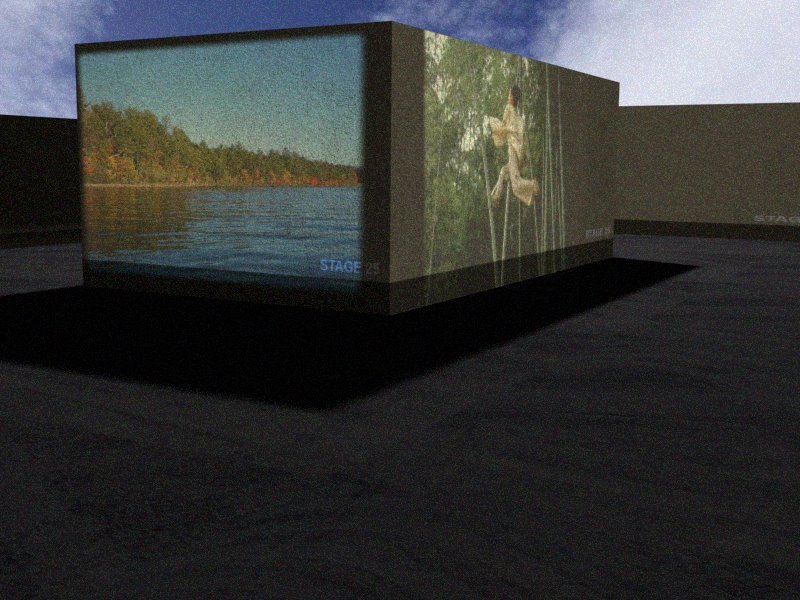
external view of the headquarter as a showcase.
Four walls: the air, the countryside, the city and the water. Each wall receives life feed from the mobile units based on each unit context.
The Ambient peacock explorer is a project I made with Philip Vriend for the Kinetic Architecture class, Assignment 2, November 2005.
