In this essay I look at Photography as a historical metaphor
I propose that experiencing the digital has influenced our perception of the physical space. It can also inspire us to re-design our physical environment. It can indeed enable the co-existence of electronic objects, virtual applications and physical objects by understanding the interdependency and influence between virtual applications and physical objects. Technology is integrated into our everyday life. My assumption is that the qualities of technology reside in the way users make sense of it and its applications.
D’abord considérée uniquement comme une technique différente pour obtenir ou fabriquer des images que notre regard avait dejà peçues, la photographie est devenue un moyen d’appréhender occulairement des choses que notre oeil ne verra jamais directement… Elle a opéré une révolution complete dans la manière dont nous utilisons nos yeux et… concernant un type d’objets que notre esprit révèle à notre regard.
William M. Ivins Jr, 1953
A useful historical metaphor exists in photography. At the inception of photography, the new medium was feared and admired.
It was reduced to the status of being useful, but devoid of meaningful interpretations of reality, which was the provence of the fine arts and painting in particular.
However, over time, the status of photography changed, and gained its independence from painting. Eventually, the photographic medium was accepted as having its own formal and aesthetic values. The end result was a revisitation of what painting could be, driven by the new aesthetic findings in photography, as exemplified in some of Duchamp's work, such as
Le Nu descendant l'escalier.
In this piece Duchamp wanted to create a static image of motion
Photography and its schematic aspect of motion have provided the cubists and futurists a new vocabulary applied to painting.
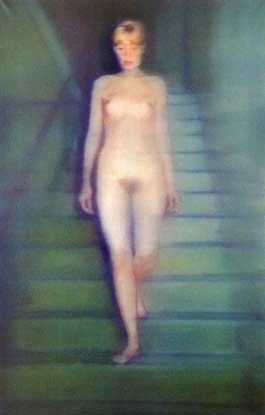
Inspired by Duchamp’s work, Gerhard Richter painted
Emma - Akt auf einer Treppe as a proof to the Avant Gardes that painting is not dead. In this piece, the boundaries between painting and photography are blurred. Photography has completely tainted the painting medium.
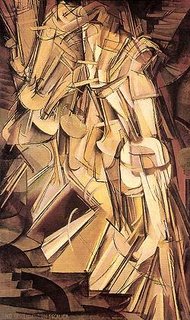 Marcel Duchamp. Nu descendant un escalier n°2, 1912. Huile sur toile. Philadelphie, Philadelphia Museum of Art ; Louise and Walter Arensberg Collection.
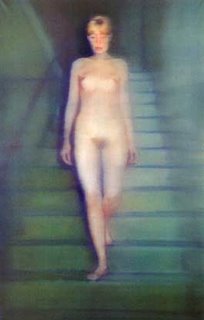 Gerhard Richter. Akt auf einer Treppe. Emma – Nu dans un escalier. 1966. Huile sur toile. Museum Ludwig, Cologne.
The paradigm shift was not limited to painting, but provided social change as a new form of expression in the arts. As in the above metaphor, the ability to shake the rules with the advent of a new medium is a latent opportunity for architecture, following Kandinsky’s dream of a
great city built according to all the rules of architecture and then suddenly shaken by a force that defies all calculation.
One area where the advent of a new artistic medium provided massive reform over a field of art and various extensions into social and physical environments took place with advances in digital photography. Digital photography has redefined the values of photography. The popular belief of visual media as being a mirror of reality has been completely revised. Indeed before the digital, the subject was not that important, and any photographer was a reporter; he/she could be “good” by knowing where to look rather than passing by without noticing anything; but what has been captured in the photographic mirror of memories has its origins in a scene that had existed at a specific time. An image is not different from the represented object, but over the years its authenticity has changed. The information presented through visuals can be twisted by using specific semantic codes to attract the attention of individuals, and by re-creating a reality using digital effects. Through these means, its credibility has been questioned. We went from information to emotion, where the status of image has transcended the limits between public and privacy. Showing visuals of a private event makes this event become public. Now because of the lack of credibility in modern visuals, journalists use emotions to make spectators believe in the truth of the scene. According to the cultural theorist and philosopher Jean Baudrillard, the Gulf War disinformation made the information itself, rather than the events, the source of the scandal.
We now look for the credibility of the truth. Documentary used to serve as a mirror of an event until recently when its credibility was again made possible. As a recent example, during the terrorist attacks in London, individuals captured and shared media with journalists
By using media made by witnesses using their photo phones, journalists gained a credibility – justified or not – in the presentation of the event. Journalists could then use these media as a ‘credibility tool’ and reinforce their reports. The documentation of the London event evolved into a collaborative report; in fact, any individual who has a photo phone is potentially a reporter who can capture key events and by combining these captured visuals, create a popular visual narrative presenting the truth of an event. This shows the shift from traditional documentary to a collaborative documentary of an event.
The digital had almost killed the initial values of photography as a mirror of an event, but with the appearance of mobile digital photography tagged to a user, the digital has created a new visual medium and a new value of credibility with that medium.
Perhaps an even more direct, although somewhat archaic, example exists for the car. Before experiencing the car, people thought that we had lost something essential in ‘walking’ with the car. The car has forced us to redefine the world. Indeed, before the car, to experience acceleration one had to jump from a window, while now it is totally inbuilt in our body. The car has redefined our physical concept pertaining to objects and the sensation of acceleration
references
William M. Irvins Jr. 1953. Prints and Visual Communication, Cambridge, Mass., 1953, p. 134.
Cababbe P. 1996. Duchamp & Cie, Editions Pierre Terrail, Paris 1996, p. 50.
Rosenblum N. 1992. Une histoire mondiale de la photographie, Abbeville Eds, P259.
Terzidis K. 2003. Expressive Form : A Conceptual Approach to Computational Design, London : Spon Press, Chapter 3 : Kinetic Form pp. 33-45
Baudrillard, J. 1992. L'Illusion de la Fin, Éditions Galilée, Paris.
http://en.wikipedia.org/wiki/2005_London_transport_explosions
Architecture Science and Technology, PICON, A. 2005, GSD personal course notes.