This is too cool. Avatar Machine by Marc Owens is a system which replicates the aesthetics and visuals of third person gaming, allowing the user to view themselves as a virtual character in real space via a head mounted interface.
Basically you walk in the everyday world, wearing glasses that provide an exclusive replica of you as an avatar, as in role playing gaming environment. It must be unreal to try it on when you have spent hours role playing games in a row. I actually love the designer's hypothesis: "The system potentially allows for a diminished sense of social responsibility, and could lead the user to demonstrate behaviors normally reserved for the gaming environment." I am not sure about the diminution of sense of responsibility, but it might help the ones who have sensory difficulties in the physical world.
Definitely a project I will refer to in my PhD, talking about playing with visual perspectives, when one can walk in the everyday world from the point of view of her avatar, one might feel more "secure", with new new sense of body limits gained from an interaction with her virtual games experience. That reminds me of the movie Ben X, where the main actor transfers his interaction in the virtual world to help him interact with the physical world.
Anyway, great project!
A video
Saturday, November 21, 2009
The avatar: your real body guide


Wednesday, December 26, 2007
Algorithmic film assembly using toy gestures
A new input device for video capturing and editing! Designed for young children, ages five and up, it allows them to craft compelling movies through the motion analysis of their interaction with toys.
A child playing with Picture This and his Naruto action figure
Continuing my research on perspective taking and tangible video editing, I recently finished the development of Picture This, a video editing and capturing device designed for young children. It allows them to craft compelling movies through the motion analysis of their interaction with toys. Children's favorite props alternate between characters and cameramen in a film. As children play with the toys to act out a story, they conduct algorithmic film assembly.
Picture This's web site.
In my prior work, Moving Pictures, I wanted to offer children the opportunity to gather imagery from their environment in the form of short video clips captured on video camera platforms modified for the application. I wanted to provide a transparent experience for the user, in which the cumbersome process of capturing and editing becomes fluid in the improvisation of a story and accessible as a way to create a final movie.
Web site for my past work on Moving Pictures.
Tangible interfaces combine operations on physical objects with digital data. I have sought to develop interfaces where either digital data can be overlaid onto physical objects in a display space or physical objects can act as handles into the digital space. The tangible handle is more than a marker or place-holder for digital data. It has the power to materialize and redefine our conception of space and content during the creative process.
If the toy had a visual perspective immediately accessible to the child, a new world would be opened to her. The toy could potentially bring the child into exploring visual and narrative perspectives of these character props, expanding her discovery and understanding of social interrelationships.
A video snippet of Picture This and a 6 minutes video for its interaction design.
The Picture this tool is an audiovisual device that combines two digital video cameras and two accelerometers. The tool captures motions, video and sound in real-time while an algorithmic video editing system composes a movie from these inputs. A motion based editing engine fluidly assembles the film as its story is being narrated, while respecting the conventions of continuity editing, namely, a sequence of shots that appear to be continuous. 
This style of film editing is made possible in Picture This by detecting turn taking behaviors between the toys. Two toy props are augmented with video cameras and custom accelerometer hardware. They use the Picture This tool both as a doll hand-bag or a doll audiovisual recorder. The tool is flexible for a child to take the perspective of props she selected for her movie.
Posted by Cati Vaucelle
♥ Architectradure
Thursday, July 26, 2007
Video, toys and perspective taking
I discovered this fabulous experimental research on perspective taking by developmental psychologist Masuo Koyasu.
Masuo Koyasu's web site (in Japanese only).
In the 1980s, I was interested in studying the development of perspective-taking in young children. Piaget's "three mountains task" had demonstrated that children find it difficult to understand how something looks to a person who is in a different position from themselves. In fact, younger children exhibit a strong tendency to choose their own view when asked to indicate how an object looks to someone in another position, a tendency that Piaget called "egocentrism." I thought there are three dimensions of egocentrism (up and down, front and back, and left and right), and that children's difficulty in understanding different perspectives might be because they do not receive feedback about other people's perspectives. To test this hypothesis, I conducted a series of experiments with kindergarteners.
Figure 1. Experimental Situation
A:Child,B:Experimenter,C:Sample Photos,D:Place to put toy animal(s),E:Three toy animals,F:Still camera or video camera
The task in the first experiment was to face a camera set up across from them and then to arrange one to three toy animals in a way that would produce a photograph like the sample (Figure 1). Forty-three percent of the four-year-olds exhibited front and back egocentrism by placing the toy animals' backs to the camera. That tendency had mostly disappeared among the five-year-olds and six-year-olds, but it became clear that hardly any of the four- to six-year-olds could position two or three toy animals in the correct left-to-right order. In a second experiment, I used a video camera instead of a still camera and provided video feedback, showing an image of the toy animals as viewed from the opposite side on a color CRT monitor. In the control group, which was shown only the CRT monitor, the children were able to correct their front-back egocentrism on their own but were not informed of their errors. Even in the experimental group, which received instruction and practice in correcting left-right egocentrism, the effect on their post-test results was clearly small (Figure 2).
Figure 2. Mean number correct in each condition
Until the age of about seven, most children facing a teacher who says, "Let's raise our right hands" while raising his or her own right hand will raise their left hands.
Incidentally, research into perspective-taking abilities has traditionally focused on investigating how children understand other people's viewpoints, but I have noticed a serious limitation in the paradigm commonly used to study this. In the case of the "three mountains task," even if children can't directly guess the viewpoint of a person in another position, they can solve the problem by conducting a mental simulation in which they imagine that they have gone to the other person's position, or by a type of mental rotation, in which they imagine that the object has been placed on a lazy Susan and rotated to the correct position. The lack of methodological distinctions in the perspective-taking paradigm was a major problem. As I was worrying about how to think about this problem, I encountered research into "theory of mind." In particular, I spent ten months as a visiting scholar in the Department of Experimental Psychology at the University of Oxford from 1994 to 1995, where I had the opportunity to come into contact with the front lines of British research into cognitive development. After returning to Japan, I began studying "theory of mind," but at that time, hardly anyone else in the country was doing so. Without intending to, I have had to carry out the role of "missionary" in the field of "theory of mind" in Japan.
The most famous experiment in "theory of mind" is the false belief task (the so-called "Sally and Anne task") of Josef Perner and his colleagues. "Sally puts a doll in a basket. While Sally is away, Anne takes the doll out of the basket and puts it into a box nearby. Sally then returns and the child is asked where Sally will look for her doll." In general, three-year-olds can't pass this task, but they become able to do so between the ages of four and six. It has also been demonstrated that even high-functioning autistic children can't pass this task. It is odd that most young children are easily deceived by this task, which is no problem at all for adults. I have been observing the daily lives of children at a Kyoto kindergarten once a week for three years, as well as conducting developmental research, including the false belief task. As a result, I have obtained longitudinal data on "theory of mind" (Figure 3).
Figure 3. Results of a longitudinal study of "theory of mind"
The data presented in this figure began with 15 children, with 4 more children transferring in at the ages of four and five, for a total of 19 children at the end. Only one child regressed from being able to pass the task to failing it, but he was a boy who became extremely nervous and made mistakes in the testing situation at age five and six. The fact that I was conducting experiments on children with whom I was in contact on a daily basis made me feel that I could interpret the results more broadly.


Friday, July 20, 2007
An Investigation into Perspective Taking Skills

"Children believe that animals understand them and that they can share some of their problems with animals. Animals unconditionally love children without judging them so children can easily share their daily problems with animals"
An Investigation into the Perspective Taking Skills of 6-Year-Old Children in Terms of Pet Feeding and Gender Variables by Aysel Koksal Akyol and Vuslat O uz. In Humanity & Social Sciences Journal 2 (1): 08-13, 2007
Paper available online.
Abstract This research has been designed in order to investigate the perspective taking skills of 6-year-old children in terms of the variables ‘pet feeding at home’ and ‘gender’. 100 six-year-old children attending nursery schools participated in the research. Data were collected through a “Personal Information Form” and the “Perspective Taking Test”. In analyzing the data, t-test was applied. As a result of the analysis, it has been determined that the status of pet feeding has an impact on the perceptional perspective taking skills of children (p<0.05) and the gender of the child has an impact on the cognitive perspective taking skills (p<0.01). Consequently, some recommendations have been made.
Overview
This paper presents the potential of a pet, as a companion for a child, transitioning from stuffed animals to communicating with others and supporting the child's emotional development. Communication with pets can be mainly non-verbal so that children with communication difficulty progress with pets. Also a study demonstrated the important correlation between the level of the relationship of children with their pets and their level of empathy.
The authors present a comprehensive definition for perspective taking
Perspective taking skills are formed from perceptional (to be aware of what another person sees), cognitive (to be aware of what another person thinks) and emotional (to be aware of how another feels) elements(...) Perspective taking is also defined as the emotional reactions shared in the experience of the child against the emotional reactions of the other person. Perspective taking includes both cognitive understanding of another person’s experience (playing a role) and the emotional understanding of another person’s emotional situation (experiencing). A person with the perspective taking ability can feel the other’s emotions after defining his emotion and perspective partially
Study
The study in this research involved 100 and 6-year-old children. Children take the “Perspective Taking Test (Perceptional Perspective Taking Test, Cognitive Perspective Taking Test, Emotional Perspective Taking Test)” and parents take the Personal Information Form and the Empathetic Skills Scale. In the results, the empathy points of pet feeding children are higher. In children’s interaction with animals, their being able to put themselves in the animal’s place is important for them to understand whether the animal is hungry or not, whether they are hurt or not, or else whether they want to be taken care of or not. The perceptional perspective skills of pet feeding children may have resulted high for this reason.
They conclude that the communication skills of pet feeding children improve and their perspective taking skills are affected positively. They propose that parents support the love and interest of their child to their pet. Children’s love for animals can be developed through visual mass communication tools and the media, by allocating more space for animal related publications and broadcasting.
Based on this result, I wander if children playing with Tamagotchi perform better at empathy, unless the attribution of feelings to a character that is virtual kind of mix the cards ...
I am particularly interested in the subject of perspective taking. Studying perspective taking in discourse structure as well as social perspective, I designed from 2000-2002 a computational toy to enhance narrative perspective-taking. The most fascinated finding in the part of this research on social perspective taking, is that children benefited from the technological toy in reflecting on their hypothesis about their environment, about people, about their personal experiences. I discovered there was a huge potential in computing toys for comforting children in their natural discoveries. Technology cannot replace human or pets interrelationship, but it has the advantage to be neither of these and just offer children fun, authorship and feedback on their creation. In this process a mechanism can be designed to reinforce a particular cognitive skill.
I later designed video systems for children to share creations with one another using video game controllers in a public museum space. Computational tools for adults and children to perform videos in real time using their video database, as well as sms'ing in the public space using a community video database, and a tangible system for remote communities to create, edit, perform and share video creations.
The power of video is immense, it is the witness of an event. I am now researching on the relationship with perspective taking between personal video and personal voice using tangible materials.
Picture extracted from my thesis Dolltalk: A computational toy to enhance narrative perspective-taking. Thesis available online
Dolltalk (2000)
I created DollTalk to help young children take different perspectives during storytelling play. The child tells his/her story to an animated computer character, using two stuffed animals as props while their story is recorded. The stuffed animals contain accelerometers that monitor the movement of those toys; statistical analysis of children's play with props allows the system to assume that if a toy is being shaken, then the child is narrating a story segment associated with that toy. The system also computes different types of motions, from a single toy being shaken, to multiple ones and their frequencies over time. In parallel, the system analyzes the speech of the child. The combination of sound and gestural parameters analysis allows Dolltalk to determine the structure of the narration: from a dialog to a narrator voice, this to offer adequate interaction. In Dolltalk "easy mode", when the child is done telling a story, the recorded audio is played back with two different pitches to signify the stuffed animal that was speaking at the time. In a more "advanced mode", the story is played back using a narrator voice and offers different understandings for the same story using the storyline of the child.
Saturday, June 30, 2007
Tuesday, April 17, 2007
Thinking about blogs

Since I met Régine Debatty and Nicolas Nova in Switzerland in June 2005, I am a blog addict. I love this form of communication, research tool, inspirational and everyday snack. I am convinced of the polarity of the blog community, because at first one can discover blogs based on interests and also networking, but it is hard to know what's out there from another side of the spectrum. I wish some machine learning algorithm could propose a set of blogs that corresponds to what I could never find based on my network and related to my interests. I love the unrelated-related. Too much polarization kills inspiration.
So it is very nice to read: "Architectradure: can you be in love with a blog? I don’t know, but Cati Vaucelle’s blog is a fascinating rollcall of invention and digital innovation that springs from her research at MIT Media Lab, and life in general" [link] and to receive a thinking Blog Award from kuipercliff, a blog that I follow regularly. I try to always blog for my personal PhD research, on what inspires me, and to post even unfinished work for critics and comments. I am happy that this process is useful for others.
In response to the thinking blog nomination, I would like to mention blogs that make me think a lot. To respect the spirit of this initiative, I will avoid mentioning blogs that are already well known or already nominated. I also picked different blog themes on purpose. I read lots of blogs in French that I find awesome, but hard to translate efficiently in English.
♥ One of my favorite French blog is the one of Etienne Mineur. Completely inspirational graphically, there is a thread of personal tastes that I enjoy. I find always useful information in the world of graphic and interactive design. His blog is already very popular in France, so maybe i am breaking a bit the spirit of the initiative, but it is worth expanding the frontiers of this blog to an international community.
♥ Olivier Vaubourg started Teratoblog, a blog on sociology and politics. He posts summary and analysis of books, a must read. He created another blog for which he shares his many years of research on the relationship between generations. The two blogs are written in French, but offer English and German translations.
♥ Yasmine Abbas has an exquisite blog on nomadic culture. She explores everything from the pure nomad, the neo-nomad, and the anti-nomad.
♥ Another blog I constantly look at is idealist for its refreshing and fun picks in product design, findings that you never discover on any other blogs. Idealist also created design corner, a feed agregator for design that I find very useful.
♥ Finally I love the aesthetic choices of multimedia lab, a blog on numerical and visual art
Yeah guys and gal! You all won a thinking blog award! Just grab one of these two Thinking Blogger award icon and put it within your blog. I cannot wait to hear your recommendations!
----
Architectradure also got nominated by Turbulence! I wander if I can chose another 5 blogs I love, but isn't that obvious all the blogs that make me think?!
Writer Response Theory tagged us for the Thinking Blogger Award. The Thinking Blogger Award was introduced by Ilker Yoldas as a tag meme with meaning. His meme asks that you tag’5 Blogs That Make Me Think. Here are mine:
architectradure http://architectradure.blogspot.com/ cati vaucelle
crtiical spatial practice http://criticalspatialpractice.blogspot.com/ nicholas senn
ideant http://ideant.typepad.com/ideant/ ulises mejias
network research http://www.asquare.org/networkresearch/ garrett lynch
we make money not art by Régine Debatty, Sascha Pohflepp and Shin’ichi Konomi
Via Jo-Anne Green at Networked-Performance
Thank you!
Wednesday, October 19, 2005
About perspective in Architecture ...
Evans R., The Projective Cast. Architecture and its Three Geometries, Cambridge, Massachusetts, 1995, new edition Cambridge, Massachusetts, MIT Press, 2000, Chapter 6, "The Trouble with Numbers", pp. 241-271.
As in THE VITRUVIAN TRADITION
In this chapter, Evans discuss the comparison between architecture and music. In architectural theory from the 15th to the 18th century, harmonies in music served as evidence as exact ratios underlay our perceptions of beauty in all things. Ratios from the octave scale were invoked to help justify systems of architectural proportion.
Rene Ouvrard, in his book 'architecture harmonique' from 1679 said that architecture should be attuned to music. The Modulor of Le Corbusier (1887–1965) is a scale of proportions, an attempt to discover mathematical proportions in the human body and then to use that knowledge to improve both the appearance and function of architecture.
18th century writers have the feeling that their unity is lost compared than before. There is then the question to know whether it is due to the predisposition to believe that it has 'come and gone'. So this chapter will try to understand if Renaissance proportion is unified or not. During the renaissance writers assumed a universal correspondence between architecture and music.
In 1436 a ceremony happened at the high, octagonal-ribbed dome of the Duomo (cathedral of Santa Maria del Fiore) in Florence created Brunelleschi. The motet called Nuper rosarum flores (rose blossoms) was being played for the occasion composed by Dufay. Warren has shown the correspondences between the cathedral and the motel but showing that borrowing of proportions could work both ways: from architecture to music as well as from music to architecture. Brunelleschi was the first to transfer harmonic proportion in music onto his buildings. He believes that while architecture borrowed radical harmony from music, music borrowed its proportioned structure back from architecture. He invented linear perspective, the perspective transformations of actual dimensions into projected dimensions are coherent and systematic. Equal measures of real space were transformed into a harmonic serie of measures in perspective. A clear distinction has been made between a geometry that belonged to the essential structure of the world -Euclidean geometry- and a geometry that recorded appearances -perspective geometry.
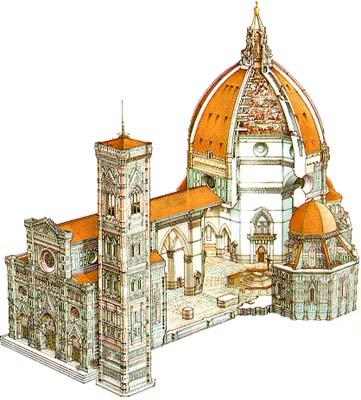
The cathedral of Santa Maria del Fiore
The opinion of the implicit or explicit character of proportion in Renaissance buildings is currently divided and uncertain. Critics such as Colin Rowe describes Palado's use of proportion as relatively clear and uncomplicated compared to Le Corbusier. Others complain that the rational idea, very clear, cannot be perceived in 3 dimensions. In practice, Renaissance artists were not trying to show proportion in things but trying to bury it in in things in imitation to nature, where it was hard to see.
“Arts needs to be imaginatively undressed in order to be appreciated and so does the world”Clarity can be fond under everything if our vision is sufficiently informed and penetrating. For instance, Donatello and Michelangelo trusted the eye rather than the compas, and Aristoxenus and Mei trusted the ear rather than the numerically subdivided string.
So this chapter concludes that the practice of proportion was not unified in Renaissance, and that the history of it has been overwritten. But is is only a characteristic not a default. The most accomplished work were unified presentations, without saying that they were the product of unifed ideas. Claude Perrault's critique of the architectural proportion did not attack proportion but ideas about it and said that since nature provided no distinct rules for architecture, we must provide them instead. He proposed that vision does not distort things, but that it relates them to one another and moved attention from invisible cause to the visible constitution of building. Finally, 'rules recognized to be necessary, could no longer provide any guarantee of quality'.
"The Vitruvian Man is a famous drawing with accompanying notes by Leonardo da Vinci made around the year 1490 in one of his journals. It depicts a naked male figure in two superimposed positions with his arms apart and simultaneously inscribed in a circle and square. The drawing and text are sometimes called the Canon of Proportions or, less often, Proportions of Man. Marcus Vitruvius Pollio was a roman writer, an architect and engineer, active in the 1st century BC. He was the author of De architectura, known today as The Ten Books of Architecture, a treatise in Latin on architecture and perhaps the first work about this discipline."
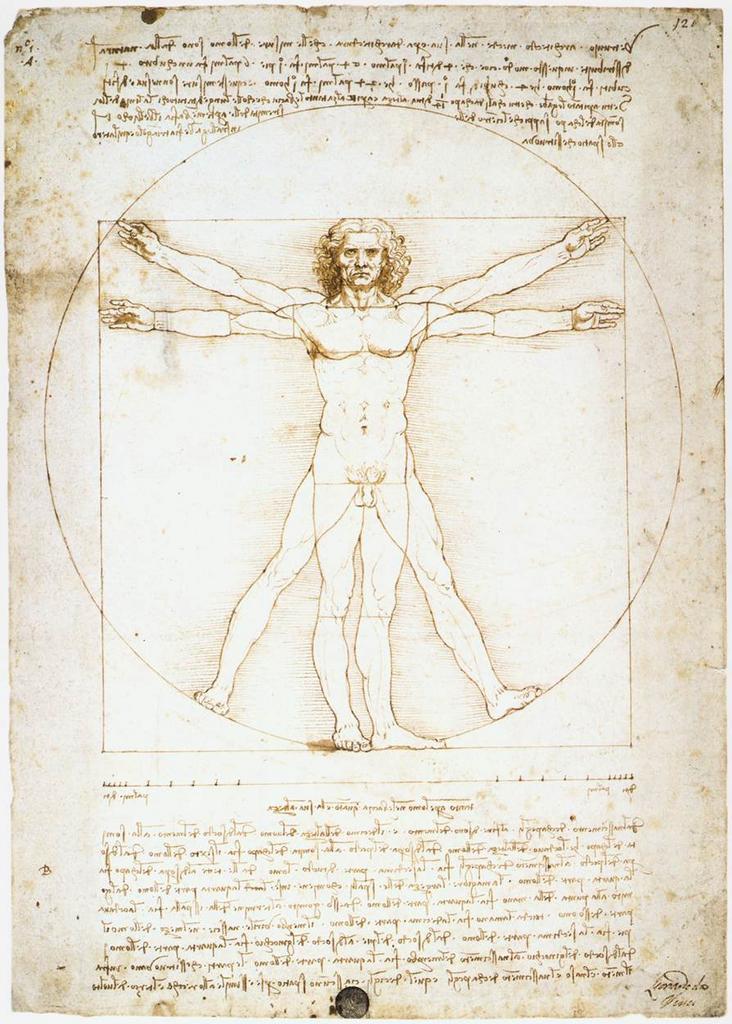
The Modulor is a scale of proportions devised by the Swiss architect Le Corbusier (1887-1965). Le Corbusier developed the Modulor in the long tradition of Vitruvius, Leonardo da Vinci's Vitruvin Man, the work of Leon Battista Alberti, and other attempts to discover mathematical proportions in the human body and then to use that knowledge to improve both the appearance and function of architecture. The system is based on human measurements, the double unit, the Fibonacci numbers, and the golden section. Le Corbusier described it as a "range of harmonious measurements to suit the human scale, universally applicable to architecture and to mechanical things."

--------------------------------------------------------------------------
Context
--------------------------------------------------------------------------
Architecture science and technology in the vitruvian tradition
The Vitruvian tradition
There was not a lot of illustrations in the beginning, not truly roman architecture (not a lot of concrete), architecture was done by slave labor so not seen as a high profession, more credit was put on pure science so instead of doing graphics they were doing fractions. To enhance the status of architecture, one had to use verbal expression. Architects have always admired the treaties of Vitruvius, but buildings are not done this way as there is no greek temples around Northern Europe. Theory can be separated from reality until the 18th century.
Proportion
They believe in proportion, not at all static. Proportion is not a static thing as there is always a slight variation, the accuracy in the modern sense is not there. The idea is that the world is order in proportion and architecture is the art of order in proportion. Ouvrard thought that music and architecture were linked (see paper). Mathematic and architecture are also linked.
A different definition of architecture
Architecture shared things with science: geometry, perception and how mind works e.g. the statues in buildings and keep the statue from looking like if it was falling into the void, interest in anamorphosis: there is a back and forth relation between world of art, math, physiology and perception. The structure between animal and architecture: the living function and the elements in architecture. And people can then be scientists and architects at the same time, eg. Wren, Perrault. Then why not transforming the building into a scientific experiment, this idea of the meridien link astronomy to cathedrals, buildings have then different shapes and towers coincide with different times in sun passage. The baroque period questions light and parts that would allow light to circulate. An example of baroque building: The Basilica of Saint Peter from (15th-16th century) with the dome designed by Michelangelo, and the The Trevi Fountain as the largest and most ambitious of the Baroque fountains of Rome (1762). In the 18th, this is the passage from having a scientific building to a metaphor.

The Basilica of Saint Peter
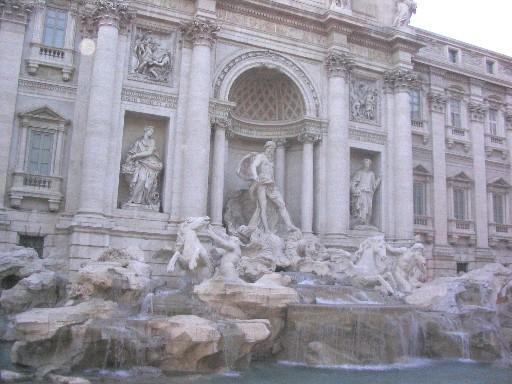
The Trevi Fountain
In the 18t, the notion of architectural space does not exist, space is not thought. Architecture of a serie of walls, more 2D not thought of as a space which is a modern idea, it is more a rhythmique architecture. But it varies between countries, there are different philosophy, in France the planes are slightly disconnected from each others and in Italy deformation of a continuous plane. There are different ways to look at a building, before architecture would look at the differences, at the details, they were not interested in describing the structure because it was obvious. Architecture was primarily by imitation with principles already given so the variations then became the only interesting parts. Now, because we are confronted to different buildings we tend to look at architecture from its structure so to understand the baroque, we need to reeducate the eye.
Architecture and technology: the key notion of solidity
People lived in a stable world and buildings had to look reassuringly solid, and the Gothic does not look solid, was too daring; the look should regulate the construction of buildings and obey more visible rules. Blondel said that Gothic church (Notre Dame) was not solid, which is not true but it does not 'look'solid.
Architecture is then not about daring performance, but it is about conveying a harmonoy of proprtions, and technology does not have as much value, innovation is not a value in itself and using geometry can dispense technological knowledge. Architecture becomes the discourse of geometry theory and does not need to know how to build it. Nature itself is understood in geometry terms, the building recipes is given through proportion. The 'new' is not a natural condition. The theory of invention today will have to change as technology allows for mass copying and imitation.
Why geometric discourse of architecture worked?
It worked because the world was technologically stable from the end of the Renaissance to the 18th century. There were relatively few materials and a few evolution of building constructions, but people still view they are in a stable world. Material was tied to nature; for instance in Angers, 'les tuiles a l'envers pour ventilation'.
A few mysteries
About Iron, nobody knows how to control Iron until the 18th century. At the time transportation is very expensive and this is why materials are very local. Also enormous importance in building a shell as the masonery is half the price at the time while now it is very cheap. Masonery gradually replaces wood after the renaissance in building construction. There is a big evolution / concrete. The foundation was the biggest technological problem and a major source of collapse. Wooden pile was cheap but at the time there was lots of water so problem. In Europe, wood has been replaced by concrete. Key technologies: oblique smoke pipe (fireplace does not have to project into a room).
Conservative institutions and professions
Social condition
you stay in the same class as born in, do what your father had done, the master trained his son. The idea of revolution is that of circular motion come back to where it was before (circular model more natural than linear one). They were highly conservative in term of innovation, and tradition is good and innovation was dangerous and not natural.
Measures are not unified, local measures are made by local guilds and governed by local laws. Later the buildings are made through geometric measurment and that method takes over in local buildings.
Profession of the architect
90% were master masons, guild masters and 10% were artistic theorists. Architecture is too close to the world of construction for innovation to happen. The renaissance marks the departure of architecture from master craftmen and innovation is not favorable for intimate connection between architecture and technology. Today theory allows for negotiation after work being done in studio. Today design and theory has a prescriptive relation to reality.
