Yeah!! The two papers I wrote for CHI 2009 were accepted this year! One paper is entitled Design of Haptic Interfaces for Therapy the second one, a work in progress, is called Cost-effective Wearable Sensor to Detect EMF
Design of Haptic Interfaces for Therapy
Abstract
Touch is fundamental to our emotional well-being. Medical science is starting to understand and develop touch-based therapies for autism spectrum, mood, anxiety and borderline disorders. Based on the most promising touch therapy protocols, we are presenting the first devices that simulate touch through haptic devices to bring relief and assist clinical therapy for mental health. We present several haptic systems that enable medical professionals to facilitate the collaboration between patients and doctors and potentially pave the way for a new form of non-invasive treatment that could be adapted from use in care-giving facilities to public use. We developed these prototypes working closely with a team of mental health professionals.
Download the .pdf ->here<-
Cost-effective Wearable Sensor to Detect EMF .
This other paper is a work in progress, based on a circuit design that I did for the class of Joe Paradiso (co-author). Even though many designers have explored wearable EMF displays, I implemented an electric field sensor that is low-cost, this to democratize EMF reading.
Download the .pdf ->here<-
Chi will be in Boston this year, so that means lots of visits and parties and hang out with old friends!
.............................................................................................
Blog Jouons 
Tuesday, February 03, 2009
Papers at Chi 2009!


Thursday, July 17, 2008
This silent language ...
In his book The Silent Language
As I focused on the chapter "how space communicates", I find intriguing the way Hall compares cultures and their reading of non verbal communication cues. He particularly states that the distance between individuals differs and can drastically affect the dynamics of space interaction. For instance, an American needs to take between 20 inches to 36 inches in a neutral conversation for a personal subject matter. Apparently in Latin America the interaction distance is much less. This claim was also proposed in his other book, The Hidden Dimension
I was wandering, as we are becoming nomads, or neo-nomads --term created and analyzed by Dr. Yasmine Abbas, now that we travel constantly, I wander how these distances of interaction and non verbal communication cues have evolved. Is it possible that we absorb most of these social interactions in our everyday routines, and that after each travel, each interaction, we come back "socially transformed"? Would these non verbal communication cues become more obvious to us?
In one of his other book, The Dance of Life: The Other Dimension of Time


Thursday, June 19, 2008
A journey for the foreigner
All foreigners who have made a choice add to their passion for indifference a fervent extremism that reveals the origin of their exile – Julia Kristeva
I recently read a book, depressing and fascinating, Strangers to Ourselves, by Julia Kristerva.
This book is a journey through the notion of the stranger (the foreigner, outsider or alien in a country and society), and explores the idea of strangeness within the self (a person’s deep sense of being). In this book Julia Kristeva distinguishes the inside from the outside appearance and the conscious idea of self. She explains mostly the point of view of the foreigner, how he feels and perceives others in his welcoming foreign country. She attempts to analyze him and shows how this exile is nurtured by a deep inside exile. I share my notes because I know many foreigners who will resonate with this book.

In the eyes of the foreigner those who are not foreign have no life at all: barely do they exist, haughty or mediocre. In contrast, the space of the foreigner is a moving train! As for confidence, the foreigner has no self. An empty confidence, valueless, which focuses his possibilities of being constantly other: “I do what they want me to, but it is not me. Me is elsewhere, me belongs to no one, me does not belong to me, … does me exist?”. Julia Kristeva concludes that the foreigner is a dreamer making love with absence, one exquisitely depressed. Happy? No one knows better than the foreigner the passion for solitude. “The paradox is that the foreigner wishes to be alone but with partners, and yet none is willing to join him in the torrid space of his uniqueness”.
The author proposes two categories of foreigner. The one who agonizes between what is no longer and what will never be, the advocate of emptiness, usually the best ironist, and the one who transcends, living neither before nor now but beyond, a believer and sometimes ripens into a skeptic! She explains how meeting balances wandering for the foreigner. The banquet of hospitality is the foreigner’s utopia with the brotherhood of guests who soothe and forget their differences … the banquet is outside of time!
The author shows how the foreigner constantly feels the hatred of others and how living with the foreigner (with the other) confronts people with the possibility or not of being an other, as in being in his place. Rimbaud’s psychotic ghost Je est un autre (I is an other) is the acknowledgment of this exile: to be foreign and live in a foreign country.
“Being alienated from myself, as painful as that may be, provides me with that exquisite distance within which perverse pleasure begins, as well as the possibility of my imagining and thinking, the impetus of my culture.” Split identity? Should we recognize that one becomes a foreigner in another country because he is already a foreigner from within?
How strange is Camus’ Meursault (The Stranger, 1942), so anesthetized, lacking emotions, all passion having been eradicated, and not a scratch to show for it. One could easily take him for a borderline case, or a fasle self, in short for a quasi-psychotic, rather than for a prototype of the foreigner.
Julia Kristeva brings language into this exile. The foreigner does not speak his mother tongue nor he is filled with resonance from the body’s memory! The resurrection through a new language slowly appears superficial and meaningless. This new language appears like a prosthesis, it is superficial.
Apparently, nobody listens to the foreigner, because the foreigner is only tolerated. As the author explains: “Those who have never lost the slightest root seem unable to understand any word liable to temper their point of view”. And the foreigner’s friends, aside from bleeding hearts who feel obliged to do good, could only be those who feel foreign to themselves.
Nowhere does one find better somatization than among foreigners, so much can linguistic and passional expression find itself inhibited
The realm of the foreigner slowly becomes silence. “It is the silence that empties the mind and fills the brain with despondency, like the gaze of sorrowful women coiled up in some nonexistent eternity.” Instead of approximating words, the foreigner no longer says them. The foreigner has lost his own language in a foreign land …
Posted by Cati Vaucelle @ Architectradure
Monday, June 16, 2008
A century of evolution between La Guerre des Boutons and Harry Potter
I'd like to share the notes I wrote about a fascinating French book:
De la Guerre des Boutons à Harry Pottter by Jean-Marie Gauthier and Roger Moukakou.
In this book, two psychiatrists connect the novel of Louis Pergaud, La Guerre des boutons (English: "War of the Buttons") written in 1906 with the best seller of Joanne K Rowling (1997-), Harry Potter. The authors present a century of evolution in the teenagers’ life: their space/time structure, their relationship to a group of peers, and their appropriation of the land. The authors analyze the progression from developing concrete skills (close to the ones of adults) to an imaginary virtual world. Based on these two influential novels, a repository for this evolution, they illustrate their clinical analysis with real life scenarios of teenagers.
 VS
VS 


You can read on La Guerre des Boutons flyer: “Il y a des guerres qui durent des années, celle-ci doit se terminer avant le diner” which stands for “There are wars that last for years, this one needs to be over before diner”. For the ones who do not know this French novel, I am posting some screenshots from a movie interpretation of La Guerre des boutons made in 1962 by Yves Robert.
An excerpt from the movie can be found ->here<-

Notes from: De la Guerre des Boutons à Harry Pottter by Jean-Marie Gauthier and Roger Moukakou.
Essais anthropologiques
The authors observed that the ones who usually have difficulties to talk and show some reserve towards socialization, tends to spend a long period of time on internet for remote communication. With the computer, the relationship between distance and proximity, direct communication, corporeal and indirect, mediated is transformed. It is as if these teenagers privilege a communication in which the body is absent. The authors propose that this transformation induces difficulties in sharing and exchanging across generations and difficulties in the position that parents take place in the growth of their children.
The relationship to the body
- Rhythm of lives is different. We neglect the sun’s motion in our lives! Before the industrial revolution, a rhythmic life was imposed due to the constraints of working in the field, outside! Now we eat at unstable hours, find abnormal quantity of food anytime of the day, forgetting that meals can have a social function. The social function of meals is replaced by their nutritional function.
- The physical constraints related to transportation have been transformed. We walk less, thus transforming our relationship to time and space as well as our relationship to the body: feelings, feeling tired, cold/heat or being well.
At the time of “la guerre des boutons”, children were progressively learning how to build toys, hunting equipment, using the wheelbarrow under the grand father’s supervision! Now we can be a champion in Karate without moving a finger! The measure of each gesture (cause and effect) goes through an iterative process usually explored by gathering in locations & spaces.

The Land
Play is key for social & individual development, a way to measure personal skills in comparison to others at the same time than measuring one’s body, a necessary step imposed by the life as an adult.


Urban concentration has reduced the children’s possibility to gather outside. The space for play and collective experience is disappearing. Not only that but the parents themselves lost their everyday corporeal connection, their craftsmanship and their personal space. These transformations impact our ability to measure the consequences of our actions; this can explain a come back of the magical thought in a world where the relationship between causes and effects is more and more uncertain. Not only the quantity of available land has changed but also its quality has decreased. Before one could close his house with doors and windows, now it is completely impossible. The house walls not only did become porous, but the family remains in communication with the entire world through telecommunication, TV, internet, mobile phone… thus interrupting the paternal order of things!
Distinguishing between the inside and the outside world is harder (this relationship becomes more and more ambiguous). Distinguishing between private, individual, internal and external realities becomes very hard.
The Group
Children have a predisposition to form groups in which learning by imitation is very important. This helps children leave the exclusive parental relationship to enter a more complex form of socialization: creating an identity and functional skills. In La Guerre des Boutons one practices his skills by crating weapons for hunting while in Harry Potter to compete with one another the children use magical formulas.
In psychoanalysis, authors such as Leroi-Gourhan, Winnicott, Mendal, Montagner, Gibbs show the importance of a psychic construction that needs to connect to the outside world, necessarily going through gesture and object manipulation. Playing without using the body, without manipulating objects is very different.


Creating relationships between children is a considerable advantage as it allows children to realize early on the human’s fundamental destiny: a social being (De Waal, F. 2005). It also allows kids to find modes of learning outside of the parental relationship. The authors remark that we need to think of this child’s pleasure to group and learn in a group and reevaluate the quality of learning that can happen within the group. It is not impossible that behind this pleasure of the group, kids can rediscover values of solidarity probably essential to our humanity and that were still very present at the beginning of industrialization but that are disappearing.
With La Guerre des Boutons one would constitute a group that opposes itself to another one, but today individuals are pushed towards being identical. Solidarity as a value is the most compromised, while individuation is assimilated to the general identical. Consumer society can only live if it destroys values of sharing and solidarity benefiting individualization ...
Time and space
Important for rational thinking, time and space are constituted and function via intuition. These intuitive forms of representation are constructed progressively while the child uses his corporeal skills. Corporeal exercise has a direct influence on the essential cognitive functions (Gibs, Gauthier, Montagner).
With a computer, one can be in contact with the entire world without having moved from the parent's house. The computer is the perfect compromise between the teenager’s necessity to go outside to become independent and the necessity to keep the protection and security of the parent’s house.


While in the 20th century, kids were riskily gathering outside, creating groups, risking their identity confronting others, now kids can just stay home while contacting the external world, protected by their parents. According to the Oedipian complex, teenagers have to develop their personal lives outside of the family environment [Winnicott & Mendel], the computer seem to be the perfect compromise as children avoid the risks of the foreign while being closely connected to this outside world. The teenagers can also escape their fears related to their own body in comparison to the severe criticisms induced by co-located peers! The narcissistic image remains idealized. The teenagers will not quit their bedrooms and will remain dependent on their parents, because this context does not offer a way to move physically away from the family house.
Speech
Communication technologies modified our relationship to space and time and this cannot be left without consequences on the development of thoughts. Instead of confronting peers using a verbal exchange, communication is now guided with icons that one needs to only “clic” in order to be projected in the other side of the globe. The relationship to speech in which the exchange is contrary to the magical icon formula, is a relationship of time.
This modification of the general relationship to space/time can explain the modification of our potential to take time to share thoughts. Language is more and more stereotypical and univocal (close to the marketing discourse) which appears in the political speech today (Chomsky, 1986, 1998).
The dialog with the computer is a series of keywords and reveal the transformation of the structure and use of language in our occidental society. Harry Potter is truly a hero of our time!
Transmission
To separate themselves from their parents, children need to be a minimum aggressive to distant themselves. At the same time, children need to identify to their parents.
However, parents are questioning their role models and hesitate to propose them as references to their children. So the entire reproduction of behavior and models is questioned. Speed, technological progress and the fact that children possess higher skills in tech fields such as IT, all contributed to this change in the parental role. Harry Potter and his adventures confront us to tendencies and forces, that are modified both in the parental and social space.
The hunting land and the exploration space are restricted. It is now rather difficult to find resources outside of the parental home, parental home from which one of the two parent is usually absent. Grand parents are usually distant geographically. Living conditions have changed so much that there is an unbalanced between our human potentials and the environment in which we evolve. This can explain largely the developmental difficulties of the children. The authors question how socially we can address the educational needs of children considering that we cannot go back in time!
The conditions for education have changed because parents have changed. It happened before, but this time it happened extremely rapidly and the educational methods have not evolved as much. Harry Potter raises interesting questions on how the individual maturation of a teenager is a complex and uncertain process, because of the uncertainties that rest on the transmission mechanism across generations.
Most probably the teenagers need to rediscover the joy of living in a group, the values of solidarity and the belonging to a group of peers. Wouldn’t that be what these novels of youth are demanding from adults?
 Posted by Cati Vaucelle @ Architectradure
Thursday, May 08, 2008
International PhD Studentship in Tectonic Textiles!
An announcement for the good cause. I know how hard it is to find a great PhD in a field that you love! Here is a call for an international PhD studentship in tectonic textiles between the Centre for IT and Architecture at the Royal Danish Academy of Fine Arts, School of Architecture, and the Textiles Future Research Group, Central Saint Martins, College of Art and Design.
The position will be based in both research environments so as to make full use of the expertise and equipment available. The applicant will be expected to move between the institutions placed in Copenhagen and London, respectively. The position is offered as a 3-year contract under the regulations of the Danish Ministry of Finance and the Danish Federation of Professional Associations, AC.
This Ph.D. application will be administerd by CITA.
Click ->here<- for further information
The deadline for application is 23 May 2008. Material received by CITA after this time will not be taken into account.
A bit of research context for the studentship
The last decade has seen an extensive development in the textile industry. The invention of new high technology fibres and yarns as well as new fabrication techniques for weaving, knitting, pleating, welding or laminating of materials, is causing an increase in the use of textiles across multiple disciplines. From the miniature detailing of knitted arteries inserted into the body to the extreme scales of geotextiles, textiles are entering new fields of fabrication, hybridising existing technologies and inventing new ones. In architecture, the metaphor of textiles is increasingly informing design practice. Whereas textiles have always been used in tensile structures and within the interior, the idea of weaving, pleating or knitting a building is challenging traditional construction techniques. The idea of a curtain wall, an independent and self-supporting membrane of steel and glass that wraps around the building, is now being explored through the metaphor of fabric.
One of the key developments in this technological innovation has been the emergence of smart textiles, or intelligent textiles, that embed digital technology in woven, pleated or knitted surfaces. These materials enable wiring or circuitry to become a direct part of the material. Intelligent clothes, wearables and soft computing are research fields that have been receiving huge amounts of international interest during the last decade. The use of conductive threads and fabrics and the embroidery of standard electronic components as well as stand-alone microprocessors have allowed the imagining of a material that holds its own capacity for sensing and actuation. Here, state-changes: the intensification of colour, the emergence of light or the stirring of movement, allow the material itself to become a reactive surface that engages with its occupant or wearer. These materials have mostly had their application in the development of smart uniforms for the military, but have also lead to more experimental and probing explorations allowing for a new conditioning of technology as something soft, pliable, adaptive and mobile. Questioning the idea of a fixed user behind a standard terminal within a rigid office environment, these investigations propose a flexible technology that ultimately is ported and changed by its usage.
The International PhD Studentship will focus on the siting of these technologies within an architectural research context. Investigating the embedding of soft technology within the interior, the project will seek to define new means by which a dynamic and user-controlled architecture can be imagined. It is the intention that the candidate will work in a practice-based and experimental manner where direct experience and engagement with materials and technologies will create the foundation for innovative research.
.............................................................................................
Blog Jouons
Tuesday, November 27, 2007
Transitional objects

Filet From the series Hommage au Sol - accesoires de prolongement du corps, objets transitionels de perception
1989-1994
Marie-Claire Bevar works with textiles, transforms them, adds all kinds of other materials to them, turns them into objects which has been her passion and necessity since childhood.
After collaborating both in trade and in theater, she decided to create objects as part of a personal introspection expressing itself through propositions evolving around the theme of the body. Both in Hommage au Sol and in L'Avant-Bras, Le Lien, Le Trait d'Union on one side and in Artextilabo, a laboratory of experimentations.
Doré
Hommage au Sol focuses around the foot and its relation to the ground. It includes accessories extending the body, transitory objects of perception, photos, videos and written documentation.
Venise
L'Avant-Bras, Le Lien, Le Trait d'Union is a work in progress. First she experimented with materials and techniques proper to the theme. A first series of objects were created, and now the artist is reflecting on them, furthering her research and figuring out how to stage them and present them to the public.
Chatting with Paulina on transitional objects made me revisit its classical roots. And what a pleasure to re-read Jerome Singer and his wife Dorothy's -authors of the awesome house of make believe book- fascinating journal paper from which I quote:
One possible route to the beginnings of the creation of miniaturized virtual realities by the very young may emerge in the course of older babies’ or toddlers’ manifestations of what the psychoanalyst, Winnicott (1971), termed involvement with “transitional objects.” Early on many children become attached to a soft cloth or to some combination of an old crib blanket and a “plush” toy, a cloth bunny rabbit, bear, or lamb. The well-known Peanuts’ cartoons’ youngest character, Linus, carries a worn blanket around all day and clings to it tenaciously. Such behavior generally meets those criteria of play developed in the research of Smith and Vollstedt (1985), nonliteralness and associated positive affect. Actually, one might propose that the tenacity with which children cling to these objects even as they fade in color, shrink or become ragged, may reflect the very beginnings of an experience of autonomy (“my blankie”) and personal ownership, a primordial expression of our nearly universal adult sense of private property upon which whole societies and legal systems are constructed.
In Singer, Jerome L. & Singer, Dorothy G. (2006). Preschoolers' imaginative play as precursor of narrative consciousness. Imagination, Cognition and Personality 25 (2):97-117.
By Architectradure
Friday, July 13, 2007
Paperless or techno flat?

Miquel Mora Mor | Paper Alarm Clock | Printed electronics on paper
What ever happened to the paperless future?
What if we could enhance paper instead of getting rid of it?
The Flat Futures project deals with this future. A future where, through printed electronics we could print technology (displays, batteries, speakers...) in flat and flexible surfaces. Objects will wear technology instead of carrying them inside. It will become their skin.
How will this affect our lives? How will our relationship with these enhanced objects change? If any surface can display anything, where will its value be? In the physical object? Or in the information itself?
Friday, March 23, 2007
A view on conventional work
At the present time there are enough cultivated entertainment and issue-oriented films, as if cinema were a stroll on walkways in a park… One need not duplicate the cultivated. In fact children prefer the bushes: they play in the sand or in scrap heaps. - Alexander Kluge

Germany in Autumn
As a medium that organizes human needs and qualities in a social form, the existing public sphere maintains a claim to be representative while excluding large areas of people's experience. Among the media that increasingly constitute the public sphere, the cinema lags behind on account of its primarily artisanal mode of production (in Germany, at least), preserving a certain degree of independence thanks to state and television funding. This ironic constellation provides the cinema with a potential for creating an alternative, oppositional public sphere within the larger one, addressing itself primarily to the kinds of experience repressed by the latter. Thus the cinema's intervention aims not only at the systematic non- or misrepresentation of specific issues—eg. family, factory, security, war and Nazism—but also the structure of the public sphere itself. - Alexander Kluge
Friday, April 07, 2006
Patent the spam strategy
More spam in my mail box. Like 10 today about Chase Bank.
Checking my emails and looking at patents, I wander if spam strategies can be patented. Anti-spam patents exist for their spam filtering techniques, however spam techniques (even if illegal) should definitly be patented.
Maybe an on-the-side patent service should exist for all illegal actions and strategies that take place, innovate and succeed.
Monday, March 13, 2006
Technology and its aesthetical dimension
Designing a physical space is interrelated to designing for people, their lives, and it implies reflecting on its critical and aesthetic roles 1
To this end, researchers have proposed that designers develop sensitivity to and control of aesthetics, for instance, by putting constraints on communications media 2
In 1958, Simondon introduced a new approach to technology3
He argued about the necessity for the individuals to defend themselves against the technical object to appropriate its aesthetic dimension. In fact, the existence of a human reality in the technical object being denied, only the aesthetic object seems to transmit human values. In general, the technical object has a function but does not express a concept. More specifically, individuals protect themselves against the technical object by reducing it to the status of being useful, and at the same time, paradoxically, they mystify the technological object by wanting it to be evil, powerful and dangerous e.g. Fritz Lang’s female robot character in the film Metropolis (1927). It seems that the artificial being that humans create in fantasy, they are afraid of, and either accuse it of destroying their lives or of only being a useful object without any aesthetic characteristics.
As much as Roland Barthes 4 tells us that the status of photography has changed from being purely technical, to being perceived as art, to finally modify the notion of art itself into a concept, it seems there is still an unjustified hierarchy among technical objects depending on their more or less common points with the artistic sphere. Simondon has denounced this unjustified imbalance between technical and aesthetic in the meaning sphere. However, we seem to work by oppositions: how could we justify a possible insertion of the technical into the meaning sphere while it is through this lack of knowledge that we can justify the ‘raison d’être’ of the aesthetic sphere? A study of the technical and its interconnections to the aesthetic sphere is necessary to generally understand the technological environment in which we live. We are indeed surrounded by technology and even if we choose to deny its human characteristics, we can still understand its implications.
The cultural theorist Paul Virilio has analyzed technology as a threat to collective memory and a ghost of an “integral accident”. He explains how a city can suffer from its conditioning to media, stating that technology becoming more and more mediatic can destroy real space to the benefice of real time provoking a sense of body lost, the body being delocalized. The evolution of technology is not so much an issue, but rather the fact that humans tend to deny the loss it generates 5
Pierre Levy on the other hand, who is more positive towards the impact of the cyber space onto our lives, proposes to not think of issues in term of the impact of technology on society, but in terms of understanding it as a collective project by acknowledging that we all are implicated in it 6
References
2Gaver, B. 2002. Provocative Awareness. In Computer Supported Cooperative Work, 11 (3) p. 475-493.
3Simondon, G. 1989 (1958). Du mode d’existence des objets techniques. Editions Aubier. Paris.
4Barthes, R. 1981 (1980). Camera Lucida [La Chambre Claire], trans. Richard Howard, New York: Hill and Wang.
5Virilio, P. 1996. Cybermonde, la politique du pire, Editions Textuel, Collection Conversations pour demain.
6Levy, P. 1994. L'intelligence collective. Pour une anthropologie du cyberespace, Paris.
Sunday, March 12, 2006
Photography, a metaphor
I propose that experiencing the digital has influenced our perception of the physical space. It can also inspire us to re-design our physical environment. It can indeed enable the co-existence of electronic objects, virtual applications and physical objects by understanding the interdependency and influence between virtual applications and physical objects. Technology is integrated into our everyday life. My assumption is that the qualities of technology reside in the way users make sense of it and its applications.
D’abord considérée uniquement comme une technique différente pour obtenir ou fabriquer des images que notre regard avait dejà peçues, la photographie est devenue un moyen d’appréhender occulairement des choses que notre oeil ne verra jamais directement… Elle a opéré une révolution complete dans la manière dont nous utilisons nos yeux et… concernant un type d’objets que notre esprit révèle à notre regard.
A useful historical metaphor exists in photography. At the inception of photography, the new medium was feared and admired.
It was reduced to the status of being useful, but devoid of meaningful interpretations of reality, which was the provence of the fine arts and painting in particular.
However, over time, the status of photography changed, and gained its independence from painting. Eventually, the photographic medium was accepted as having its own formal and aesthetic values. The end result was a revisitation of what painting could be, driven by the new aesthetic findings in photography, as exemplified in some of Duchamp's work, such as Le Nu descendant l'escalier.
In this piece Duchamp wanted to create a static image of motion2
Photography and its schematic aspect of motion have provided the cubists and futurists a new vocabulary applied to painting.3
Inspired by Duchamp’s work, Gerhard Richter painted Emma - Akt auf einer Treppe as a proof to the Avant Gardes that painting is not dead. In this piece, the boundaries between painting and photography are blurred. Photography has completely tainted the painting medium.

Marcel Duchamp. Nu descendant un escalier n°2, 1912. Huile sur toile. Philadelphie, Philadelphia Museum of Art ; Louise and Walter Arensberg Collection.
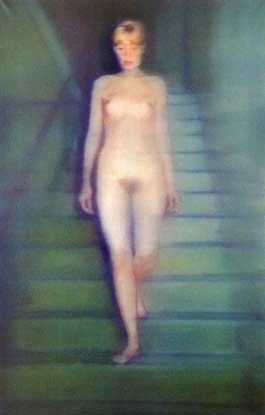
Gerhard Richter. Akt auf einer Treppe. Emma – Nu dans un escalier. 1966. Huile sur toile. Museum Ludwig, Cologne.
The paradigm shift was not limited to painting, but provided social change as a new form of expression in the arts. As in the above metaphor, the ability to shake the rules with the advent of a new medium is a latent opportunity for architecture, following Kandinsky’s dream of a great city built according to all the rules of architecture and then suddenly shaken by a force that defies all calculation.
One area where the advent of a new artistic medium provided massive reform over a field of art and various extensions into social and physical environments took place with advances in digital photography. Digital photography has redefined the values of photography. The popular belief of visual media as being a mirror of reality has been completely revised. Indeed before the digital, the subject was not that important, and any photographer was a reporter; he/she could be “good” by knowing where to look rather than passing by without noticing anything; but what has been captured in the photographic mirror of memories has its origins in a scene that had existed at a specific time. An image is not different from the represented object, but over the years its authenticity has changed. The information presented through visuals can be twisted by using specific semantic codes to attract the attention of individuals, and by re-creating a reality using digital effects. Through these means, its credibility has been questioned. We went from information to emotion, where the status of image has transcended the limits between public and privacy. Showing visuals of a private event makes this event become public. Now because of the lack of credibility in modern visuals, journalists use emotions to make spectators believe in the truth of the scene. According to the cultural theorist and philosopher Jean Baudrillard, the Gulf War disinformation made the information itself, rather than the events, the source of the scandal. 5
We now look for the credibility of the truth. Documentary used to serve as a mirror of an event until recently when its credibility was again made possible. As a recent example, during the terrorist attacks in London, individuals captured and shared media with journalists 6
By using media made by witnesses using their photo phones, journalists gained a credibility – justified or not – in the presentation of the event. Journalists could then use these media as a ‘credibility tool’ and reinforce their reports. The documentation of the London event evolved into a collaborative report; in fact, any individual who has a photo phone is potentially a reporter who can capture key events and by combining these captured visuals, create a popular visual narrative presenting the truth of an event. This shows the shift from traditional documentary to a collaborative documentary of an event.
The digital had almost killed the initial values of photography as a mirror of an event, but with the appearance of mobile digital photography tagged to a user, the digital has created a new visual medium and a new value of credibility with that medium.
Perhaps an even more direct, although somewhat archaic, example exists for the car. Before experiencing the car, people thought that we had lost something essential in ‘walking’ with the car. The car has forced us to redefine the world. Indeed, before the car, to experience acceleration one had to jump from a window, while now it is totally inbuilt in our body. The car has redefined our physical concept pertaining to objects and the sensation of acceleration 7
1William M. Irvins Jr. 1953. Prints and Visual Communication, Cambridge, Mass., 1953, p. 134.
2 Cababbe P. 1996. Duchamp & Cie, Editions Pierre Terrail, Paris 1996, p. 50.
3Rosenblum N. 1992. Une histoire mondiale de la photographie, Abbeville Eds, P259.
4Terzidis K. 2003. Expressive Form : A Conceptual Approach to Computational Design, London : Spon Press, Chapter 3 : Kinetic Form pp. 33-45
5Baudrillard, J. 1992. L'Illusion de la Fin, Éditions Galilée, Paris.
6 http://en.wikipedia.org/wiki/2005_London_transport_explosions
7Architecture Science and Technology, PICON, A. 2005, GSD personal course notes.
Thursday, March 09, 2006
Digital and virtual applications can inform our conception of the physical space
These technologies now reach across multiple generations. Furthermore, it is now common for digital technologies to borrow rules from the physical environment, extending their interfaces through tangible means. Indeed, we enter a technology cycle characterized by the disappearance of a number of boundaries that we were used to, this happens with nanotechnology, biotechnology, and information.
We are surrounded by artificial intelligence through the means of microcontrollers in our space, body and networking".1
However, an interesting dichotomy exists between the physical and digital. Despite efforts to inform digital design with physical rules, digital technologies have a tendency to drive people from the physical space. Digital applications are attracting and extending our social, community based, and physical means of interaction, e.g. gathering, friendships through online communities, diary through blogs, research online, even the way we order food. The question is: now that we have been digital, how can we return to the physical and do so by gaining the value of our digital opportunities? How can we leverage the benefits of the digital while driving new interactions within the physical environment?
Kaplan D. 2005. « Civilisations numeriques », premiere: Conquetes et conflits, InternetActu #92.
Thursday, November 10, 2005
The Strive to Capture the Elusive
From this chapter, I selected parts that found the most important for my research. It is not a summary.
Design as a term can be confused with planning. Design is about conceptualisation when planning is about realization. Design is about the stage of capturing, conceiving, and outlining the main features of a plan, as such, it always preceds the planning stage.
In Latin, the word design is about the derivation of something that suggests the presence or existence of a fact, condition, or quality. In greek, it is about incompleteness, indefiniteness, or imperfection. « Design signifies not only the vague, intangible or ambiguous but also the trive to capture the elusive »
For the Greeks, design is linked indirectly to a loss of possession and a search into an oblivious state of memory. This is antithetic with the western notion of design that is stepping in the future and frequently associated with innovation.
Innovation is associated with originality but originiality is about a point of departure. Within the modernist tradition of novelty, the search for innovation may have become a misguiding rather than a guiding factor in deisgn.
« While the shock of the new may have provided in the early twentith-century an escape from the traditions of the past, its constant us ein the world of fashion today and the everlasting struggle to introduce something new for, or as if for, the first time defies its original purpose. »
A different appearence does not necessarily justify novelty, and an original concept involves newness in a productive, seminal and influential ways. Since novelty involves the negation of existence (something that did not exist before), novelty is impossible. It is only a sensory illusion.
Then the notion of an origin as a starting point is key in the process of design. First to determines the similar producst and second that it connects to the reminiscence of something that was lost but whose consequences are still present.
Kinetic form
Terzidis K., Expressive Form: A Conceptual Approach to Computational Design, London: Spon Press, 2003, Chapter 3: Kinetic Form pp.33-45
From this chapter, I selected parts that found the most important. It is not a summary.
Kinetic form
'Kinetic is a term used to describe a situation related to or produced by motion' ; motion is the act or process of changing position or place over time. While the goal of motion may be immovability, the goal of kinetic form is to express perpetual motion through its immovable structure.
Observations : The perception of motion is relative ;
Superimposition is the act of laying or placing something on or over something else and can express motion.
Sequential justaposition : a serie of changes to a form are laid out in a sequential fashion, suggest motion by evolution, continuity.
Friction is a force that resist the relative motion perceived as motion when associated with matter and force.
Deformation can be associated with friction
Adhesion, stickiness, resistance and sluggishness suggest resistance to motion
Abscence as the state of being away and subtraction as the act of taking something away imply change since something was detached or dissappeared.
Aftereffect is an effect following its cause after some delay
Motion can be suggested to the viewer and not be literal, e.g. through metaphor or analogy like in the showing of a waterfalls without water.
Imagine a design where all is in motion. A variety of elements (geometrical form or symbolic form signifying a memory from the past) can be selected by a designer who directs the event. All the in between stages are transparent and become part of the compositional experience. The result is a moving image the behavior of which becomes the responsability of the designer.
« Kandinsky dreamed of a 'great city built according to all the rules of architecture and then suddenly shaken by a force that defies all calculation'. This dream sums up the double challenge of architecture and architectural theory today and the double challenge of computational design.(…) The architect of the past is seen as the virtuoso performer. The future architect may become the composer of symphonies in form, space, and color ».
Space and motion
Space and motion
Nietzsche : « we want to have ourselves translated into stone and plant, we want to go for a walk in ourselves when we wander in these halls and gardens ». By means of empathetic projection, Nietzsche connected architecture to events in the body.
Schmarsow : the beholder’s body is essential to our experience of space (close to the idea of Nietzsche and Henri Poincare : the body being an instrument of measurement). But Schmarsow adds the notion of movement of the body in space as an essential element of architecture.
Husserl : all spatiality is constituted through movement. The speed of the observer affects the experience of space and like for Kant, the body is the source of our notion of space. For Kant there is the Nullpunkt : « thanks to the body, I am the center of things », Husserl adds a distinction between a lived body and a physical body « In walking my organism constitutes itself (…) the kinaesthetic activities and the spatial movements stay in union by means of association » For Husserl the body is the center of space.
Merleau-Ponty : our body is not primarily in space. What we understand as the axis of up and down does not change when we lie in a bed instead of standing up. In the abstract up and down has no meaning, it only is possible through other experience e.g. gravity
Deleuze : the idea of smooth space that can only be explored by the body (resemble Husserl’s notion of Nahspharen)
Deleuze and Gattari : A nomad is distended in the region. The absolute has become local because place is not delimited. The absolute is not at a particular place but become a non-limited locality.
Post-constructivist designs based on this idea of smoothness : they spa-tialize time (related to musical notation + rhythm of flow of things as in Bergson)
Lars Spuybroek says that space must be conceived from the perspective of the moving body « Bodies try to transgress themsleves in time… connected to other bodies, other rhythms, other actions. In this sense, you can really only talk about space as a result of an experimental body timing its actions. Space is never a given ».
Motion also implies disclocation relative to a frame of reference or an outside and motion is not contained within an object in movement but in a continuous differentiating co-constitution of the frame and the mobile, e.g. the sky annalogy of Deleuze where the flash of lightening is distinguished from the balc sky but must carry the sky with it. Things with different properties must be different things, so that a hand as a detached member is not the same thing as a hand connected to the body. Then for Hegel, parts of an organic whole are inconceivable except as parts of that whole which is self contradcitory according to Moore as it assumes that the part is logically distinguishable from the whole.
Derrida radical organicism, where in the actual workd everything is bound to and conditioned by everythign else (resemble Nietzsche). Boundaries of art for instance are marked by somthing that exists beyond the work. The outside constitutes the inside, e.g. a frame in a painting. Hence the very concept of an organic unity is self-contradictory.
Jormakka, author of the paper « Instead of desinging objects with a spectacular inside but no connection to exterior systems, one needs to consider the ways the building taps into other fields of forces that are all in motion and have no clear spatial boundaries. (…) A decentered and polyvalent architectural practice will concentrate not on aesthetic totalities but on infrastructural interventions, organizational re arrangments, and a discontinuous dispersion of strategic architectural moves in the existing fabric in cooperation with other professions and interest groups »
