Showing posts with label teenagers. Show all posts

Monday, June 16, 2008

A century of evolution between La Guerre des Boutons and Harry Potter

I'd like to share the notes I wrote about a fascinating French book:
De la Guerre des Boutons à Harry Pottter by Jean-Marie Gauthier and Roger Moukakou.

In this book, two psychiatrists connect the novel of Louis Pergaud, La Guerre des boutons (English: "War of the Buttons") written in 1906 with the best seller of Joanne K Rowling (1997-), Harry Potter. The authors present a century of evolution in the teenagers’ life: their space/time structure, their relationship to a group of peers, and their appropriation of the land. The authors analyze the progression from developing concrete skills (close to the ones of adults) to an imaginary virtual world. Based on these two influential novels, a repository for this evolution, they illustrate their clinical analysis with real life scenarios of teenagers.

La Guerre des Boutons VS Harry Potter, The Order of the Phoenix movie


You can read on La Guerre des Boutons flyer: “Il y a des guerres qui durent des années, celle-ci doit se terminer avant le diner” which stands for “There are wars that last for years, this one needs to be over before diner”. For the ones who do not know this French novel, I am posting some screenshots from a movie interpretation of La Guerre des boutons made in 1962 by Yves Robert.

An excerpt from the movie can be found ->here<-

La Guerre des Boutons


Notes from: De la Guerre des Boutons à Harry Pottter by Jean-Marie Gauthier and Roger Moukakou.

Essais anthropologiques

The authors observed that the ones who usually have difficulties to talk and show some reserve towards socialization, tends to spend a long period of time on internet for remote communication. With the computer, the relationship between distance and proximity, direct communication, corporeal and indirect, mediated is transformed. It is as if these teenagers privilege a communication in which the body is absent. The authors propose that this transformation induces difficulties in sharing and exchanging across generations and difficulties in the position that parents take place in the growth of their children.

The relationship to the body
- Rhythm of lives is different. We neglect the sun’s motion in our lives! Before the industrial revolution, a rhythmic life was imposed due to the constraints of working in the field, outside! Now we eat at unstable hours, find abnormal quantity of food anytime of the day, forgetting that meals can have a social function. The social function of meals is replaced by their nutritional function.

- The physical constraints related to transportation have been transformed. We walk less, thus transforming our relationship to time and space as well as our relationship to the body: feelings, feeling tired, cold/heat or being well.
At the time of “la guerre des boutons”, children were progressively learning how to build toys, hunting equipment, using the wheelbarrow under the grand father’s supervision! Now we can be a champion in Karate without moving a finger! The measure of each gesture (cause and effect) goes through an iterative process usually explored by gathering in locations & spaces.

La Guerre des Boutons

The Land
Play is key for social & individual development, a way to measure personal skills in comparison to others at the same time than measuring one’s body, a necessary step imposed by the life as an adult.

guerre3.png

Harry Potter, The Order of the Phoenix movie

Urban concentration has reduced the children’s possibility to gather outside. The space for play and collective experience is disappearing. Not only that but the parents themselves lost their everyday corporeal connection, their craftsmanship and their personal space. These transformations impact our ability to measure the consequences of our actions; this can explain a come back of the magical thought in a world where the relationship between causes and effects is more and more uncertain. Not only the quantity of available land has changed but also its quality has decreased. Before one could close his house with doors and windows, now it is completely impossible. The house walls not only did become porous, but the family remains in communication with the entire world through telecommunication, TV, internet, mobile phone… thus interrupting the paternal order of things!
Distinguishing between the inside and the outside world is harder (this relationship becomes more and more ambiguous). Distinguishing between private, individual, internal and external realities becomes very hard.

The Group
Children have a predisposition to form groups in which learning by imitation is very important. This helps children leave the exclusive parental relationship to enter a more complex form of socialization: creating an identity and functional skills. In La Guerre des Boutons one practices his skills by crating weapons for hunting while in Harry Potter to compete with one another the children use magical formulas.
In psychoanalysis, authors such as Leroi-Gourhan, Winnicott, Mendal, Montagner, Gibbs show the importance of a psychic construction that needs to connect to the outside world, necessarily going through gesture and object manipulation. Playing without using the body, without manipulating objects is very different.

La Guerre des Boutons

Harry Potter, The Order of the Phoenix movie

Creating relationships between children is a considerable advantage as it allows children to realize early on the human’s fundamental destiny: a social being (De Waal, F. 2005). It also allows kids to find modes of learning outside of the parental relationship. The authors remark that we need to think of this child’s pleasure to group and learn in a group and reevaluate the quality of learning that can happen within the group. It is not impossible that behind this pleasure of the group, kids can rediscover values of solidarity probably essential to our humanity and that were still very present at the beginning of industrialization but that are disappearing.

With La Guerre des Boutons one would constitute a group that opposes itself to another one, but today individuals are pushed towards being identical. Solidarity as a value is the most compromised, while individuation is assimilated to the general identical. Consumer society can only live if it destroys values of sharing and solidarity benefiting individualization ...

Time and space
Important for rational thinking, time and space are constituted and function via intuition. These intuitive forms of representation are constructed progressively while the child uses his corporeal skills. Corporeal exercise has a direct influence on the essential cognitive functions (Gibs, Gauthier, Montagner).
With a computer, one can be in contact with the entire world without having moved from the parent's house. The computer is the perfect compromise between the teenager’s necessity to go outside to become independent and the necessity to keep the protection and security of the parent’s house.

La Guerre des Boutons

Harry Potter, The Order of the Phoenix movie

While in the 20th century, kids were riskily gathering outside, creating groups, risking their identity confronting others, now kids can just stay home while contacting the external world, protected by their parents. According to the Oedipian complex, teenagers have to develop their personal lives outside of the family environment [Winnicott & Mendel], the computer seem to be the perfect compromise as children avoid the risks of the foreign while being closely connected to this outside world. The teenagers can also escape their fears related to their own body in comparison to the severe criticisms induced by co-located peers! The narcissistic image remains idealized. The teenagers will not quit their bedrooms and will remain dependent on their parents, because this context does not offer a way to move physically away from the family house.

Speech
Communication technologies modified our relationship to space and time and this cannot be left without consequences on the development of thoughts. Instead of confronting peers using a verbal exchange, communication is now guided with icons that one needs to only “clic” in order to be projected in the other side of the globe. The relationship to speech in which the exchange is contrary to the magical icon formula, is a relationship of time.
This modification of the general relationship to space/time can explain the modification of our potential to take time to share thoughts. Language is more and more stereotypical and univocal (close to the marketing discourse) which appears in the political speech today (Chomsky, 1986, 1998).
The dialog with the computer is a series of keywords and reveal the transformation of the structure and use of language in our occidental society. Harry Potter is truly a hero of our time!

Transmission
To separate themselves from their parents, children need to be a minimum aggressive to distant themselves. At the same time, children need to identify to their parents.
However, parents are questioning their role models and hesitate to propose them as references to their children. So the entire reproduction of behavior and models is questioned. Speed, technological progress and the fact that children possess higher skills in tech fields such as IT, all contributed to this change in the parental role. Harry Potter and his adventures confront us to tendencies and forces, that are modified both in the parental and social space.

The hunting land and the exploration space are restricted. It is now rather difficult to find resources outside of the parental home, parental home from which one of the two parent is usually absent. Grand parents are usually distant geographically. Living conditions have changed so much that there is an unbalanced between our human potentials and the environment in which we evolve. This can explain largely the developmental difficulties of the children. The authors question how socially we can address the educational needs of children considering that we cannot go back in time!
The conditions for education have changed because parents have changed. It happened before, but this time it happened extremely rapidly and the educational methods have not evolved as much. Harry Potter raises interesting questions on how the individual maturation of a teenager is a complex and uncertain process, because of the uncertainties that rest on the transmission mechanism across generations.
Most probably the teenagers need to rediscover the joy of living in a group, the values of solidarity and the belonging to a group of peers. Wouldn’t that be what these novels of youth are demanding from adults?

La Guerre des Boutons


Posted by Cati Vaucelle @ Architectradure

Wednesday, July 18, 2007

Elisabeth Sylvan: the Sharing of Wonderful Ideas


Dr Elisabeth Sylvan

Today I attended the thesis defense of my friend Elisabeth Sylvan, now Dr Elisabeth Sylvan, from the Lifelong Kindergarten research group at the MIT Media Laboratory. Her dissertation is entitled the Sharing of Wonderful Ideas: Influence and Interaction in Online Communities of Creators.

At her dissertation committee: Mitchel Resnick, Alex P. Pentland and Peter Gloor

Abstract
This thesis presents a new framework for understanding how communities of creators share work, influence one another's creative processes, and learn from one another. I introduce the concept of Online Communities of Creators (OCOCs), which are online communities where the core activity is sharing personal creations. Using a mixed-methods approach of ethnography and social network analysis, I study two specific OCOCs: the Computer Clubhouse Village and the Scratch online community.

I analyze how ideas spread through OCOCs using the framework for diffusion of innovation developed by Everett Rogers. I map specific behaviors in OCOCs to Roger's five stages of adoption of innovation: awareness, interest, evaluation, trial and adoption. Within OCOCs each of these stages represent deepening understanding of other community members' work. The last two stages can be seen as members learning from each other. I report on how different social and project-related activities support the communities. I analyze which community members and which projects are most commonly in the trial and adoption stages. Finally I describe what creator and project factors predict influence in OCOCs.

Even though developed for two specific communities, her framework could be re-applied to the understanding of the sharing of creations within another community. It would be interesting to research on the mechanism of creation through blogs, or social communities.

Throughout her research, she analyzes the forms of participation, the mechanism of adoption of ideas and how ideas spread within the community, and finds ways to predict influence. For instance, prediction for download of user's projects happens:
1st- when the project is featured by administrator of the community
2nd- when the creator of the project has many projects already
3rd- when the creator of the project comments on projects
4th- when the creator of the project has uploaded projects recently
5th- when the creator of the project has friends, etc...

By observing a specific community, she studies how the learning happens socially.
Community members spontaneously filled in surveys that her software uses as data to generate a network visualization. She noticed that community members were developing popularity and skills that went beyond the community itself and could motivate users to later do something on the internet.

Wednesday, April 18, 2007

Flying video-taking pet?


Would you like a flying video-taking pet that follows you around? Here is a fun visionary video on the future of mobile technology for teenagers by Microsoft found on RoomWare


Video: Career in Computer Science - MS Research

Tuesday, August 01, 2006

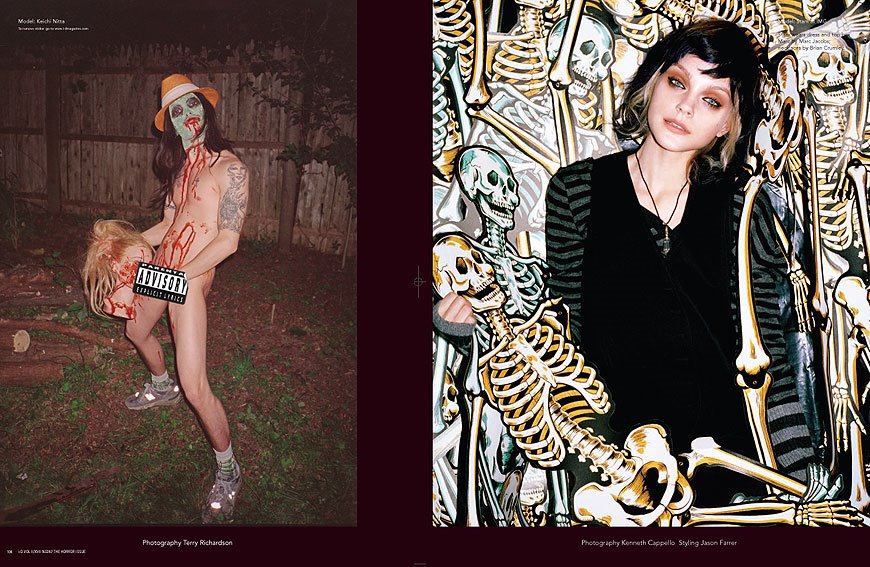
Goth youth subculture. self mutilation. suicide attempts


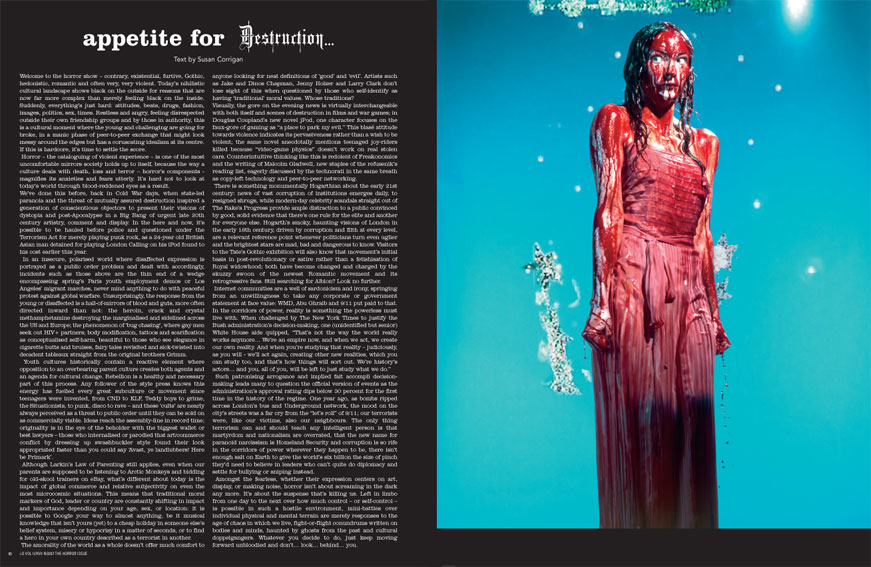
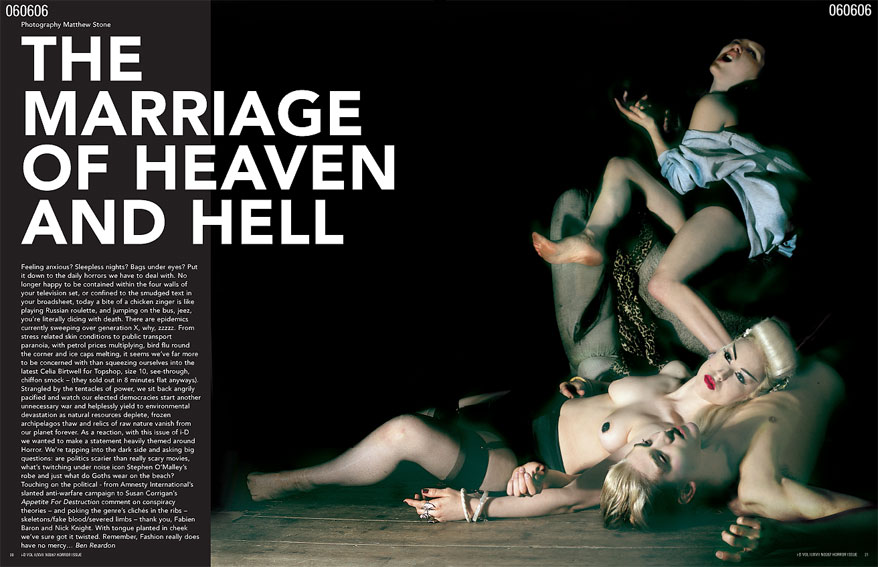
Picture taken from the magazine I-D horror issue of July 2006


A longitudinal cohort study develops on the relationship between goth youth subculture, self mutilation and suicide attempts to understand if deliberate self harm is associated with contemporary Goth youth subculture.

The paper, published in April 2006, is written by Robert Young, Helen Sweeting, and Patrick West: Prevalence of deliberate self harm and attempted suicide within contemporary Goth youth subculture: longitudinal cohort study. It is a study made with 1258 people aged 19, surveyed in 2002-4 and followed-up since age 11 (1994) in Scotland.

Identification as belonging to the Goth subculture was the best predictor of self harm and attempted suicide. Although based on small numbers, additional longitudinal analysis suggests both selection and modelling mechanisms are involved, selection mechanisms possibly being more likely.


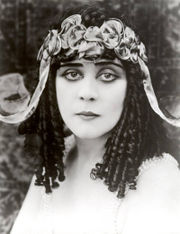
One famous female role model is Theda Bara, the 1920s femme fatale known for her dark eyeshadow, curves and smoldering onscreen presence. By Wikipedia about Theda Bara's look being an inspiration for Goth fashion.

Definition of Goth subculture by Wikipedia
Goth is a contemporary subculture prevalent in many countries around the globe. It began in the United Kingdom during the early 1980s in the gothic rock scene, an offshoot of the post-punk genre. The goth subculture is remarkable for its longevity compared with others of the same era. Its imagery and cultural proclivities show influences from nineteenth century Gothic literature, mainly by way of horror movies (particularly cinematic depictions of vampires).
The goth subculture has associated "gothic" tastes in music and fashion. Gothic music encompasses a number of different styles. Common to all is a tendency towards a “dark” sound. Styles of dress within the subculture range from death rock, punk, Victorian, androgyny, some Renaissance style clothes, combinations of the above, and/or lots of black attire, makeup and hair.


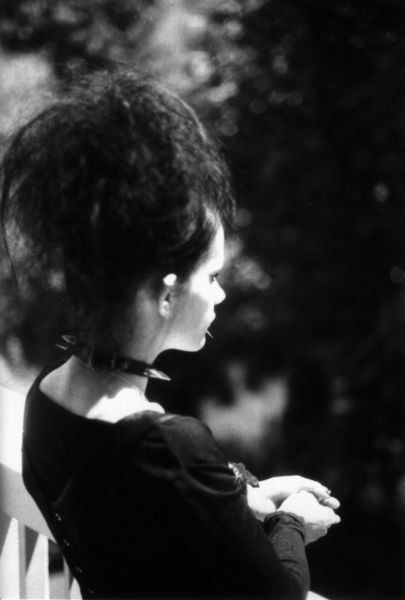
Gothic woman, traditional style, with big hair, spikes and piercings

Picture from Wikipedia, the free encyclopedia.

The reviews were also particularly interesting in judging the results of this work. A pertinent one by Mark Taubert, Senior House Officer in Palliative Medicine:
Young’s interesting study (1) claims to find a strong association between Goth subculture and deliberate self-harm before and after adjusting for confounders.

Importantly, it fails to distinguish that the Goth subculture is not easily defined or categorised, spans several continents and has evolved to include a wide range of musical and clothing styles. This contemporaneously includes Mallgoths in the US, Gogans in Australia, Dark in Latin America, Cuervos in Spain and Spooky kids and Neogoths in the UK (2, 3). Young et al should have made it clear in their discussion that any conclusion only relates to a small sample of gothic youth in the Central Clydeside Conurbation. One cannot assume that Goth youths’ subcultural trends, icons and ideals would be similar in other geosocial regions.

Perhaps not all confounders have been taken into consideration given that Young’s study was conducted in Scotland between 2002 and 2004. During this period, a Scot won ‘Pop-Idol’ (Michelle McManus) and another won ‘Fame-Academy’ (David Sneddon). Both these TV programmes were difficult to avoid given the intense media coverage. The study concludes that the causality for Goths self-harming more than, say, Pop-Fans (53% and 7% respectively) remains unclear. The exasperation with current popular cultural trends may have driven one subculture, the Goths, to drastic methods of protest, such as overt self-harming.

Could frequent, involuntary exposure to mass-produced pop music affect the mental health of one youth sub-culture population more than another’s? As Ovid states in Tristia: Est quaedam flere voluptas.


Another point of view on the paper by Andrew J Ashworth, General Practitioner:

The observed association between deliberate self harm and the Goth subculture is seen as most likely to be by self-selection. I propose a physiological basis for that self-selection that is consistent with this and other evidence and offers theraputic possibilities.

The recorded method of deliberate self-harm in this study was “cutting, scratching or scoring”: all activities that might be expected to release endogenous endorphins systemically. Those who have suffered long term trauma can be expected to have higher levels of dynorphins (chronic endogenous antinociceptives), which are opiate kappa agonists, reducing dopamine secretion in the Nucleus Accumbens and causing reduced mood reactivity. “Driving” dopamine secretion through increased opiate mu secretion through physical (eg cutting), psychological (eg taking part in dangerous activity) or drugs (eg Heroin), or by smoking (Nicotine acts directly on Dopaminergic fibres)can rebalance the opiate system by overcoming the inhibitory kappa effect to permit perceived normality. Reactivity of mood mediated by dopamine can thus be subject to behavioural control, including deliberate self-harm by cutting, scratching or scoring.


Finally, the author's reply to the reviews:


The definition of “Goth” is contentious, but covers a wide range of musical tastes, social groupings, and aesthetics. The most relevant distinction here is between contemporary (usually younger) “Baby, Bat or sometimes referred to as Mall (US)” Goths vs. “mature, real or Elder Goths” 1. Our paper, as is clear from the title, refers to younger Goths; the results may not apply to all Goths.

The range of comments in response to our conclusion, that both selection and influence mechanisms may be involve, reflect the lack of evidence on this issue. To highlight this, we drew attention in the press release following publication to the possibility that engagement with Goth subculture could have positive rather than negative consequences for some young people. Our contribution is a first step towards producing an evidence base to test this, rather than relying on media speculation.

Some contributors have suggested that the association between self- harm and Goth subculture may be accounted for by other factors. However this is unlikely, since we adjusted for the strongest and most relevant correlates of self-harm found in other studies of young people. Others have suggested that our results were not valid due to the small numbers involved. We would point out that our paper underwent a formal statistical review before publication. Further, while the media focused on the 25 young people who unambiguously identified as Goth, nearly 8% of our representative sample had identified with Goth subculture, in varying degrees of intensity, and were 3-4 times more likely to self-harm, than the other participants.

It has also been suggested that by adopting a quantitive approach we may have missed contextual factors (this is obviously true of any non- qualitative study), and that the high rate of self-harm found among Goths is a form of decoration, analogous to body modification. We dispute this on two grounds. Firstly, since those who self-harmed were asked why, we know that the majority, regardless of youth subculture did so to relieve anxiety, anger and other negative emotions. Secondly, while cutting could be interpreted as some form of subcultural display, such an argument is difficult to sustain in relation to attempted suicide.


Finally, on a hopeful note, the I-D horror issue that I bought this July 06 seems to offer a nice come back into the Goth world ...


In self mutilation and fashion