
Keep on Smoking by Michel de Broin
As an alternative to petrol, this custom-made bicycle transforms kinetic energy produced by the cyclist into smoke. The will to power is a renewable energy resource that can be recuperated by a power generator supplying enough electricity to operate a smoke machine. The work is the result of two coupled machines; the one human is productive and the other machine, consumptive. This coupling of machines produces smoke, a waste energy that is liberated freely in the atmosphere.
Video.

.............................................................................................
Blog Jouons 
Showing posts with label sustainability. Show all posts
Showing posts with label sustainability. Show all posts
Tuesday, March 18, 2008
Bicycles can create smoke too!

Friday, March 14, 2008
Recycle your equipment!
The power of digital technology fundamentally transforms our lives. Materiality is being technically extended. The digital offers another variety of artifacts that impact remembrance. While expanding our experience, some things also get lost along the path to de-materialization.
For the contextual area of my general exams I research on the attachments to physical, digital and virtual objects. I explore the psychological trade-off between what we call virtual and tangible “attachments”: I focus on people’s attachments to things, and through things, their relations to people (virtual and digital).
I investigate the journey of the physical and digital object being appropriated, collected, hacked, transformed, possessed and shared on virtual environments and communities. I review the hacker’ skills in appropriating objects by transforming it: the Nintendo Wii becomes an umbrella with a map to provide real time directions while on the walk. The Roomba becomes a robotic dog, Guitar Heroe becomes Guitaraoke Revolution a learning system!
A hacked Roomba by Hacking Roomba dot com
With the industrial revolution we lost our ability to intervene on the design of our objects. Even if the old paradigm of mass production has been thrown away, dixit Pine, I believe that Mass Customization only allows few parameters in a product to be customized. There is no appropriation of the object as in the artisan-customer relationship. That is what came to mind while I was repairing my old mac, I had so much fun opening the machine, looking for tutorial and guides, ordering missing parts just to give a life to this machine.
A bit of nostalgia maybe, but recycling and reusing laptop parts, computer parts, and any objects in general would not only be good for the environment but also recreate this sense of ownership through creative use and appropriation. That is why I am so fascinated by hackers, custom car designers and also collectors. Everything could be recycled, reused, repaired, reinvented and investigated!
.............................................................................................
Blog Jouons
Thursday, March 13, 2008
The Environmental Health Clinic

Dr. Natalie Jeremijenko, my favorite artist engineer, came to our lab to share with us her latest research. I had the chance to work closely with her in Ireland for the Save the Robots summer exhibition so I was already familiar with her past work. She presented her new work, the health clinic, a clinic to which you can go to discuss your environmental health concerns.
Natalie with her robot-talkative duck
The Environmental Health Clinic develops and prescribes locally optimized and often playful strategies to effect remediation of environmental systems, producing measurable and mediagenic evidence and coordinating diverse projects to effective material change.
The clinic works like this. You make an appointment, just like you would at a traditional health clinic, to talk about your particular environmental health concerns. What differs is that you walk out with a prescription not for pharmaceuticals but for actions: local data collection and urban interventions directed at understanding and improving your environmental health; plus referrals, not to medical specialists but to specific art, design and participatory projects, local environmental organizations and local government or civil society groups: organizations that can use the data and actions prescribed as legitimate forms of participation to promote social change.
.............................................................................................
Blog Jouons
Friday, January 18, 2008
The Den Den Mushi
Have you ever thought of inventing a new fruit? The type of fruits you find in anime can be inspiring. Slugs, insects, monsters can also be a source of inspiration for new design objects. I remember loving the Den Den Mushi, the Transponder Snail Phone, a snail that works as a portable phone in One Piece. 
A physical representation of the One Piece "den den mushi" - Photo by MJ Reyes
Well not far from these electro-snail ideas, designer Peter d'Alessandro invented a fruit, sketched a cannibal one, a fruit that cooks another fruit by working as a solar oven. This is particularly self-contained and sustainable! 
The plant cooks the fruit by working as a solar oven
Posted by Cati Vaucelle
♥ Architectradure
.............................................
Monday, November 26, 2007
Bio Battery Powered By Sugar

4 prototype bio battery units connected to Walkman for playback
Following up on my previous post kinetic vs electric toys by Sony, Sony also developed a bio battery prototype that generates electricity from sugar, similar to the method used in living organisms. Sugar is a naturally occurring energy source produced by plants through photosynthesis. It is therefore regenerative, and can be found in most areas of the earth, underlining the potential for sugar-based bio batteries as an ecologically-friendly energy device of the future.
As humans breakdown food for energy, the battery would generate electricity by breaking down carbohydrates or sugars through the use of enzymes. Since sugar is a natural energy source, the bio battery would be an environmentally friendly choice as it would dramatically reduce disposal issues with disposable batteries used today.
Test cells have generated up to 50 milliwatts, which is the highest for a bio battery of this type according to Sony. Currently, it produces just enough to power music play back on a memory-type Walkman. Thank you Got 2 be green for the source!
Friday, October 12, 2007
Windbelt: Cheap Generator Alternative
As part of the 2007 Breakthrough Awards discovered on Popular Mechanics.
Frayne’s device, which he calls a Windbelt, is a taut membrane fitted with a pair of magnets that oscillate between metal coils. Prototypes have generated 40 milliwatts in 10-mph slivers of wind, making his device 10 to 30 times as efficient as the best microturbines. Frayne envisions the Windbelt costing a few dollars and replacing kerosene lamps in Haitian homes.Video
Third-World Wind Power: First Look
Thursday, September 06, 2007
More on Theo Jansen
I recently posted on Theo Jansen for his giant kinetic sculptures, always elegant, massive and impressive with their ability to be eco friendly at the same time than resembling apocalyptic robots. Yesterday, Laura Galloway, from the TED conference, offered me to exhibit the 8 min video Theo Jansen's talk at the TED conference. The video is a must see.
Theo Jansen
From TED2007
Talk summary
Dutch artist Theo Jansen demonstrates his amazingly lifelike kinetic sculptures, built from plastic tubes and lemonade bottles. His "Strandbeests" (Beach Creatures) are built to move and even survive on their own.
Bio
Dutch artist Theo Jansen has been working for 16 years to create sculptures that move on their own in eerily lifelike ways. Each generation of his "Strandbeests" is subject to the forces of evolution, with successful forms moving forward into new designs. Jansen's vision and long-term commitment to his wooden menagerie is as fascinating to observe as the beasts themselves. His newest creatures walk without assistance on the beaches of Holland, powered by wind, captured by gossamer wings that flap and pump air into old lemonade bottles that in turn power the creatures' many plastic spindly legs. The walking sculptures look alive as they move, each leg articulating in such a way that the body is steady and level. They even incorporate primitive logic gates that are used to reverse the machine's direction if it senses dangerous water or loose sand where it might get stuck.
Monday, August 20, 2007

Saturday, August 11, 2007
Recycled Jack-in-the-Box Camera

Thursday, July 19, 2007
Eco-friendly robots

Picture of Theo Jansen work found on Myninjaplease.
I am fascinated by the giant kinetic sculptures of Dutch artist Theo Jansen, always elegant, massive and impressive with their ability to be eco friendly at the same time than resembling apocalyptic robots.
Tuesday, July 10, 2007
Floating homes

Jelly-fish 45 Habitat
The Jelly-fish 45 floating dwelling unit of 10 metres high and with a diameter of 15 meters is designed to accommodate up to six persons. It would be ideally situated in sea parks, atolls, bays and seas rich in flora and fauna. The Jelly-fish 45 allows the sea dwelling owners to live either above or below sea level in perfect harmony with the ocean environment.
It consists of five levels connected by a spiral staircase. The top level is 5.6 metres above the sea level and has been kept for study rooms. The next lower level is situated at 3.5 metres above the sea level and contains the night time zone while the next lower level at 1.4 metres contains the daytime zone with a kitchen and bathrooms. The lowest living level at 0.8 metres above the sea level is semi-submerged and has been kept for the guest room, bathroom and technical spaces.
The acrylic viewport globe situated at -3.00 mts above the sea level allows the occupants conmplete enjoyment of the submarine world. Its shape comes from the observation of jellyfishes that animate our seas with their transparent and weightless structure. The main carrying structural component of the Jelly-fish 45 is entirely constructed from plastic reinforced by incorporated fiberglass while the submarine globe is made from acrylic with a high compressive resistance.

Trilobis 65
Trilobis 65 Floating Home is a semi-submerged dwelling environment. Its 20 metres in length makes it an habitation by six people at sea. It is ideal for living in bays, atolls and maritime parks. The main aim of the project is to allow anyone to live in a unique environment through a self sufficient, non-polluting dwelling cell in unison with their ocean surroundings.

The shape of Trilobis 65 allows the annular aggregation of more
modular units, creating island colonies.

Wednesday, November 02, 2005
Encouraging sustainability at home!
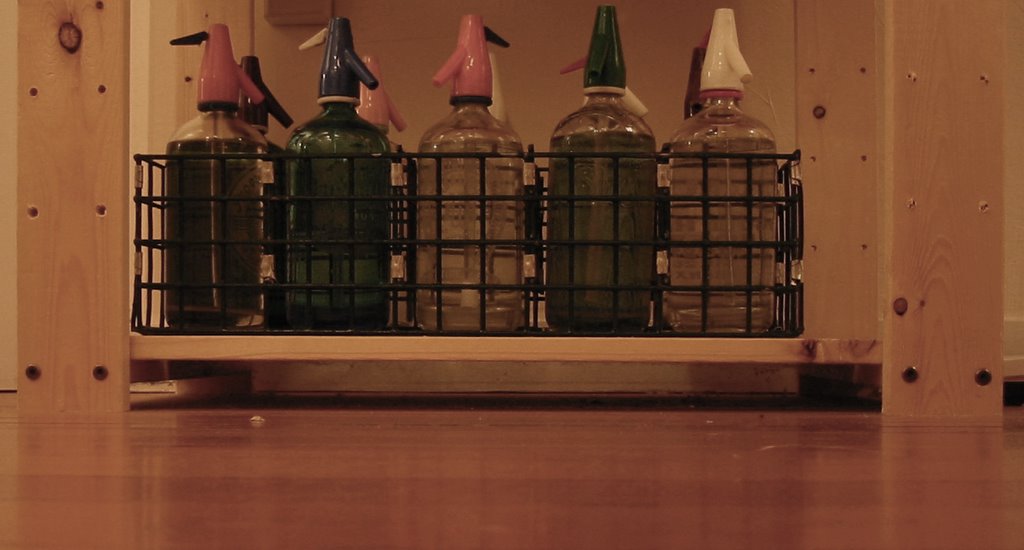
Our, Lauren my roomate and I, bottles of sparkling water made by people around here: pure sustainability :D
By Cati in 'home design'
Subscribe to:
Posts (Atom)
