Keep in Touch designed by Nima Motamedi at Simon Fraser University, Canada, is a networked fabric touchscreen designed to support and maintain intimacy for couples in long distance relationships. To achieve this she created a novel sensorial interface by combining the visual and tactile senses together. Each partner is presented with a blurred digital projection of their lover. When they touch their partner's body, the image comes into focus revealing their features.
In the paper presented at TEI in 2007, the authors describe how this sensory mapping creates an expressive and emotional interface allowing couples to communicate through touch, gestures, and body language.
See also her paper: The aesthetics of touch in interaction design!
See also Mutsugoto by Tomoko Hayashi, Stefan Agamanolis and Matthew Karau.
.............................................................................................
Blog Jouons 
Wednesday, May 07, 2008
Keep in touch: a tactile-vision intimate interface


Monday, November 05, 2007
Monday, October 29, 2007
High touch visual

Hoehenluft by Pixelgarten
Tactile shows how graphic design is moving into three-dimensional objects and products. The innovative examples documented in the book TACTILE – High Touch Visuals, distributed by Die Gestalten Verlag, demonstrate how designers are developing and implementing their ideas spatially from the very outset of a project. Tactile proves that spatial innovation in graphic design is not limited to personal work or artistic endeavours, but is being sought out more and more often by commercial clients, for example, in store design.
Wednesday, September 26, 2007
A stretchy fabric controller
Created by Angela Chang, Zstretch is a fabric device that can capture the richness of active touch interactions for controlling music interactions. Much of the prior work on integrating electronics with textiles focused on rigid, exact places for touching the fabric, rather than supporting the many actions our hands and bodies can create. The project explores how to support the large range of forces that people apply when interacting with fabric.
Paper for Nime 2007
Thursday, July 19, 2007
Scarf with electrically operated massager
Scarf with electrically operated massager United States Patent 6537235, by Connor, Clara (Fountain Valley, CA, US) and Busto, Ernest J. (Cypress, CA, US), March 2003.
A combination massager and scarf assembly having a number of electrical motors secured in a flexible casing, which flexible casing is removably secured in the interior of the scarf. The scarf is wrapped around the flexible casing and the motors in the casing are electrically connected to a control box having an A.C. or D.C. power supply to actuate the electrical motors. The control box includes a knob to regulate the speed of vibration of the motors.

Tuesday, June 26, 2007
Undercover

I recently spent time with friends Jean-baptiste Labrune and Dana Gordon these past two days, and we had awesome research discussions about the future of HCI! Dana Gordon explained me her fascinating projects and I loved her Undercover blanket.
The Undercover contains 24 wireless speakers and provides a special physical sound experience. The Undercover allows you to enjoy the vibrations of the speakers on your body and provides a private mobile soundscape.
The blanket has an embedded array of small speakers that can receive a wireless audio signal via a Bluetooth connection. This audio signal can be beamed from any kind of audio device, such as mp3 player, television, computer, radio, etc. The volume controllers were designed in a way, which suits the blanket’s natural cuddling behaviour. The upper corners (A.K.A 'the blanket’s ears') control the volume - (pull the right one for higher volume and the left one for lower).

Thursday, May 24, 2007
Secret under my skin

Today I met with Valerie Bugmann who works on the e-Skin project. She shared her ideas about the perception and simulation of touch for visually impaired persons.
I discovered her performance works and especially liked Secret under my skin. "With the Skin-to-skin communication the body stands as a medium between the technology and the world. In the performance, the participant exteriorizes inner thoughts by inputting them into the keyboard and interiorizes them into the body again with the use of Skin-to-skin communication for the purpose of transmitting them personally by touch to the performer."
The performance takes place in the room of secrets where a skin-to-skin communication network is employed. Here, the performer and the space await the opportunity to become alive through the interaction with the participant who comes to intimately confess/convey a secret by touch. A lighted keyboard floating in the darkness invites the participant to type a secret into its glowing keys. Once typed out, by simply touching the keyboard the secret is reintroduced into the participant’s body in the form of its new physicality – an electric wave. The secret, now flowing from the keyboard into the participant’s body is ready to be further transmitted/confessed to the performer by touch. Once skin-to-skin contact is established with the performer, the participant will be able to see his/her secret revealed on a wearable display on the performer’s body; the participant is then confronted with a very intimate part of him/herself. Despite the secret being displayed on the performer, it remains unread by anyone expect the participant, or has the performer – this almost inert object of inscription, desire and redemption - actually become aware of the secret through the transmission?
Skin-to-skin communication, as a suitable technology to express intimate thoughts, generates an intense effect as we recognize ourselves as part of the other through touch. Secret under my skin brings together different notions and implications of touch in this confession-like context, exploring new behaviors and novel parameters of social interaction that can develop out of this contact.
Touch: a meaning system socially and culturally located
Today, I met with Anne Cranny-Francis based in the Department of Critical and Cultural Studies at Macquarie University. Her web site is a great ressource of references, hyperlinks to papers related to the meaning of touch.
I presented and discussed my research on touch simulation for persons with neurological and pathological disorders. She works on the touch project to understand touch as a meaning system that is socially and culturally located. "The project is concerned with the diversity and specificity of touch as it is experienced by people in their everyday lives. Touch is one of our fundamental ways of negotiating the world and each other. It is specific to different genders, classes, cultures, ages – for all of whom the same physical touch may mean very different things."
She wrote a paper The Midas Touch to re-think the representation of touch. "Its essential argument is that touch defines our being in the world, so that touch is always already a cultural and political practice."
A must-read paper for me as soon as it is published: somatic technologies
My argument is conducted via a series of encounters: a reading of the figure of Christ’s body in late Middle Ages devotional texts, in which the hybridity of Christ is both celebrated and fetishised; the recent appearance of hybrid and cyborg figures in the Stephen Sommers’ film, Van Helsing (2004) and the excess of religious (mostly Christian) references throughout the film; and a mapping of the homologies between the figures of Christ crucified and Sommers’ representation of Dracula, which suggests their interrelationship. This paper is based in a belief in the inextricable relationship between embodiment and the technologies (material, cultural and political) that generate it, the semiotic density of those technologies, and their iterative deployment to generate new ideas – about technology and about embodiment.
Wednesday, May 09, 2007
Social affective touch for robots

My past research on psychohaptics and taptap at the Tangible Media Group, MIT Media Laboratory, involved studying the perception of touch, and how people relate affectively to haptic sensations. Today, Dr Cynthia Breazeal who leads the Robotic Life research group at the MIT Media Laboratory addressed the question of social affective touch. Her main theme is to build cooperative machines that work and learn in partnership with people.
Today at the h2.0 event -new minds, new bodies, new identities- she presented her latest research including the robotic companion. The robotic life group explores social affective touch and develops machine learning algorithms to categorize various sense of touch, from pleasant to annoying ones. Exploring the sense of touch and interpretation of touch by robots is a new area of research.
The robot is designed in the form of a bear, the bear being a universal symbol of comfort. The robot itself is covered of silicone skin to not feel like a machine when hugged. In their first experiments, the robot had local intelligence, local sensing and response, coordination. An operator could communicate with the bear to a 3d bear model on a screen.
Applications behind this work could be for family members to be able to play from everywhere, to bridge the usual generation gap between grandparents and grandchildren, to allow people to remain in contact while separated. This is especially important when a child is spending a day at the hospital alone and what it means for the parents to be able to stay with the child remotely.
Another high vision for this work is to allow collaborative partnership using a remote tutor. Cynthia mentioned that eventually the bear could be highly trained and could offer high quality education to the ones who usually are not exposed to such education.
Wednesday, April 04, 2007
Clothing with memories

For my sculpture class, I created a dress that works as a low-tech magnetic tape of tactile sensations. I vaccum formed hands, objects, textures throughout the fabric of a dress I made in transparent plastic.
I depart from scarring on the body: tatoos, percings, scarves in our western societies. I am looking for envelops: mental but also physical. These envelops that people try to create after traumas. I want to represent these envelops in a sculptural form.
I would like to create a skin shell, in the form of a coat, that can be worn. A skin shell that is a souvenir of a previous body and that was left out. This skin shell that showcases traces of influences, people, and objects. Yet I want this skin to be vulnerable, fragile. A skin that tries to protect, to be useful and accepted. I also want the skin to be obvious and a showcase of its internal fight.
I like the vinyl raincoat metaphor because it protects against the rain, but it does not comfort, nor does it contain. It does not isolate, because it is transparent. It feels vulnerable. I was envisioning creating clothing elements in transparent vinyl / PVC / plastic. Vinyl could symbolize the material used for the outside against the rain. Clothing and fashion, the showcase. A coat could work as to represent the cocoon, the shell, a protection against the outside.
I mold objects, textures, persons within the transparent pieces of clothing, objects that have been internalized and been forced to appear for a showcase. It has to be a mess of objects, or organs or things that can show the violence of the showcase done onto someone.
Because I want this sculpture to be a left over of a fight, I want it to be left on the ground, like an animal mutation. Yet in this case it could also be re-worn and re-appropriated.
Thursday, January 12, 2006
Taptap, the affectionate scarf
TapTap: A Haptic Wearable for Asynchronous Distributed Touch Therapy
I continued the development on my conceptual idea touching memories and as a team we came up with a final prototype called 'taptap'.
TapTap is a wearable haptic system that allows nurturing human touch to be recorded, broadcast and played back for emotional therapy. Haptic input/output modules in a convenient modular scarf provide affectionate touch that can be personalized.
Movie of Taptap
This picture shows the second prototype that is a scarf with large pockets with a power supply. The design of the scarf is intended to make it wearable in a number of ways and allow specific TapTap actuators to be mounted wherever the wearer desires. The outside of the scarf is a public color (gray) while the inside and its intimate actuators are a warm color (pink).
Based on haptic devices, taptap can be re-configured to record and play back the touch that is most meaningful to each user. It is made from felt in two layers: one grey one that faces the public and a pink layer that touches you and contains the haptic modules in specially designed pockets. Taptap can be worn as a regular scarf, and custom touch modules can be placed in powered pockets within to record and play back touch where and when you want it
Taptap was blogged by Regine Debatty on we-make-money-not-art.com with a nice summary and useful references :)
Taptap is a team and class project for the Tangible Media class final assignment at MIT Media Lab taught by Dr Hiroshi Ishii. I presented with Leo at CHi'06 as an extended Abstract of Conference on Human Factors in Computing Systems (CHI '06), (Montreal, Quebec, Canada. April 22-27, 2006) by Bonanni, L., Lieberman, J., Vaucelle, C., Zuckerman, O. (alphabetical order). Download pdf.
Taptap was part of the second Seamless fashion show, on February 1, at the Boston Museum of Science.
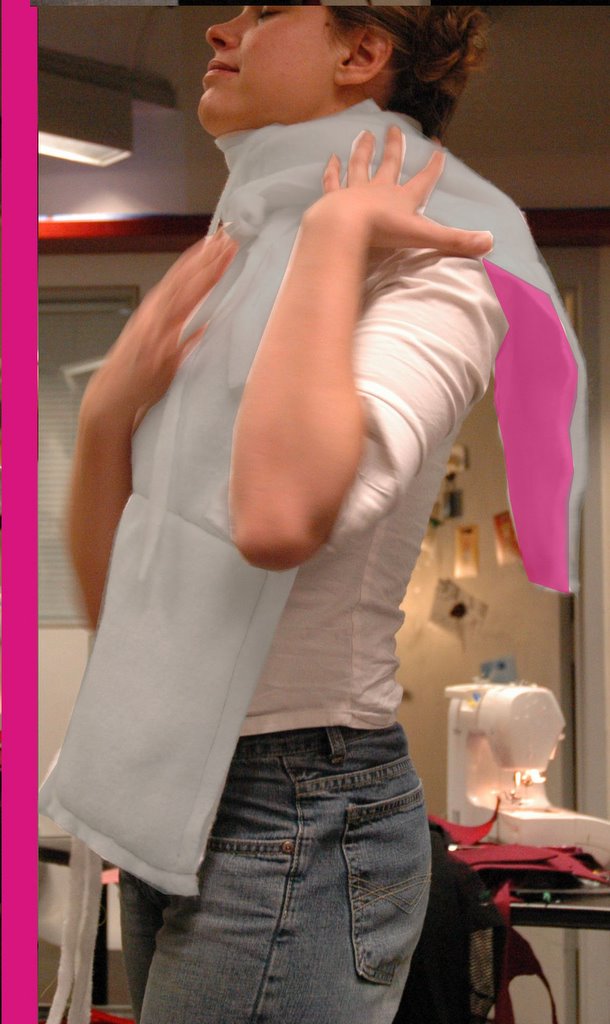 On this picture, I wear a second prototype
A few publications on Taptap and its next steps:
. A Framework for Haptic Psycho-Therapy Published in the Proceedings of IEEE ICPS Pervasive Health Systems Workshop, Lyon, France, 2006.
. Affective TouchCasting Published in the Proceedings of SIGGRAPH'06, Boston, USA. Abstract from publisher: ACM Press. Download pdf
Thursday, November 17, 2005
Touching memories

Touch is at the heart of intimate relationship. It is also a powerful trigger of past emotions. Touching memories is a system that detects and records a touch by a loved one. Be it a stroke, a pat, a hug, or a rub, the system will store the touch and play it back to you whenever you need it
This project is in its conceptual phase.
