I came across the concept of a Scentsory phone by Nokia on Gadgettastic. The phone uses the human senses of sight, sound, touch and even smell for an ultimate multi-sensory experience. It could detect, transmit and emit smells, as well as radiate colors, lighting, and temperature from the caller’s environment. Its electronic nose works with highly sophisticated (i.e. unknown) sensors. The nose samples the odor of the caller’s environment and transmits this to the recipient electronically. 
Nokia Scentory Phone
Smells' detection and re-creation is a fascinating topic today most probably because it is still very hard to achieve technically. Last year I started developing the Odora Storyteller, a smell collector. It encompasses the experience of the everyday collector and creates an associative memory of smells, places and objects. The prototype was conceived for children to collect samples from their environment. The children can reveal and create associative connection between smells, textures and visual components of elements that they gather. The collected elements are then used to create and recall stories. I also envisioned this for persons suffering from Alzheimer's disease. People with Alzheimer’s could benefit from associative memory between smell and souvenirs of places.
Apparently it could work due to "distinct genetic patterns that are associated with every odor, and it’s simply a matter of matching electrical harmonics with gene activity" sounds like the equipment involved in this affair would go beyond the portability of such device. Could the perception of a smell by electrical stimulation be technologically induced? 
.............................................................................................
Tuesday, February 19, 2008
The sense of smell in interaction design

Tuesday, February 12, 2008
New interaction design for mobile phones

Smartphone Battle by Bill Bagnall
Posted by Cati Vaucelle
♥ Architectradure
.............................................
Monday, November 05, 2007
Phones

Photo by James Bowskill
A phone that seems to come out of L'Odeur de la papaye verte (Cyclo).
Photo by Patrick Gries
This one is more for a need that I witness around me! Adjustable isolation space by Robert Stadler.
Apparently one can notice a need for blocking out all peripheral sensory distraction while talking on the phone, hence the Auger-Loizeau's Isophone.
Sunday, April 29, 2007
Tilt and feel
Shoogle, created by John Williamson, Roderick Murray-Smith, Stephen Hughes at the University of Glasgow, UK, is an interface for sensing data within a mobile device.
It is based around active exploration: devices are shaken, revealing the contents rattling around “inside”. Vibrotactile display and realistic impact sonification create a compelling system. Inertial sensing is used for completely eyes-free, single-handed interaction that is entirely natural.
Download the Shoogle's paper for Chi 2007
Video of Shoogle
Stephen Hughes was previously a researcher in the Palpable Machines research group with Sile O'Modhrain at Media Lab Europe. The group published key papers on vibrotactile display and mobile multi-modal interfaces.

MESH an iPaq running a simple tilt-driven maze game by the Palpable Machines group
SuiPo: the interactive poster


The interactive Poster “SuiPo” by Fuminori Tsunoda, Takayuki Matsumoto, Takeshi Nakagawa, Mariko Utsunomiya, East Japan Railway uses a combination of IC card ticket Suica and Internet accessible mobile phone where customers can get e-mail information by touching their IC card ticket on the reader located near the poster.
More on SuiPo
Tuesday, February 27, 2007
With - an emotional communication device

With - an emotional communication device - was selected as part of the Next-Gen PC design Competition organized by Microsoft and International Council of Societies of Industrial Design in 2006-2007. The device is designed for family members who live separately and to communicate over the internet. It is designed with the objective to convey emotions with the assumption that current technology interfaces are made too complex. The device resemble everyday objects (eggs, egg carton) to be familiar thus easy to use. The shape of the pillow is made "huggable" to offer a comfortable interaction.
A lot is being done in product design regarding remote communication using devices. Not so much attention is given to digital interaction using these devices (from a product design perspective). Because these objects are made interactive, I wander how the form factors can really match the technology outcomes. How do product designers think the functionalities of the interactive parts of the proposed objects? I liked the following example because it kept its product-like justifications even though it did not really address the interactive components. Instead it presented how people will use the designed generic tokens in relation to three main internet functionalities: talk, mail, play.
Small egg shape tokens called Identcons play a key role in this proposed emotional communication.
Each of them represents a person's identity.
The objective of With is to respond to growing need for a new, human-oriented communication device that conveys emotional qualities and solidifies people’s relationships by sharing their emotions.

Thank you Idealist for the link!
And thank you Microsoft, IDSA and ICSID for the pictures of the Design Competition.
Friday, February 02, 2007
Nokia concept phone

This was the 1st prize project done for NOKIA 4G mobile concept competition. It incorporates a scrowlable lcd screen, with touchscreen technology and allows to adjust the space on screen to each function you want to use like video conference and internet navigation at the same time. One main button controls the primary functions. All others are acessible on the screen. Modeled in Rhino, rendered in Studio Tools.By Hugo Danti
Found on idealist
Monday, October 24, 2005
From Nokia to Vertu
Nokia, from cell phone manufacturer to ...
Nokia has developped 24000 dollars high end luxury phones ... vertu
It raises the design aspect, it is hand craft like a high hand brand. The idea here is to propose the newest material and a taylored service, same idea than Gucci, you buy a Gucci because you try to reach the high end.
'Vertu was born from an obsession to create a personal communication instrument that deployed craftmanship and technology in a way that had never been achieved before'on Vertu's website
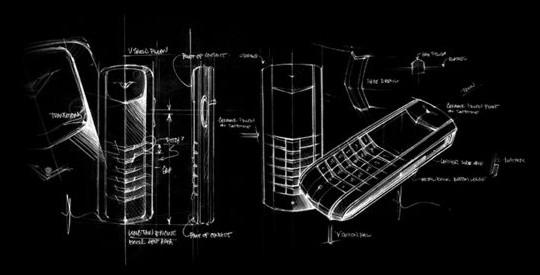
From the product design, GSD course 2315
