
A costume that controls a video presentation by truth dare double dare
A zipper that turns on/off the light!
Or Rainbug, a raincoat that relies upon the natural gesture of the young wearer to interact and transform butterflies into flowers!
Showing posts with label wearable. Show all posts
Showing posts with label wearable. Show all posts
Tuesday, November 13, 2007
Tech outfit communication

Monday, July 30, 2007
The SynchroMate
The SynchroMate fits snuggly in the palm of one's hand (...) it encourages serendipitous synchronous interaction by indicating when a message is being composed for you by a distant companion through gentle vibrations and pulsing concentric circles of lush colors on the display

SynchroMate: A Phatic Technology for Mediating Intimacy, by Martin R. Gibbs, Steve Howard, Frank Vetere, Marcus Bunyan (2006)
Abstract
By and large interaction design has been concerned with information exchange - technologies for the collection, processing and transmission of informational content. This design sketch discusses preliminary ideas about an alternative way to think about interactive technologies - phatic technologies - that are less concerned with capturing and communicating information and more about the establishment and maintenance of social connection. Drawing on insights and inspiration gleaned from a recent field-based study of the role of interactive technologies within intimate relationships we outline our preliminary ideas concerning technologies to support phatic interaction. Using materials collected during our fieldwork as design inspirations, we developed design sketches for phatic technologies intended to support playful connection between intimates. One of these sketches - SynchroMate - is presented. SynchroMate is a phatic technology designed to mediate intimacy by affording serendipitous synchronous exchanges.
Full case study
Thursday, May 24, 2007
A wearable artificial skin


"Our own skin and hair is the largest organ of the human body: a tactile reactive interface which special metaphorical connotations of communication and sensitivity." M. Lappe and J. Holt.
The e-Skin project aims at developing a novel type of wearable interface which mimics the sensory capabilities of the human skin. The interface consists of a multilayered flexible hightech textile and senses stimuli both on its outside and inside surface. At the same time the interface possesses actuation mechanisms to provide tactile feedback through its inside and outside surfaces.
"The ability of the skin to acquire and process information rivals our senses of sight and hearing."
e-Skin is a research initiative to create an interface based on the modalities of the human skin (temperature, vibration, pressure, proprioception). It is a tactile interface consisting both of sensors and actuators, a wearable artificial skin and a navigation aid in space.
Wednesday, May 23, 2007
Psychophysical Elements of Wearability
Looking for references on the relationship between specific mechanisms of the body and wearable computing, I never accross anything relevant to my research. During Chi 2007, I discovered the work of Lucy Dunne: Psychophysical Elements of Wearability. She has a large number of publications on the subject and her research is fascinating.
My primary research focus is wearable technology design, a new field that is only recently beginning to gain direction and depth. As a functional apparel designer, I approach wearable technology with the goal of expanding garment functionality through use of technology. One of the most useful and salient applications of technology to garment functionality is in the area of body sensing: knowledge of the physical, emotional, and situational state of the user is essential to many next-generation computing applications, particularly in the areas of ubiquitous computing and adaptive information delivery, as well as the more direct areas of medical and sports monitoring. However, while many sensing technologies are predominantly well-established and reliable, they have also emerged from an engineering tradition that rarely includes the geometric, dynamic, cognitive, and emotional unpredictability that is the human body.
One of the most significant themes in my work has been the importance of designing truly wearable technology: defining the elements that influence wearability and overcoming the technical challenges of gathering data in a comfortable and unobtrusive manner. Most of my recent work has been applied to deducing the position and movement of the human body by detecting forces and bends in worn garments, with a wearability focus on moving sensing technology out of the electronically reliable but often awkward and uncomfortable medical standard and re-designing it to function adequately in “normal” clothing.
My doctoral dissertation, Wearable Sensing of Body Position and Movement Through Body-Garment Interactions, establishes the psychophysical elements that comprise “wearability” of technology and argues that in wearable technology, the influence of wearability extends to the user’s physical functionality, cognitive processing, and acceptance of innovation in worn artefacts. The design considerations that are established in the theoretical portion of the work are then applied to the problem of sensing the movement and position of the human body by detecting the shape and dynamics of worn garments, rather than by sensing (unwearably) the body itself. - Lucy Dunne
Saturday, September 09, 2006
Pocket-sized psychology studies
Pocket-sized psychology studies: exploring daily diary software for palm pilots.
By Le B, Choi HN, Beal DJ. In Behav Res Methods. 2006 May ; 38(2): 325-32
Abstract
Daily dairies, also known as experience sampling methods (ESM) or everyday experience methods, are a common methodology utilized to provide insight into momentary psychological processes. Traditionally, such studies often have utilized paper-and-pencil surveys administered several times each day over a span of several days or weeks. However, advances in technology now allow these studies to be conducted using palmtop computers (i.e., personal digital assistants; PDAs). Three software packages for running these studies on the Palm operating system were explored and compared on a number of features Specifically, ESP (Experience Sampling Program, by Feldman Barrett & Barrett, 2001), iESP Version 3.2 (Intel Experience Sampling Program, by Intel Research Seattle & the University of Washington Computer Science and Engineering Department), and PMAT Version 2.0 (Purdue Momentary Assessment Tool, by the Military Family Research Institute at Purdue University) were examined, with their key features compared. These advances in software for running diary studies include a number of features that provide researchers with methods and information previously unavailable in diary studies and may expand the range of possibilities in diary study designs.
In psychology & wearable technology
Wednesday, April 12, 2006

Friday, February 10, 2006
Taptap and its next steps
The Seamless Fashion show has presented Taptap a project I team-developped for the Tangible Interface class at MIT Media Lab. Previously called Touching Memories, it is about the possibility to record memories of touch.
I cared about recording affectionate touch rather than touch used during physical therapy or learning. Trying to find a potential application for this concept, I remembered the urgency in the need of nurses during war; during such event orphans, especially young babies, need a certain amount of hugs to survive. The scarf was then an attempt to overcome this problem. It could be used as a platform for the nurse to hug many children at once and help them survive. After discussing with Leo about this application, he has found some research on baby monkeys in relationship to an artificial mother. Regarding the design and this application in mind, I wanted the sensory object to be a scarf to easily position the sensors where and when needed. The modularity also offers the potential for the scarf to be independent from the electronic as much as the electronic to differ from the scarf and have a life on its own.
We have written a work in progress paper for CHI'06 about Taptap that has just been accepted. We are now discussing with health care department about the next steps of our system.
In the meantime, Taptap has been exhibited at the Seamless Fashion Show in Boston.
The following in a slideshow presenting the pictures I took of the fashion show
Photos during rehersal and also more photos during the fashion show.

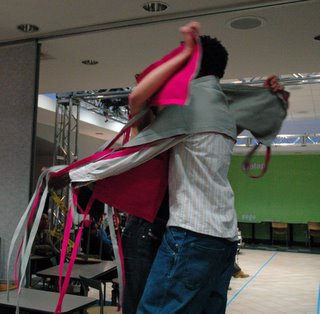
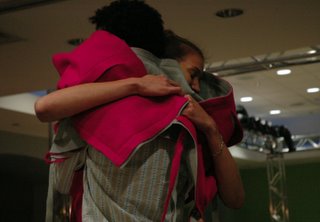
Models: Lauren and Joy
I cared about recording affectionate touch rather than touch used during physical therapy or learning. Trying to find a potential application for this concept, I remembered the urgency in the need of nurses during war; during such event orphans, especially young babies, need a certain amount of hugs to survive. The scarf was then an attempt to overcome this problem. It could be used as a platform for the nurse to hug many children at once and help them survive. After discussing with Leo about this application, he has found some research on baby monkeys in relationship to an artificial mother. Regarding the design and this application in mind, I wanted the sensory object to be a scarf to easily position the sensors where and when needed. The modularity also offers the potential for the scarf to be independent from the electronic as much as the electronic to differ from the scarf and have a life on its own.
We have written a work in progress paper for CHI'06 about Taptap that has just been accepted. We are now discussing with health care department about the next steps of our system.
In the meantime, Taptap has been exhibited at the Seamless Fashion Show in Boston.
The following in a slideshow presenting the pictures I took of the fashion show
Photos during rehersal and also more photos during the fashion show.


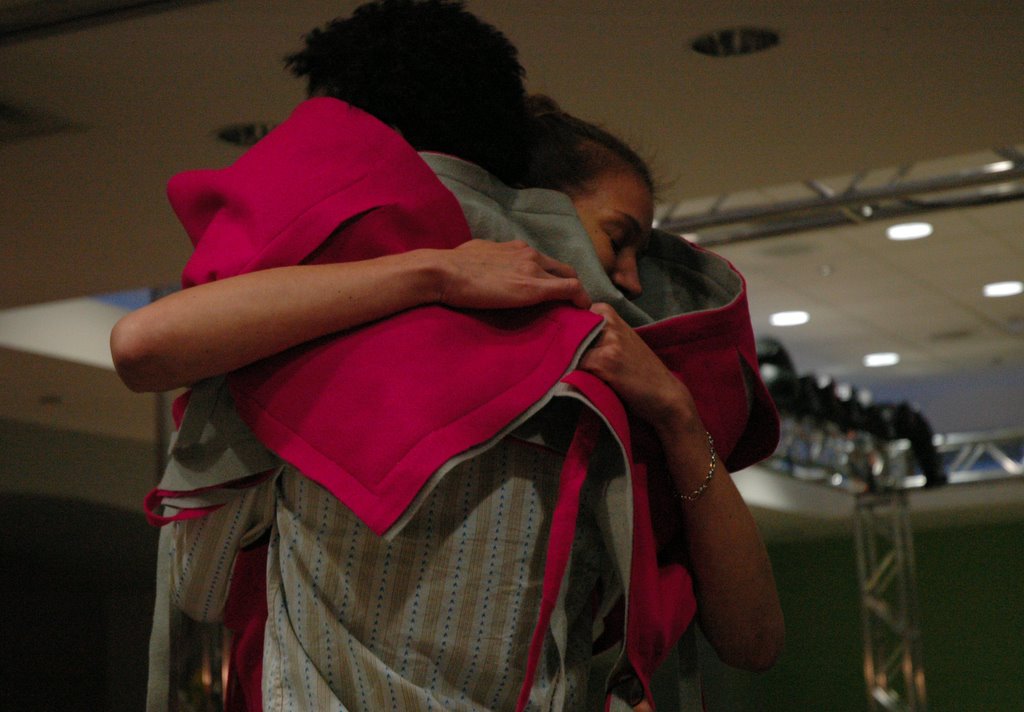
Models: Lauren and Joy
By Cati in computational product design
Subscribe to:
Posts (Atom)
