Sunday, May 14, 2006

Stelarc's work as haptic psycho therapy?


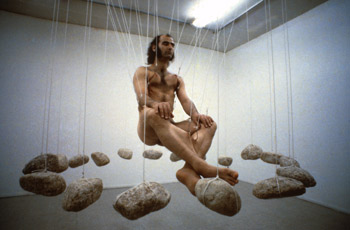
Stelarc, 'Sitting/Swaying: Event for rock suspension', Maki Gallery, Tokyo, Japan 1980. Courtesy the artist and Sherman Galleries, Sydney

The artist Stelarc creates medical instruments that could be interpreted as masochistic tools. As an example, he explores connections with the body by inserting hooks into his skin. Although not intended for therapy, I believe that the ideas about controlled pain, as in Stelarc’s installation, could serve as a support to treatments for pathologies where the patient is prone to self mutilations. By providing a controlled painful stimulus, the patient could ground his mind and overcome the dissociation he suffers from.

Electroconvulsive therapy involves passing sufficient electricity through the brain of a patient, such that a seizure is induced in the patient. It is currently used as a last-resort for individuals with tendencies towards self mutilation. Also, in some conditions, electroconvulsive therapy is implied for treatment of depressive disorders. In electroconvulsive therapy the patient is passive and receives the stimulus delivered by another person. However, the opportunity of haptics is that we are able to better specify limits where the patient can administer their own stimulus and gain both import and control on their own therapy.

In haptic research

Thursday, May 11, 2006

Kendall Roses


Leonardo Bonanni and I were finalists in the Kendall interactive design competition with Kendall Roses. The competition Kendall Square Interactive Design competition was organized by Lyme Properties.

Based on my previous research Passing Glances (2002-2004), the Kendall Roses are designed to be an autonomous art installation that brings added value to the Kendall Square community. Bright, inexpensive daytime displays on two towers and the ground fulfill the role of the roses to provide compass directions to local attractions through graphics and text on billboards and the ground.
Data to the Roses is entirely wireless: SMS, internet and a local database are streamed to a wireless server inside each tower from local hotels, businesses, residents and the World Wide Web. In addition to useful information about local businesses, sports and attractions, the Kendall Roses offer opportunities for families and children to play on an interactive ground display that can project a variety of games. After an initial investment and potential partnership with local businesses and telcos for promoting SMS messaging, the towers will generate income primarily through advertisement for local businesses and as a tax credit for displaying public service announcements relevant to the community.

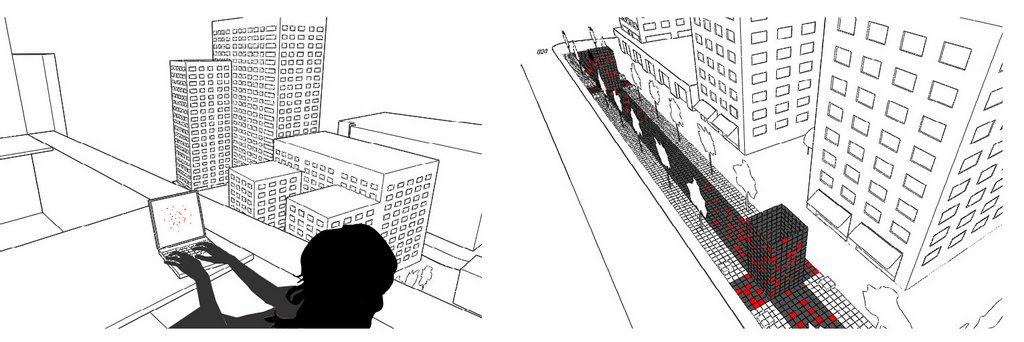
Some screenshots of the Kendall Roses interaction movie:


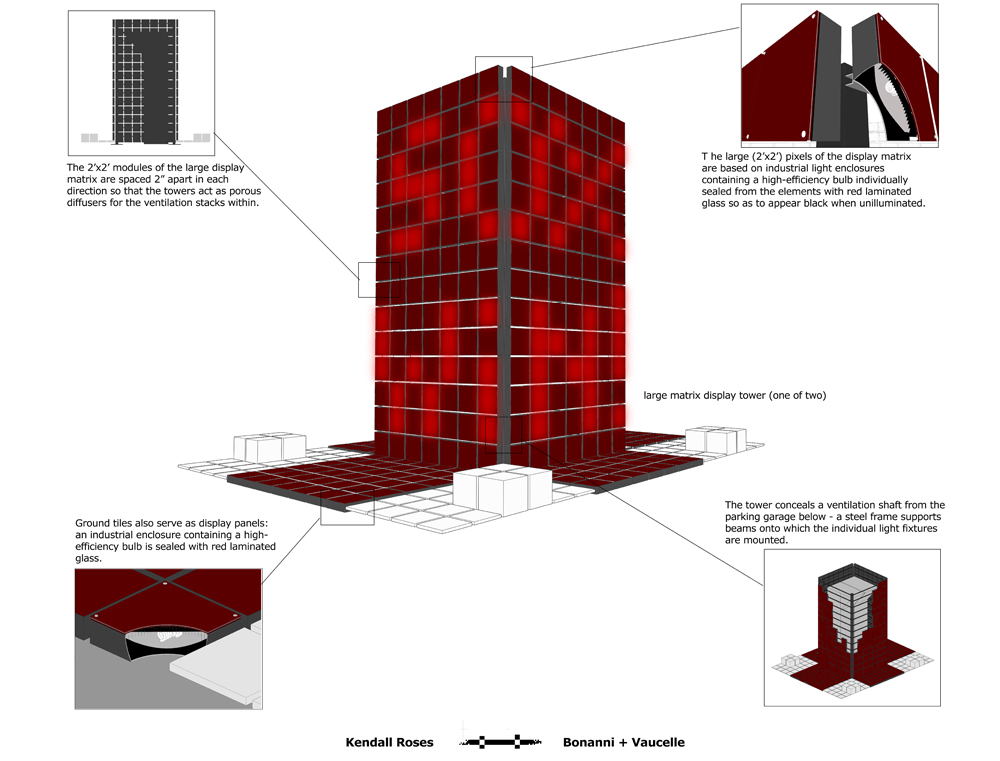
Details of the architecture


Plans of the Kendall Roses site


A movie of our entry


If it does not appear above, clic here
In personal work

Wednesday, April 26, 2006

CHI 2006 report


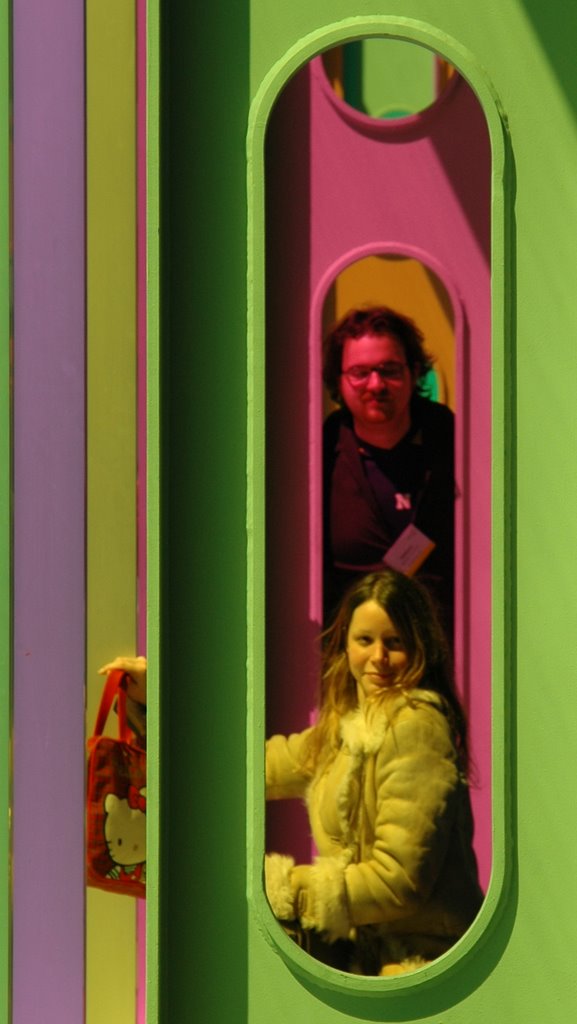
The spirit of CHI 2006, full of colors, nice people and nice food. This picture features Matt and I, and I must admit Leo has taken the best picture of all!

So I am in Montreal for the CHI'06 conference. I present with Leo two of our collaborative projects Playpals and Taptap.

I attended the Real World Design Solutions session and was impressed by the
Experience Report on The Design of a Tangible Interaction Device to Alleviate Anxiety and Pain in Paediatric Burns Patients talk presented by Sam Bucolo from Queensland University of Technology Australasian CRC for Interaction.
News from the CRC on this project

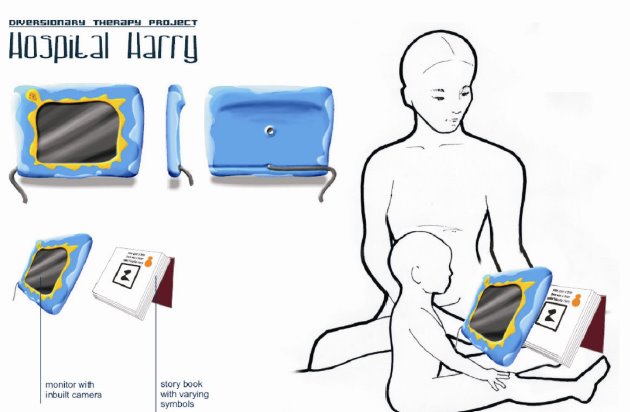
One of the author presented a case study on the design of a tangible media device to alleviate anxiety and pain in pediatric burns patients. He worked with a multidisciplinary interaction design team throughout the research. He presented his encouraging results of an initial study of the device within a clinical trial.


The initial design sketches from the paper

The main questions on that work for me is to know how the mechanism work, if it is 'distraction' that patients experienced or if this is another mechanism. What if the graphics displayed on the screen were not aesthetically pleasing, would this aspect change the results of the study? The novelty of the device, its amazing graphics and scenarios maybe have impacted the results. ALso maybe the kinesthetic experience can impact the patient in a different manner than just 'distraction' that can be done by interacting with any kind of device.
This is to me an interesting step in building devices for hospitals in the form of a psychological support to strong pain killers medicaments.

Saturday, April 15, 2006

Selection of short animation movies

This semester, I take the Harvard Animation class, a VES course at the Faculty of Arts and Sciences, taught by Ruth Lingford.
Yesterday during our weekly screening, I particularly enjoyed watching movies from Gaelle Denis, Lisbeth Svarling, and especially the work of Emily Mantell 'To Have and to Hold'.

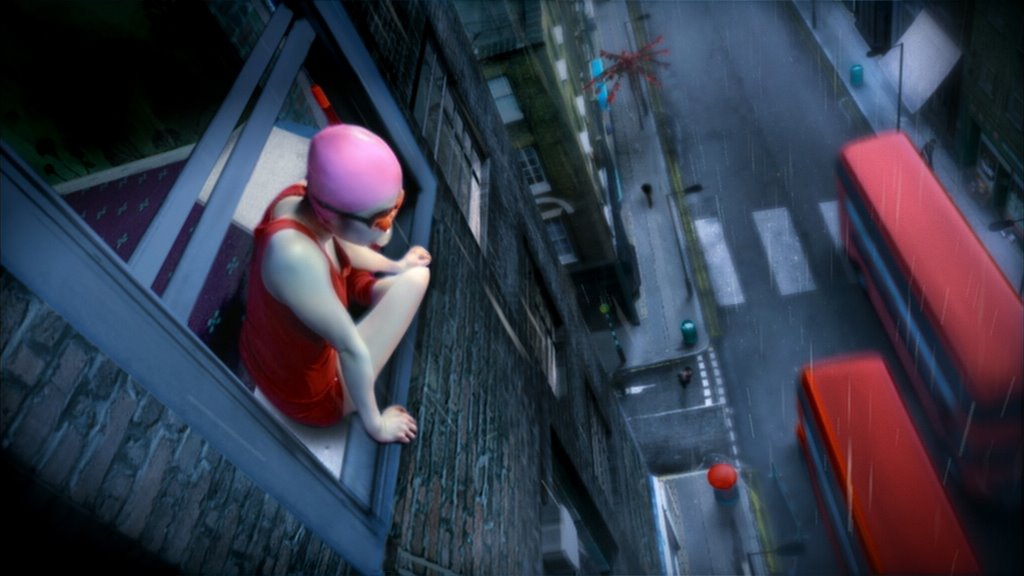
From Gaelle Denis I watched the very beautiful City Paradise, a journey through a very atmospheric London.

screenshots from the animation


She also is the author of Fish Never Sleep a very cute but intense story of an insomniac.


The cute Cloud Cover animation from Lisbeth Svarling can be watched here. The story features beautiful drawings and a story that can be interpreted in many ways. A little girl followed by her black cloud, looking for cure, looking for love... very touching and sweet.


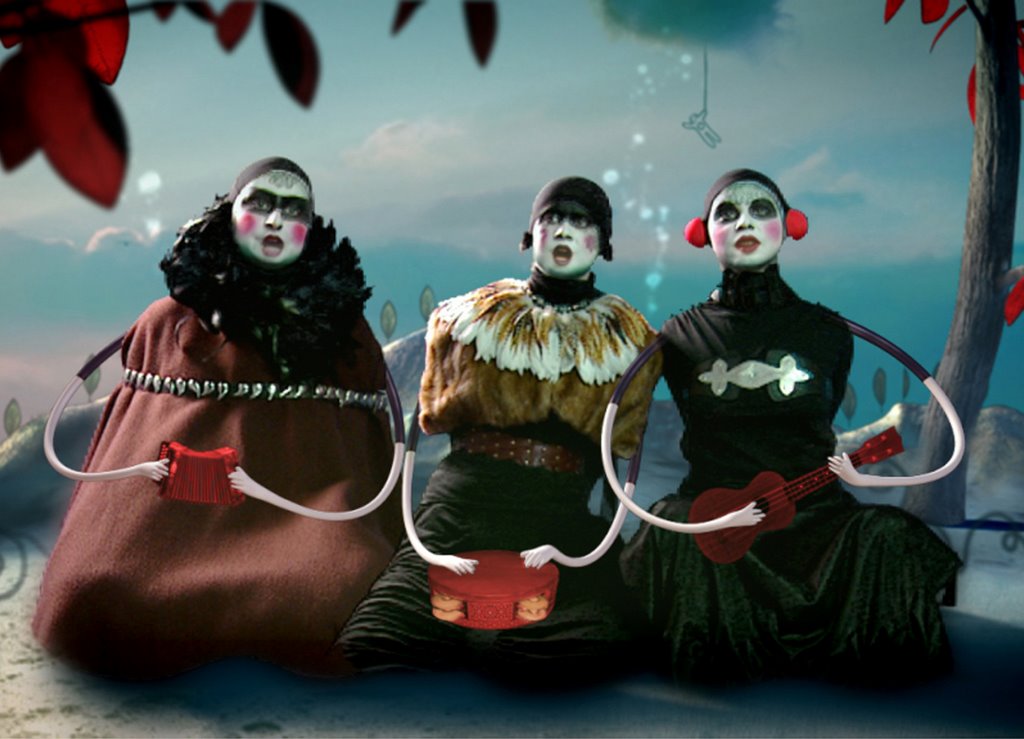
Finally, I literally adored the work of Emily Mantell 'To Have and to Hold'
An alternative world based on a companionship fantasy where women take the lead.


  • pieces of all the individual animations from the RCA show 2004 can be watched and downloaded here Check the Matthew Abbiss' Play

  • various kinds of animations can be watched here


  • In Animation

    Thursday, April 13, 2006

    Wall color changes for therapy?


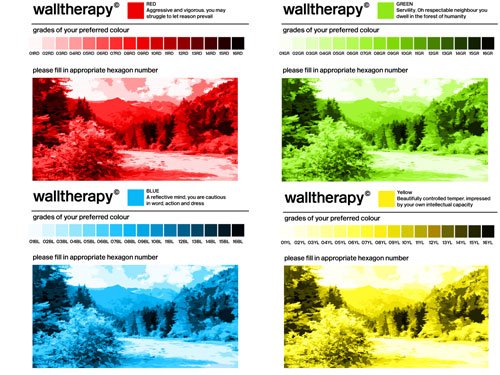
    Walltherapy is research on design methodology for bespoke, end-user created designs that can have a positive effect on their environment. Based on research that states that ambient color, light and texture can affect mood, Walltherapy invites anybody to use their favorite colors to create their own environment.

    Walltherapy is an empirical exploration of the neurological, cognitive and contextual bases underpinning the impact of visual stimuli such as colour and light and how people's mood can be expressed in design through a creative, scientifically-led design process


    More about the project

    In color therapy

    A time-aid watch


    The Time Aid watch by Christophe Koch and Lea Kobeli. They won the Timex 2154 The Future of Time Competition in 2004. The clock changes as the wearer moves from one place to another.

    Using a satellite/video interface, Time-aid can be programmed to display any clock face the user chooses, in real time, from a local clock tower to a sundial halfway around the world. This personal object contains advanced technology that, paradoxically, connects the wearer to history and the larger world. New and old, personal and global, Time-aid inspires an awareness of time and space


    In wearable broadcasting

    Sensory clock


    I have found various designed clock such as the 'designer time machine' with its own time-telling technique.

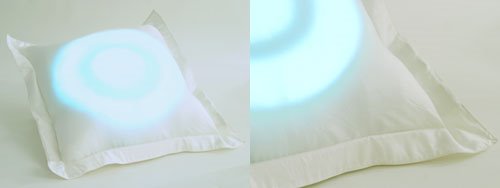
    The most intriguing one to me so far is the silent alarm clock by Rachel Wingfield and Mathias Gmachl. Currently researching on haptics for sensory therapy, I find this bedding a poetic and transparent manner to support patients with SAD.


    Light Sleeper is an illuminating, personalised alarm integrated into bedding that gently wakes in the most natural way. Ever since the beginning of time light has controlled our body clock telling us when to sleep and when to wake. As lifestyles are rapidly changing with increased travel and demands on our time, people's natural body clocks are out of sync (...) The bedding aims to treat sufferers of seasonal affective disorder (SAD) where insufficient levels of daylight cause medical conditions caused by a hormonal imbalance ranging from depression to loss of energy, pre-menstrual syndrome, weight gain and migraines. It is recognised by most scientists that SAD and other sleep/ mood disorders are linked to a shift in the suprachaismatic nucleus or circadian rhythm and often referred to as the ‘body clock’

    The following is a quote about the research on relationship between light and the body internal clock.
    Research shows that the body’s internal clock only responds to bright light at certain times of day. This peak time in normal people occurs when the circadian rhythm is in R.E.M sleep, which is approximately 1 to 2 hours before waking. This promotes the use of Light Sleeper Bedding and proves it to be one of the most effective products for treating SAD and improving well being as it synchronises our body clock each morning


    In sensory design

    Wednesday, April 12, 2006

    A need for a carry-on keyboard?


    This one is very much wearable! A hand bag made out of computer keyboards by João Sabino.

    In wearable technology

    The subliminal watch


    Can we know the time almost naturally?

    James Auger and Jimmy Loizeau were my colleagues while I researched at the Media Lab Europe. Product designers at heart, they came up with impressive installations at the lab, e.g. the gigantic isophone, and regularly gave me great feedback on conceptual insights. Just checking on their website, I saw that they have researched on a product that allow us to know the time almost naturally. They have created a watch that generates electric pulses to four quadrants on the wrist.

    The shocks serve a similar purpose as the Church bells’, to subliminally remind us of the hour. Wearing the watch is a learning experience, requiring a period of training to ‘read’ the watch and a further period to ‘know’ the time. The watch is connected to the Rugby atomic clock timeserver, suggesting a return to elements of a former era when the sun standardised or synchronised our reading of time on a global scale


    It is a conceptual project. More info on their work and about the subliminal watch.


    In haptics

    Monday, April 10, 2006

    Processing point of view

    I have tried processing by entering a few lines of script into the processing window.


    processing en essais

    For instance I wrote the following script:
    size(600, 600);
    background(50,50,50);
    for(int x=0; x<600; x="x+7){" y="0;" r =" (int)(40*(log(x)));" g =" (int)(30*(log(y)));" b =" (int)(r*g" gr =" (r"> 128){
    stroke(r, g, b);
    rect(r,g, 1, 8);
    }
    else{
    stroke(50,0,0);
    rect(x,y, 10, 91);
    }

    }
    }

    and processing has generated the following graphic:


    Rendez-vous creation
    has selected a few images I made with processing.

    In digital graphics