
What if objects that people carry with them and even carry on them could offer this sensory comfort that they seem to seek?
Together with Yas I have codevelopped a touch-sensitive apparel for massage and sensory therapy. The research focuses on the material - how the structure and the embedded components of the garment participate in pushing its function to become an envelope or cocoon for one's well-being.
Touch·Sensitive is a haptic apparel that allows massage therapy to be diffused, customized and controlled by people while on the move. Made of modular garments, it applies personalized stimuli. Touch·Sensitive aims to provide individuals with a sensory cocoon, a comforting and alerting apparel with a feedback system. Our design for the Touch·Sensitive apparel comes from the observation that people need to sooth their body to protect themselves from everyday aggressions. Touch·Sensitive is a matrix made of clothing elements that allows diffusion of tactile information through heat sensors, mechanically-driven textural sensation and liquid diffusion.
The following is a series of our Low-Fidelity prototypes.
LOW-FIDELITY PROTOTYPE #1 
This wired apparel alerts the user by mechanically shrinking the fabric onto specific points of tensions on the body.
LOW-FIDELITY PROTOTYPE #2
The second low-fidelity prototype of Touch·Sensitive is made of buttons with silicone.
LOW-FIDELITY PROTOTYPE #3
Manually inflatable vinyl pockets can be used to receive a comforting pressure
LOW-FIDELITY PROTOTYPE #4
Structure flex
Touch·Sensitive allows the diffusion of tactile information through computational and mechanical technologies. It is a computerized touch therapy apparel whose modular pieces can be integrated within the clothing. We have taken advantage of the growing miniaturization of computational components to integrate them seamlessly within the fabric.
Keep tuned!
-------------------------------------------------------
Touch · Sensitive Apparel work-in-progress 6 pages paper has been accepted to CHI 2007. Come see Yas and I in Saint Jose from April 28-May 3 2007!
Abstract
Touch·Sensitive is a haptic apparel that allows massage therapy to be diffused, customized and controlled by people while on the move. It provides individuals with a sensory cocoon. Made of modular garments, Touch·Sensitive applies personalized stimuli. We present the design process and a series of low fidelity prototypes that lead us to the Touch·Sensitive Apparel.
Download pdf of the paper
Tuesday, January 16, 2007
Touch · Sensitive Apparel

Friday, January 12, 2007
Remembrance of an absence
In my sculpture work, I combine the material representation of a souvenir and its effect over time. I print on plaster molds a series of clothing on life-sized frames. The pieces of clothing carved in the plaster come from people I care for. Their prints represent their passage in my life at a point, and the mold essentially keeps the shape and the textural significance of the clothing.
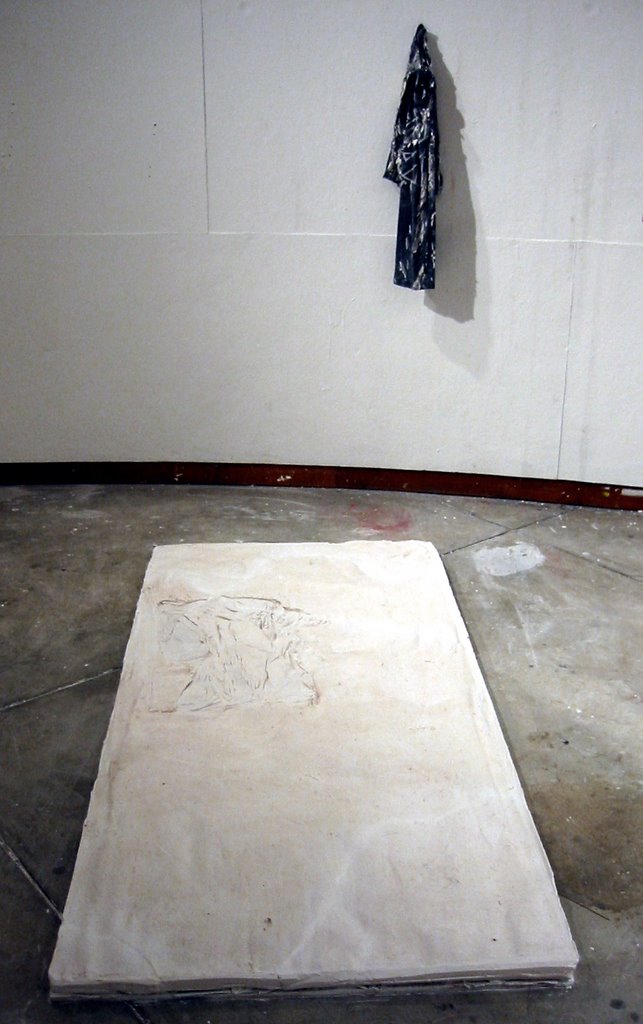
final installation (2007)
More pictures.
My paper on a selection of sculptures for Helen Mirra, VES, Harvard University, (Cambridge, MA, USA. December, 2006). Remembrance of an absence
Tuesday, January 09, 2007
Pure Nomade
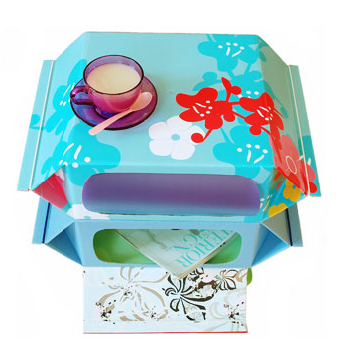
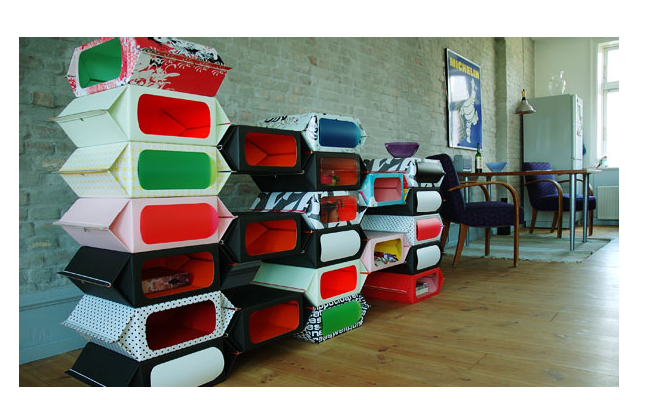
Since I work with a pure nomad Yas, I revisit my assumptions about my moving around furniture and stuff. Today I found on the internet this interior design modular system for an aestheticized nomadic life ...
The "Hotel" box concept is a brand new product to the market. It is neither a box, nor a piece of furniture, but all in between. Through years the industrial designer: Lilian Adler stuffed all her latest treasures of shoes, as we all do, in randomly shaped boxes and, again as we all do, into the far-end corner of the closet. Hard to manage, tough to stack. As time passed by and the space became even more tight, she just had to come up with something smarter. A shoebox which could be towed away when not in use, and put at display when requested

More on Pure Nomade
Sunday, December 10, 2006
More about alter-ego images in the media ...
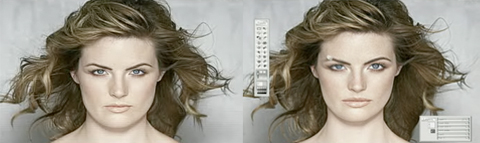
I read the blog of Jeff Lieberman and found this campaign for real beauty by Dove and through the comments I also discovered this swedish campain.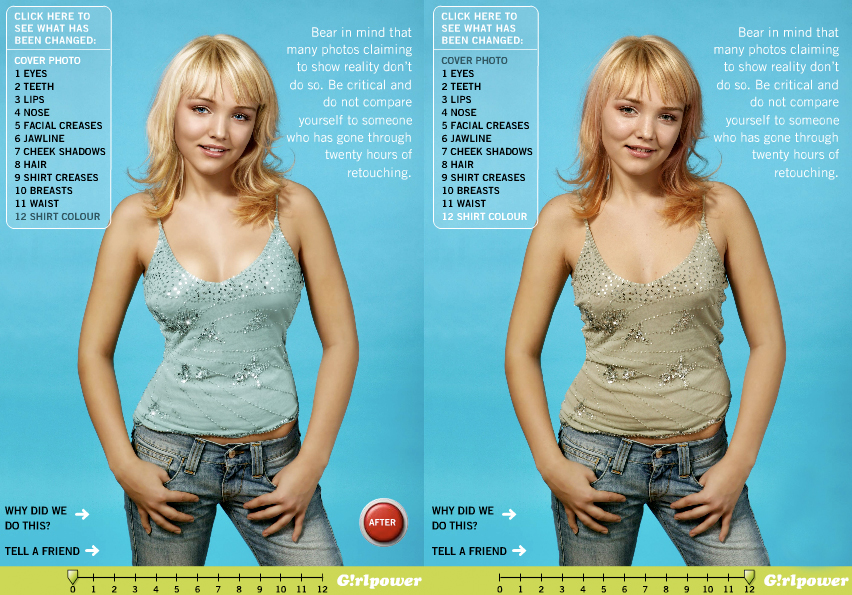
The idea behind the campaign is to make women aware of how altered these images can be and how our vision of beauty can be distorted. The campaign of Dove is pretty clever in bringing us through all the steps of the woman metamorphosis. From makeup & light to digital edition. You can watch the movie here. Photoshop, le meilleur ami de la femme!
It seems to me that this ad tells us more than just the woman metamorphosis through editing. It also talks about the authority of the consumer. It of course plays an important role on accusing the fetishized repetition of Alter-Ego images in the media.
For the discussion, I readapted the semiotic identity square from Metz, Christian; “The Imaginary Signifier”, from Apparatus Theory., pp408-439. 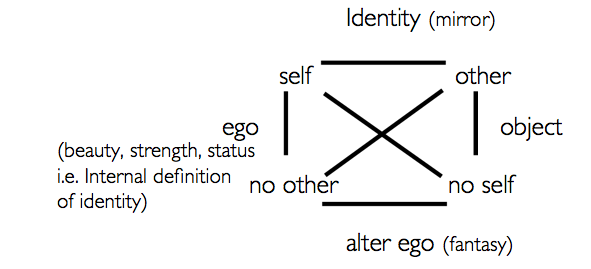
Considering identity made of the self and the others (the mirror), the ego (our internal definition of identity) made of the self and the no-other, the alter ego (fantasy identity) that does not include the self neither the other, and the object (no self, other). The characters presented on these ads are unreal, fictional and the emotional resonance with the viewer cannot be of an identification, because the identities are impossible. However these images represent an alter ego, an alter-identification. An attachment to the image as an Alter Ego. Through these images, individuals try to reconcile the alter ego and identity such as they correspond to the ego. They end up forcing the alter ego image into the mirror, and end up into phenomena such as anorexia, aesthetic surgery and so on.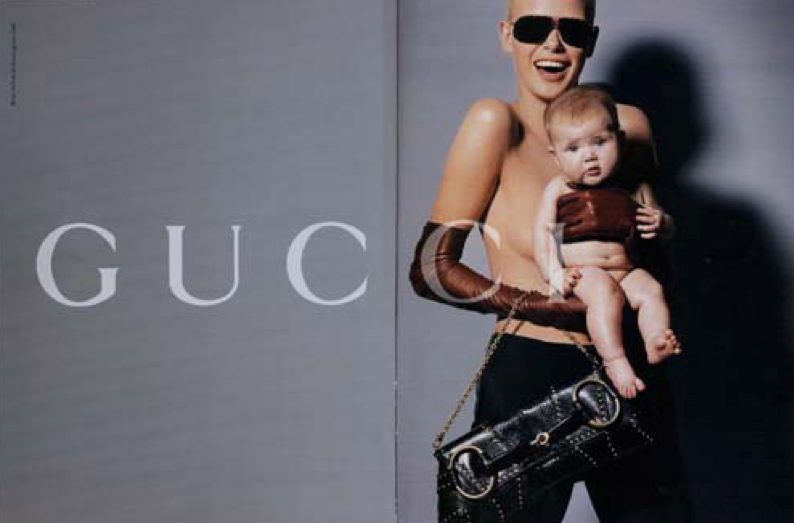
Gucci ad used as reference point
An interesting reference on the subject is the semiotic analysis of high fashion advertising by Alan Rhodes and Rodrigo Zuloago (2003). Here is the .pdf of the paper.
However, the Dove campaign tells us more. By giving authority to the viewer, it mentions a new area for advertisement . It talks to this naive consumer that has not overcome the manipulation of the media. However is also implies that there is another consumer that has already overcome this manipulation. This campaign tries to satisfy both consumers.
Hugo Liu has analyzed the passage from being a naive consumer to being the superconsumer, the one that is self-constructed culturally and can freely choose the culture that will fulfill him/her. An idealistic view of the after post-modern area and another paper that makes you feel good of being multicultural... .pdf of the paper.
Wednesday, December 06, 2006
Peter Welz
For the context of the class, Helen Mirra invited the sculptor Peter Welz. He also reviewed my work on inside/outside and shared with me his approach from studying the figure to lastly using the figure as a tool. I am fascinated by his process. During his trajectory, he sculpted and casted the figure to later get rid of its cast to only project the figures onto structural spaces.
Today, Peter Welz gave a talk at the Harvard Film Archive, Carpenter Center. He presented a selection of work expressing the relationship between the space and being.
In the following work, a line is projected on a concrete wall. By blowing onto the camera, the line vanishes and disappear to present a plain concrete wall; as the artist stops blowing, the line reappears.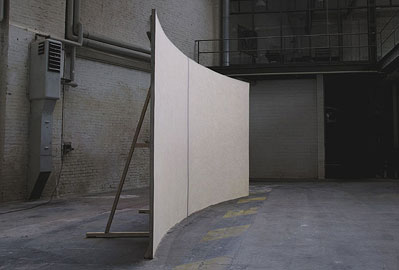
line | vanishing | disappearing | breath | aspirate |
onto fake concrete wall | concave, Berlin 2004
video projection onto a fake concrete wall, 550 x 280 cm, 30 min Loop on DVD
In this work, Peter Weltz translates a unfinished portrait from Francis Bacon into figure movements.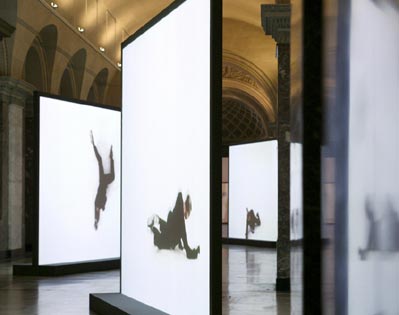
retranslation | final unfinished portrait (francis bacon) | figure inscribing figure | [take 02] Installation view Musée du Louvre
Photo: © Musée du Louvre / Angèle Dequier © Peter Welz / DACS & the Estate of Francis Bacon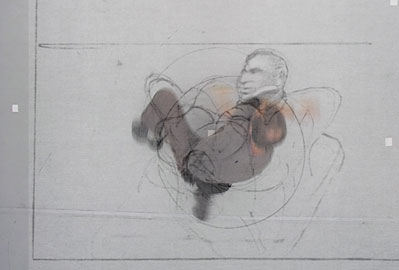
study | w.forsythe re-translating the unfinished portrait by francis bacon
colour print on acitate/paper, permanent marker, gaffa tape 61cm x 86 cm, 2005 (© Estate of Francis Bacon | Dublin City Gallery The Hugh Lane)
Tuesday, December 05, 2006
Prediction market for corruption
For our pro-seminar class, a PhD requirement, Stefanie Tellex, Noah Vawter and Aaron Zinman and I am designing a prediction market for corruption. Our idea is that citizen can bet on the next congress that will be indicted.
Looking for visual tools and data analysis, I have found on Jaiunblog, the observatoire presidentiel web site.
It is an interactive presidential observatory. It allows individuals to visualize a tendançologue to follow the media popularity of main political French figures estimated for this election and this until the presidential elections of 2007.
The interactive µtendançologue considers also news from blogs, newsgroup, online press. It allows the user to compare between presidential online press.
This online observatory also proposes an interactive political blogopole map. The map represents the total of citizen's blogs that bring up political debates in France.
The Blogopole and a close-up on the French Green party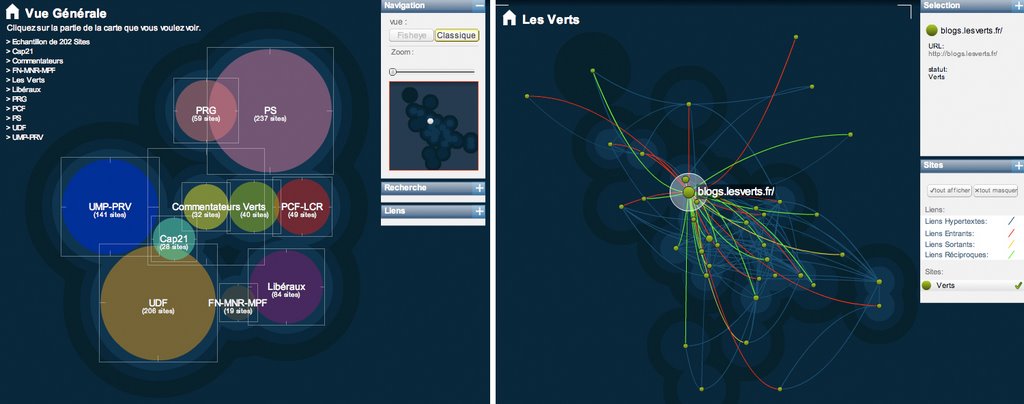
Sunday, December 03, 2006
The Revigators
Adam showed me an amazing web site on radioactivity. All you want to know about the cool products that contain radiation from uranium are listed here.
My favorite pick
The idea is that you drink the water coming out of this revigator. The radioactive water is exceptionally healthy for you according to studies (see below). Theodore Gray (the author of this web-catalog on uranium) proposes a nice parallel to our current expectations of what is "natural", assuming natural is pure and unharmful. This object came from a time where radioactivity was considered "natural".
The claim that it can't possibly be harmful because it's not a drug or medicine, it's all natural. The "it" being radon gas, which is now known to be one of the most powerfully toxic substances in the world, so toxic that even barely measurable concentrations from natural sources are a problem in many people's houses.
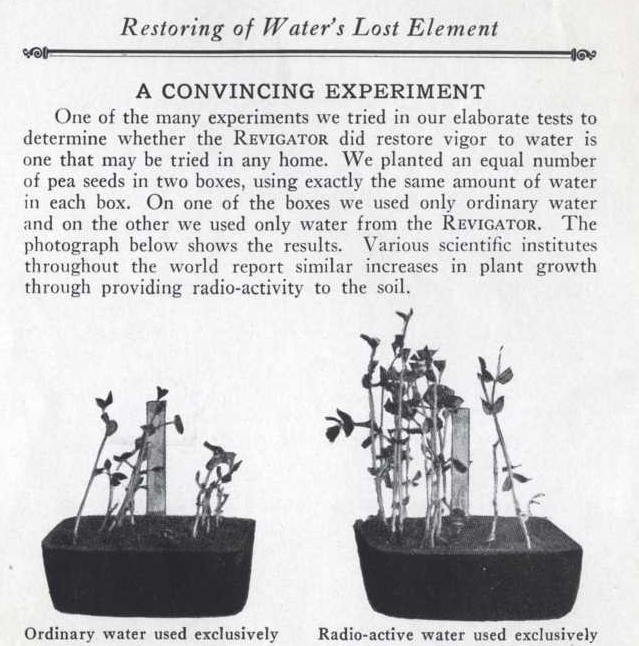
The study
Here is the book that describes the revigator.
Saturday, December 02, 2006
An outside of the dysmorphic body

Screenshots from the video
In this sculpture the dysmorphic body is reappropriated to create an outside of the body and therefore exemplify its disproportion. 
Screenshots from the video
For this video, I arranged lights and shadows to create a positive out of a negative impression that I carved in the mold. I reappropriate the dysmorphic body and through the camera I confuse the eye of the viewer and create the illusion of a body being carved. Finally, I end the video by using a string to present the illusion trick to the viewer, the string is a link between the inside and the outside.
Video
Material: plaster
Video: Raw data with no editing
Thursday, November 30, 2006
Effects of a Snoezelen on self-injury and aggression

Attribution: Photo of a snoezelroom at Het Balanske, Halensebaan 2, 3390 Tielt-Winge, Belgium by Michaël RY Laurent, Belgium.
Snoezelen or controlled multisensory stimulation is used for people with (severe) mental disabilities, and involves exposing them to a soothing and stimulating environment, the "snoezelen room". These rooms are specially designed to deliver stimuli to various senses, using lighting effects, color, sounds, music, scents, etc. The combination of different materials on a wall may be explored using tactile senses, and the floor may be adjusted to stimulate the sense of balance.by Wikipedia
Originally developed in the Netherlands in the 1970s, snoezelen rooms have been established in institutions all over the world (like in Germany, where more than 1200 exist).
Snoezelen might be beneficial to people with autism and other developmental disabilities, dementia, and brain injury. However, research on these matters is scarce, with variable study designs.[1] [2]
References
[1]Chung JCC, Lai CKY. Snoezelen for dementia. The Cochrane Database of Systematic Reviews 2002, Issue 4. Art.
[2]Lancioni GE, Cuvo AJ, O'Reilly MF. Snoezelen: an overview of research with people with developmental disabilities and dementia. Disabil Rehabil. 2002; 24: 175-84.
Effects of Snoezelen room, Activities of Daily Living skills training, and Vocational skills training on aggression and self-injury by adults with mental retardation and mental illness. Res Dev Disabil. 2004 May-Jun;25(3):285-93. By Singh NN,
Lancioni GE, Winton AS, Molina EJ, Sage M, Brown S, Groeneweg J.
Abstract Multi-sensory stimulation provided in a Snoezelen room is being used increasingly for individuals with mental retardation and mental illness to facilitate relaxation, provide enjoyment, and inhibit behavioral challenges. We observed aggressive and self-injurious behavior in three groups of 15 individuals with severe or profound mental retardation and mental illness before, during, and after being in a Snoezelen room. All participants were receiving psychotropic medication for their mental illness and function-derived behavioral interventions for aggression, self-injury, or both. Using a repeated measures counterbalanced design, each group of participants was rotated through three experimental conditions: Activities of Daily Living (ADL) skills training, Snoezelen, and Vocational skills training. All other treatment and training activities specified in each individual's person-centered plan were continued during the 10-week observational period. Both aggression and self-injury were lowest when the individuals were in a Snoezelen room, followed by Vocational skills training and ADL skills training. The levels in the Snoezelen room were significantly lower than in both the other conditions for aggression but only in ADL skills training for self-injury. The difference in levels before and after Snoezelen were statistically significant with self-injury but not with aggression. The order of conditions showed no significant effect on either behavior. Snoezelen may provide an effective context for reducing the occurrence of self-injury and aggression.
PMID: 15134793 [PubMed - indexed for MEDLINE]
Michael Graves and universal design
Discussing about Universal Design with my research group, Amanda showed us the fascinating work of Michael Graves featured in Metropolis magazine.
"People who become disabled have to radically redesign their outlook about the physical world," Graves says, remembering the first days after he was out of danger and learning to live with paralysis. "They redesign their sense of privacy and their sense of independence. Yet in the products they have to use, design has abandoned them."
The following is a very nice cane-bag combo, cane that can be hidden at any time.

This model folds into a built-in padded nylon bag. The latter was developed after Peschel and his team noticed that people often like to keep folding canes out of sight in a bag or purse. Getting it manufactured, however, was tricky: the designers ultimately had to find one factory to make the bags, then a second to assemble the cane into it.—M.C.
Courtesy Michael Graves Design Group

Shower Heads
Graves Design developed two handheld shower-spray products, both in white injection-molded plastic with blue overmolded rubber grips. The smaller one was designed to fit in the palm of the hand; people with arthritis or dexterity problems can comfortably use it without a tight grip. A swivel connector at the base allows the unit to spin without twisting the attached hose (it also fits into standard shower holders). —M.C.
Joe Andris/courtesy Michael Graves Design Group
