Juste des petits bouts de Boston
Saturday, March 18, 2006

Wednesday, March 15, 2006
My review on a selection of personal past research
The following are three examples of my work with features that can be re-appropriated to found new research directions pertaining to my future research question.
Passing Glances
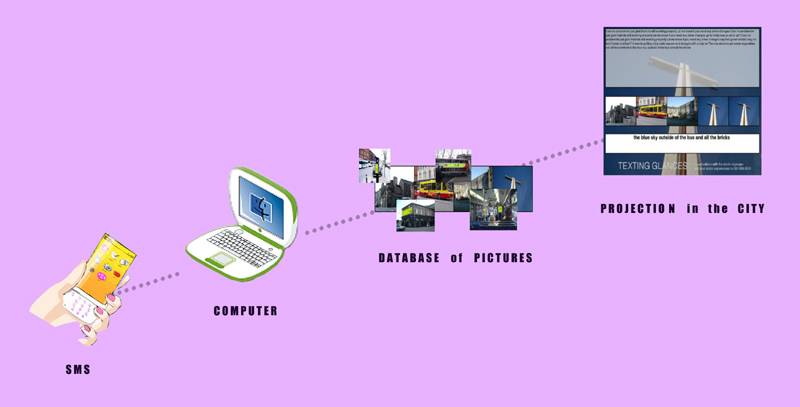
Imagined for installation in an urban, public space (bus stop, train station, etc.), PASSING GLANCES invites people to use SMS messaging on their cell phones to post images or video to a public display board. Display boards in different cities would be connected to one another. The system intelligently draws in other imagery to support the content of what users posted to the board. The goal was to have individuals describe their physical space in a substantial way, without the limitations of distance.
Through the supportive research on this application, I found that users were initially using SMS to experiment with the system, but then quickly preferred to make the unknown crowd react through anonymous posting to co-located users. On hindsight, this project had interesting implications for how digital technologies can mediate between how we assert ourselves privately and publicly within the physical space.
Connected to a server, each user’s cell phone could browse inside of their personal computer to display videos, pictures, and sound files. This was done privately and anonymously. The SMS media (picture, text, audio, etc.) posted to the display board could only be retrieved by specific users at a reasonable distance. Because these messages are unpredictable, they create an atmosphere of surprise and excitement.
People were motivated to explore the relationship of private and public roles through the act of anonymous posting in the physical space. However, I would like to expand the system to explore and model the public desire for “subversive” acts, their overlap with the desire to exchange new media and ideas, and how digital technologies can maximally support how these desires translate into the redesign of the physical space.
I designed this project in collaboration with Sven Anderson, Glorianna Davenport, Linda Doyle and Katherine Moriwaki when I was a researcher at Media Lab Europe. The origin of this work was to bring my previous project Textable Movie into a urban sms interactive display.
Web site
More info about Passing Glances
MOVING PICTURES
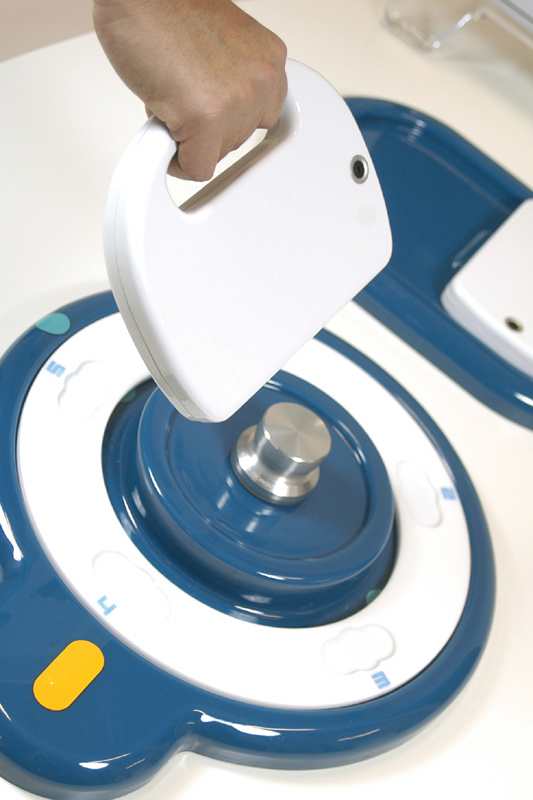
In the MOVING PICTURES project, I have sought to develop interfaces where either digital data can be overlaid onto physical objects in a display space or physical objects can act as handles into the digital space.
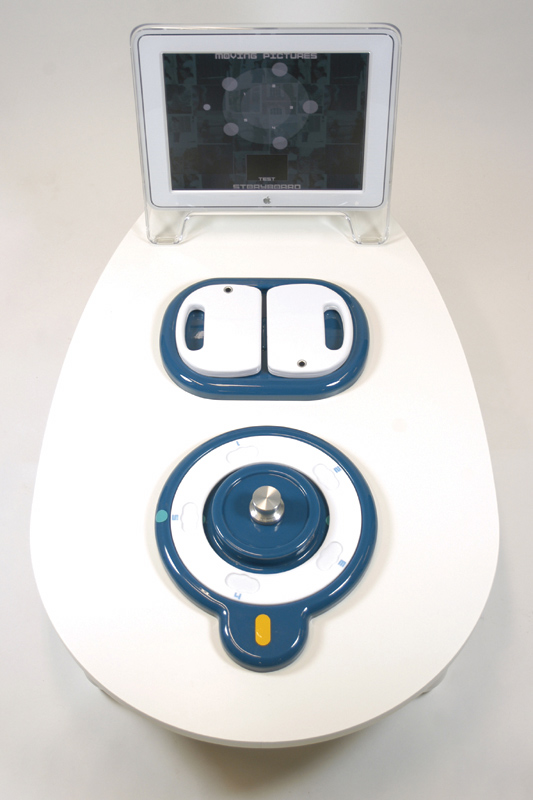
MOVING PICTURES offers children the opportunity to gather imagery from their environment in the form of short video clips captured on video camera platforms that we modified for the application. I wanted to provide a transparent experience for the user, in which cumbersome process of capturing and editing becomes fluid in the improvisation of a story is accessible as a way to create a final movie.
For editing, MOVING PICTURES includes a multi-user workstation consisting a set of two cameras, tokens, screen and an interactive platform where users to create, explore, manipulate and share video content with others. Multiple device input to the workstation supports group interaction and collaborative creation.
MOVING PICTURES suffers from several limitations related to the problem of how to best digitally support meaningful interactions in the physical space.
I designed this project in collaboration with Diana Africano, Glorianna Davenport and Oskar Fjellstrom when I was a researcher at Media Lab Europe. The origin of this work was to bring my previous project Textable Movie into a tangible video editing platfofrm for children.
More info on Moving Pictures
TERRARIA
TERRARIA was a system for visitors of a three-month exhibition in Dublin to author the content of the exhibition space by creating their own movies.
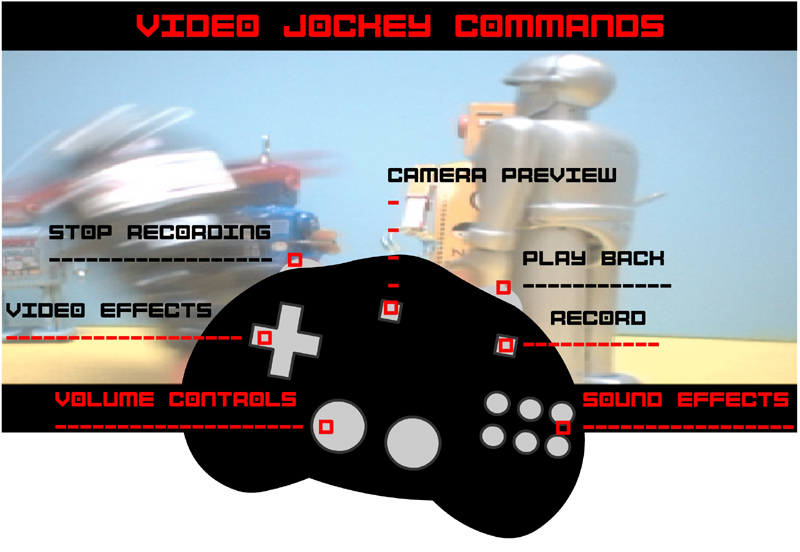
I have designed a technology that enabled visitors to experience movie making using popular devices, e.g. a joystick to control the movie making process.
I also re-thought real time video capturing and editing for the museum exhibition space by combining the traditionally separate capturing and editing processes. One can participate in the physical space through capturing video and export instantly to the digital space for the modification of the content they create.
Finally, that content is projected within the museum, extending into the physical environment. Finally, the simplicity of use, and immediacy of response aims to engage visitors in movie creation. Video capture, editing and publication of the final video is optimized.
With this interface I have attempted to expand the level of interaction for individuals in the physical museum space. Unlike the typical museum, spectators can transform and contribute to the physical exhibition space.
Research on TERRARIA was primarily driven to optimize the video capturing and production process for the unique demands of the museum visitor and museum environment. The component of this work that is most exciting to me is the user capturing the physical space and immediately having the opportunity to re-project into that space with modifications of the video.
If possible, I would like this process to be scaled across spaces, with distributed interfaces, and with computational models in place to describe how the users navigate the data representation and reproduction. Without the consistency of the museum I will need to rethink the display to visualize the content publicly. Investigating appropriateness of display and visualization create a critical component of all of this work.
I designed this project in collaboration with Andrew Clancy, Michael John Gorman and Brendan Tangney when I was a researcher at Trinity College University in Dublin. Michael John Gorman was curating an exhibition on robots and offered me to design a platform for children to create and share their animations using robots.
More info on Terraria

By Cati in personal research
Integrated dropped ceiling
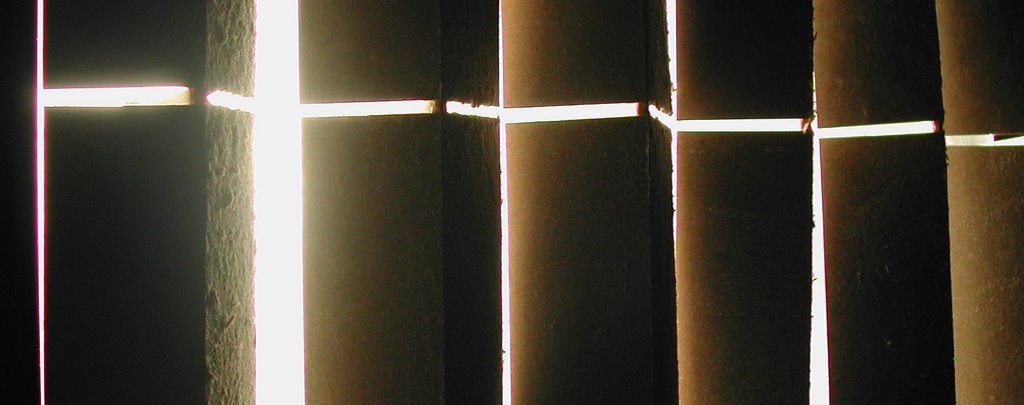
I take a Product Design course at Harvard GSD taught by Marco Steinberg.
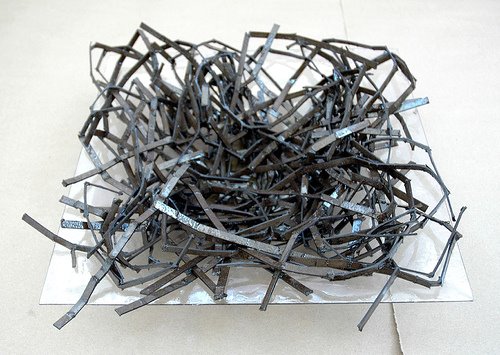
The first assignment consisted of a free-form research on Chip Board. I worked on it with Alexandra Ginsberg (Daisy) and Sharon Kim. We decided to laser cut the Chip board into many thin slices and create different molds with rubber, resine and clear plastic; we mixed wet and also dry chip board slices to the materials.
A documentary on our design process of the chip board transformation ...
The following picture shows the chip board dried with resine
For our second assignment, Marco asked us to research on dropped ceilings.
We documented dropped ceiling and done intensive online search.
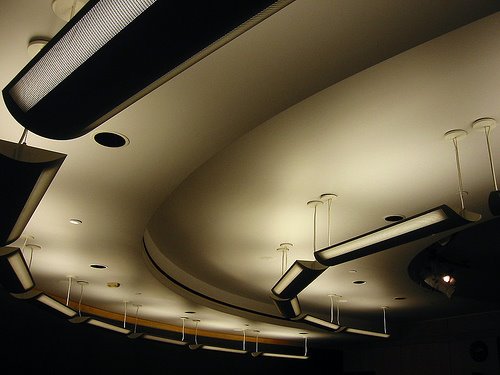
The following slideshow presents our on-site documentation on existing drop ceilings
We came up with a process of categorisation: economy, aesthetics, sustainability, and function. We looked at the advantages, negatives and opportunity of each category and defined cross over between category to design our 'ideal' dropped ceiling. We then investigated a dropped ceiling with integrated functionality.
Our aim is to combine luminaire with dropped ceiling functionality (could be described as concealing HVAC) whilst considering other potential uses such as ventilation/lighting control
How can a ceiling system be an essential element of the conception and design of a space, not just an added suface?
Our design process

EMBODIMENT general considerations
Functionality could include heat/responsive technologies (does it open up into
a louvered system, could we integrate ventialtion, and replace an additional HVAC system ?)
Layering with sunlighting strategy above the dropped ceiing
– ie. the louvres rotate and allow natural ventilation ?
Do the smaller individual parts of the ciling contribute to a greater overall visual aesthetic – cf. the chipboard exercise where the scale of the material lends itself to another set of readings when considered at a larger scale. Can we control this feature ?
Is there a limit to the functionality?
Do multiple configurations make the system too complex, or could this system enable truly multi-functional space with a large variety of available lighting strategies?
Can the system be used with both daylighting and/or natural lighting systems, or could its appeal be as a referential system that tracks outdoor weather/lighting conditions and replicates through the ceiling system to improve user conditions.
Material: Our requirements
- transparent surface
- opaque surface
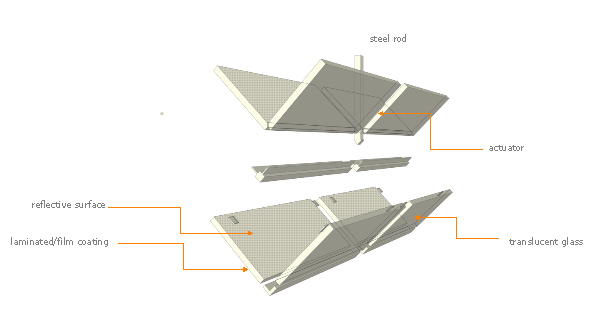
- reflective surface
- material for upper panels
- framing material
- sustainable choices ?
We researched on the properties of glass and past related projects
Processes: laminated, painted, fretting, dichroic glass
Soda-Lime Glass, Borosilicate Glass, Silica Glass, Glass Ceramic
Recycle potential is high
Corrosion resistant
Wear resistant
We also researched on other material options
- Plywood (Used as solid, perforated, thin veneer)
- Plastics
- Films/Laminating/Coating
EMBODIMENT
Function Shaping
Our Initial Concept is a pixilated ceiling that can be programmed as a referential/interactive installation.
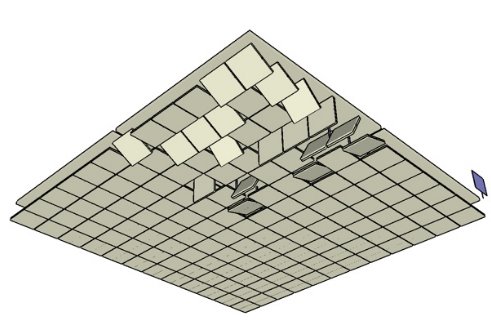
Function Motion with Actuators
We have chosen the Tork-Mate 890 for
- its low friction
- extended life
- up to 15 million cycles
- ideal for the operation of 90 degree turn devices
- can be coupled with other electronic components etc...
It works by redirected air pressure: the pistons linear movement is converted to
rotary motion (gear).
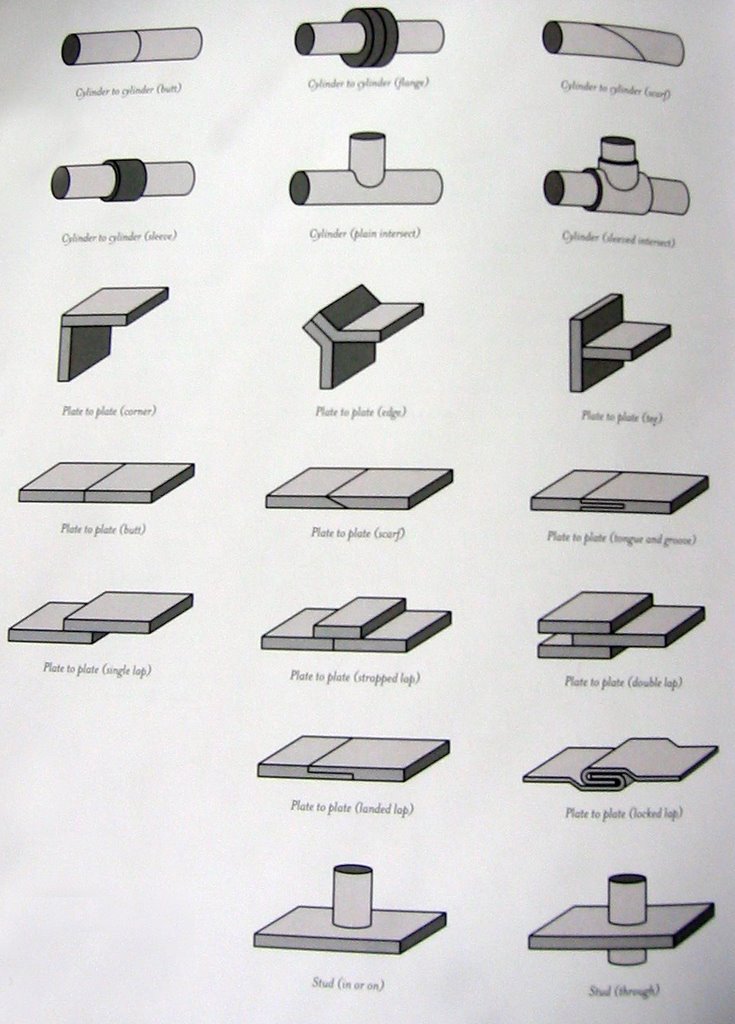
Function Joining and the value of working on joints
- economy of assembly
- ease of assembly
- most appropriate process
- performance of the joint
- must resolve the problem with weight of glass (joint solution is very important)
Function Surfacing
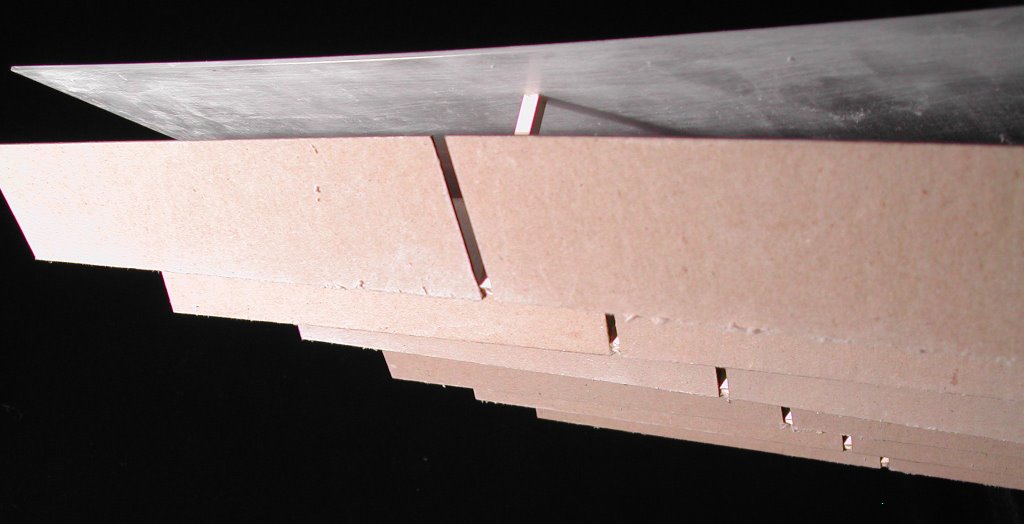
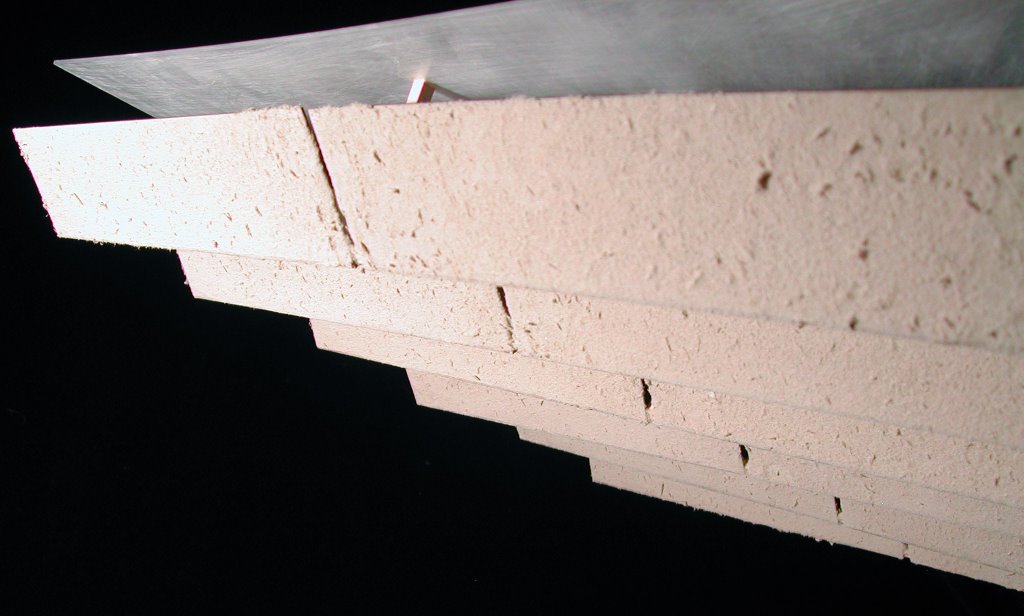
Our final material choice is glass but we made our first prototype in chip board.
The following is a picture of the Reflective side (glue laminated on chip board)
Other side (scratched chip board)
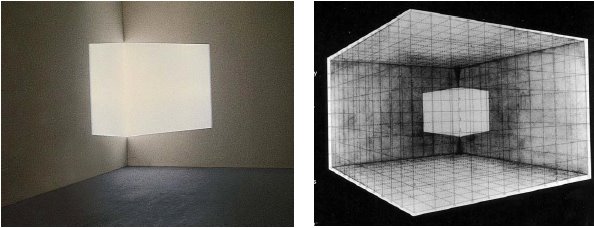
During this process we were inspired by James Turrell light installation
Our final model is composed of



APPEAL Background
- industrial standards keep within fixed constraints.
- how can smart materials/technologies improve the dropped ceiling?
- hospital : how can existing research into improved user interface/consideration of users inform design process?
- integration of function as sustainable/intelligent solution.
APPEAL Application
- A general purpose solution that could be used in hospitals, homes, offices, public buildings, museums
- Variable lighting functionality and possible multiple application possibilites are key.
- Could this be part of an integrated HVAC solution (ventilation) ?
APPEAL Benefits
- Sustainable design
- Improved lighting conditions
- Variety of lighting solutions available, even simultaneously.
- Aesthetic benefits
I completed this last assignment with Young Joong Chang, Alexandra Ginsberg, Sharon Kim and Irwin Sentilles.
References
By Cati in Product Design Research
Monday, March 13, 2006
Architectural computing
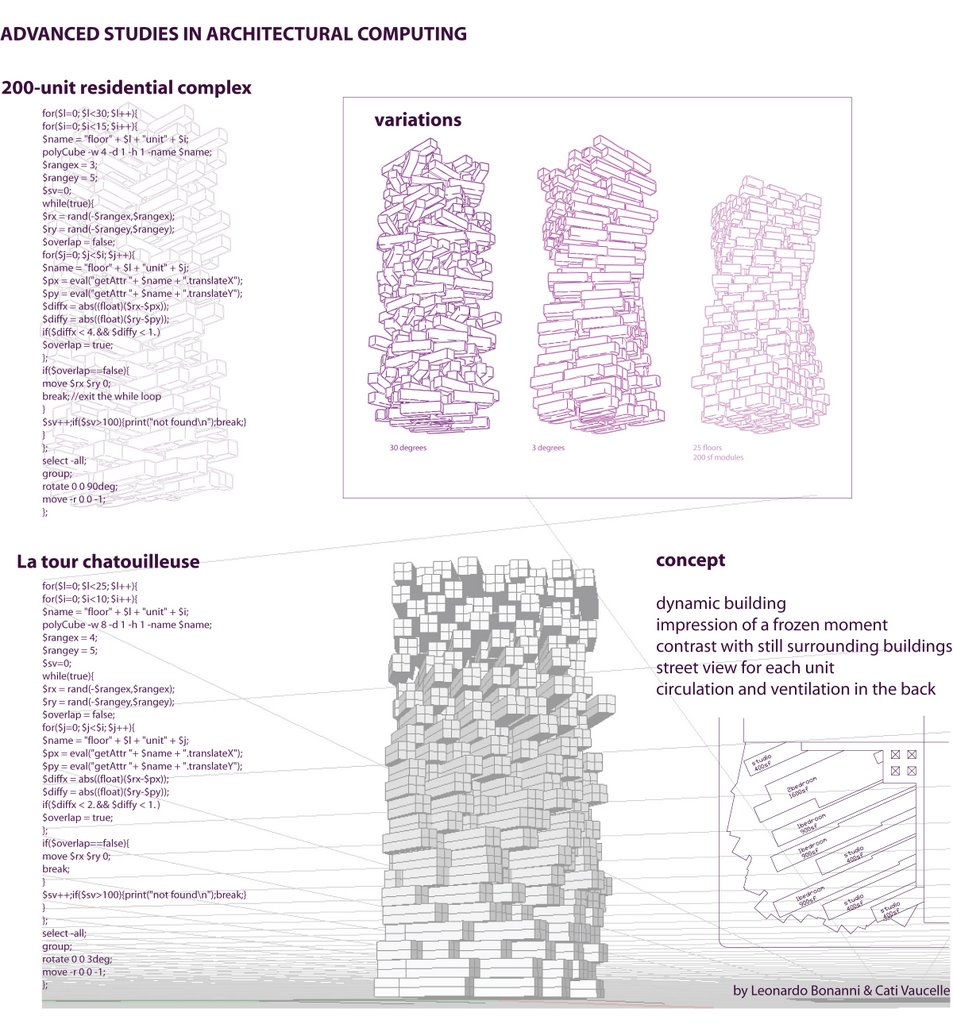
This semester I am studying Advanced Studies in Architectural Computing : Harvard Design School, Spring 2006 taught by Kostas Terzidis
Description
The course is an in-depth study into the theories, processes, and structures of computing in architecture. It will seek to develop design projects that will illustrate the applicability, value, and potential of computing in addressing, solving, or (re)defining architectural problems. The purpose is to invent computational schemes that encapsulate the processes that lead to the generation of buildings and structures. Furthermore, the course will seek to define, explore, and critically evaluate the aesthetics of computing not only as a form of artistic expression but also as a means for architectural poetics.
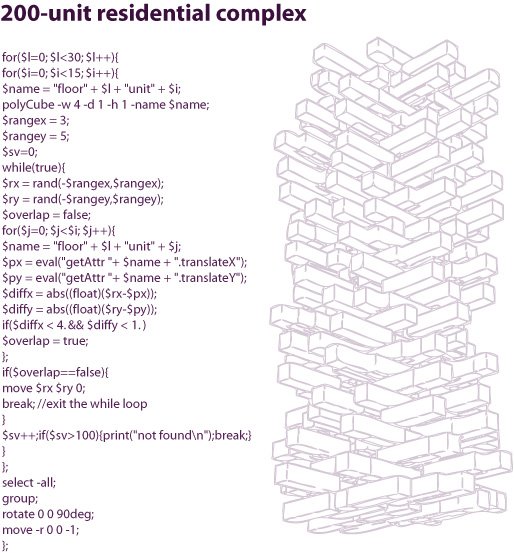
For the first assignment we had to test script editor from the Maya software and create a building under particular conditions:
Site: Flat/urban context: square (110’ x 110’) on a corner of two streets
Program: 200-units 80% made of
50 effic. ( 400 sqft)
100 1-bed ( 900 sqft)
50 2-bed (1,600 sqft)
Circulation 20%
Constraints: For each unit facing the street we get one point. For each floor we go up we loose 10 points. Satisfying the above requirements for the lowest cost, create a structure(s) using any (or combinations) of the following algorithms: stochastic search, hybridization, cellular automata, multi-Booleans, genetic.
First, as shown in the following code and model, we have resolved the problem by creating the units with no overlap between one another (we did a scholastic search on the units location):
We tested the following variations by modifying our previous Maya script:

We decided that our final model will
- be a dynamic building
- give the impression of a frozen moment
- contrast with still surrounding buildings
- offer a street view for each unit
- have the circulation and ventilation in the back
The following diagram features the organization of one floor:

Our final model ' la Tour Chatouilleuse' is made out of the following Maya Script
for($l=0; $l<25; i="0;" name = "floor" rangex =" 4;" rangey =" 5;" sv="0;" rx =" rand(-$rangex,$rangex);" ry =" rand(-$rangey,$rangey);" overlap =" false;" j="0;" name = "floor" px =" eval(" py =" eval(" diffx =" abs((float)($rx-$px));" diffy =" abs((float)($ry-$py));" overlap =" true;" overlap="=">100){print("not found\n"); break ;} } }; select -all; group; rotate 0 0 3deg; move -r 0 0 -1; };

By Cati in Architectural computing
Technology and its aesthetical dimension
For this essay I researched on technology and its aesthetical dimension.
Designing a physical space is interrelated to designing for people, their lives, and it implies reflecting on its critical and aesthetic roles 1
To this end, researchers have proposed that designers develop sensitivity to and control of aesthetics, for instance, by putting constraints on communications media 2
In 1958, Simondon introduced a new approach to technology3
He argued about the necessity for the individuals to defend themselves against the technical object to appropriate its aesthetic dimension. In fact, the existence of a human reality in the technical object being denied, only the aesthetic object seems to transmit human values. In general, the technical object has a function but does not express a concept. More specifically, individuals protect themselves against the technical object by reducing it to the status of being useful, and at the same time, paradoxically, they mystify the technological object by wanting it to be evil, powerful and dangerous e.g. Fritz Lang’s female robot character in the film Metropolis (1927). It seems that the artificial being that humans create in fantasy, they are afraid of, and either accuse it of destroying their lives or of only being a useful object without any aesthetic characteristics.
As much as Roland Barthes 4 tells us that the status of photography has changed from being purely technical, to being perceived as art, to finally modify the notion of art itself into a concept, it seems there is still an unjustified hierarchy among technical objects depending on their more or less common points with the artistic sphere. Simondon has denounced this unjustified imbalance between technical and aesthetic in the meaning sphere. However, we seem to work by oppositions: how could we justify a possible insertion of the technical into the meaning sphere while it is through this lack of knowledge that we can justify the ‘raison d’être’ of the aesthetic sphere? A study of the technical and its interconnections to the aesthetic sphere is necessary to generally understand the technological environment in which we live. We are indeed surrounded by technology and even if we choose to deny its human characteristics, we can still understand its implications.
The cultural theorist Paul Virilio has analyzed technology as a threat to collective memory and a ghost of an “integral accident”. He explains how a city can suffer from its conditioning to media, stating that technology becoming more and more mediatic can destroy real space to the benefice of real time provoking a sense of body lost, the body being delocalized. The evolution of technology is not so much an issue, but rather the fact that humans tend to deny the loss it generates 5
Pierre Levy on the other hand, who is more positive towards the impact of the cyber space onto our lives, proposes to not think of issues in term of the impact of technology on society, but in terms of understanding it as a collective project by acknowledging that we all are implicated in it 6
Designing a physical space is interrelated to designing for people, their lives, and it implies reflecting on its critical and aesthetic roles 1
To this end, researchers have proposed that designers develop sensitivity to and control of aesthetics, for instance, by putting constraints on communications media 2
In 1958, Simondon introduced a new approach to technology3
He argued about the necessity for the individuals to defend themselves against the technical object to appropriate its aesthetic dimension. In fact, the existence of a human reality in the technical object being denied, only the aesthetic object seems to transmit human values. In general, the technical object has a function but does not express a concept. More specifically, individuals protect themselves against the technical object by reducing it to the status of being useful, and at the same time, paradoxically, they mystify the technological object by wanting it to be evil, powerful and dangerous e.g. Fritz Lang’s female robot character in the film Metropolis (1927). It seems that the artificial being that humans create in fantasy, they are afraid of, and either accuse it of destroying their lives or of only being a useful object without any aesthetic characteristics.
As much as Roland Barthes 4 tells us that the status of photography has changed from being purely technical, to being perceived as art, to finally modify the notion of art itself into a concept, it seems there is still an unjustified hierarchy among technical objects depending on their more or less common points with the artistic sphere. Simondon has denounced this unjustified imbalance between technical and aesthetic in the meaning sphere. However, we seem to work by oppositions: how could we justify a possible insertion of the technical into the meaning sphere while it is through this lack of knowledge that we can justify the ‘raison d’être’ of the aesthetic sphere? A study of the technical and its interconnections to the aesthetic sphere is necessary to generally understand the technological environment in which we live. We are indeed surrounded by technology and even if we choose to deny its human characteristics, we can still understand its implications.
The cultural theorist Paul Virilio has analyzed technology as a threat to collective memory and a ghost of an “integral accident”. He explains how a city can suffer from its conditioning to media, stating that technology becoming more and more mediatic can destroy real space to the benefice of real time provoking a sense of body lost, the body being delocalized. The evolution of technology is not so much an issue, but rather the fact that humans tend to deny the loss it generates 5
Pierre Levy on the other hand, who is more positive towards the impact of the cyber space onto our lives, proposes to not think of issues in term of the impact of technology on society, but in terms of understanding it as a collective project by acknowledging that we all are implicated in it 6
References
1Dunne, A. 1999. Hertzian Tales: Electronic Products, Aesthetic Experience and Critical Design. London: RCA Press.
2Gaver, B. 2002. Provocative Awareness. In Computer Supported Cooperative Work, 11 (3) p. 475-493.
3Simondon, G. 1989 (1958). Du mode d’existence des objets techniques. Editions Aubier. Paris.
4Barthes, R. 1981 (1980). Camera Lucida [La Chambre Claire], trans. Richard Howard, New York: Hill and Wang.
5Virilio, P. 1996. Cybermonde, la politique du pire, Editions Textuel, Collection Conversations pour demain.
6Levy, P. 1994. L'intelligence collective. Pour une anthropologie du cyberespace, Paris.
2Gaver, B. 2002. Provocative Awareness. In Computer Supported Cooperative Work, 11 (3) p. 475-493.
3Simondon, G. 1989 (1958). Du mode d’existence des objets techniques. Editions Aubier. Paris.
4Barthes, R. 1981 (1980). Camera Lucida [La Chambre Claire], trans. Richard Howard, New York: Hill and Wang.
5Virilio, P. 1996. Cybermonde, la politique du pire, Editions Textuel, Collection Conversations pour demain.
6Levy, P. 1994. L'intelligence collective. Pour une anthropologie du cyberespace, Paris.
By Cati in personal research
Sunday, March 12, 2006
Photography, a metaphor
In this essay I look at Photography as a historical metaphor
I propose that experiencing the digital has influenced our perception of the physical space. It can also inspire us to re-design our physical environment. It can indeed enable the co-existence of electronic objects, virtual applications and physical objects by understanding the interdependency and influence between virtual applications and physical objects. Technology is integrated into our everyday life. My assumption is that the qualities of technology reside in the way users make sense of it and its applications.
I propose that experiencing the digital has influenced our perception of the physical space. It can also inspire us to re-design our physical environment. It can indeed enable the co-existence of electronic objects, virtual applications and physical objects by understanding the interdependency and influence between virtual applications and physical objects. Technology is integrated into our everyday life. My assumption is that the qualities of technology reside in the way users make sense of it and its applications.
D’abord considérée uniquement comme une technique différente pour obtenir ou fabriquer des images que notre regard avait dejà peçues, la photographie est devenue un moyen d’appréhender occulairement des choses que notre oeil ne verra jamais directement… Elle a opéré une révolution complete dans la manière dont nous utilisons nos yeux et… concernant un type d’objets que notre esprit révèle à notre regard.
William M. Ivins Jr, 19531
A useful historical metaphor exists in photography. At the inception of photography, the new medium was feared and admired.
It was reduced to the status of being useful, but devoid of meaningful interpretations of reality, which was the provence of the fine arts and painting in particular.
However, over time, the status of photography changed, and gained its independence from painting. Eventually, the photographic medium was accepted as having its own formal and aesthetic values. The end result was a revisitation of what painting could be, driven by the new aesthetic findings in photography, as exemplified in some of Duchamp's work, such as Le Nu descendant l'escalier.
In this piece Duchamp wanted to create a static image of motion2
Photography and its schematic aspect of motion have provided the cubists and futurists a new vocabulary applied to painting.3
Inspired by Duchamp’s work, Gerhard Richter painted Emma - Akt auf einer Treppe as a proof to the Avant Gardes that painting is not dead. In this piece, the boundaries between painting and photography are blurred. Photography has completely tainted the painting medium.

Marcel Duchamp. Nu descendant un escalier n°2, 1912. Huile sur toile. Philadelphie, Philadelphia Museum of Art ; Louise and Walter Arensberg Collection.
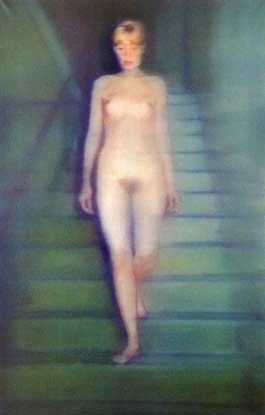
Gerhard Richter. Akt auf einer Treppe. Emma – Nu dans un escalier. 1966. Huile sur toile. Museum Ludwig, Cologne.
The paradigm shift was not limited to painting, but provided social change as a new form of expression in the arts. As in the above metaphor, the ability to shake the rules with the advent of a new medium is a latent opportunity for architecture, following Kandinsky’s dream of a great city built according to all the rules of architecture and then suddenly shaken by a force that defies all calculation.
One area where the advent of a new artistic medium provided massive reform over a field of art and various extensions into social and physical environments took place with advances in digital photography. Digital photography has redefined the values of photography. The popular belief of visual media as being a mirror of reality has been completely revised. Indeed before the digital, the subject was not that important, and any photographer was a reporter; he/she could be “good” by knowing where to look rather than passing by without noticing anything; but what has been captured in the photographic mirror of memories has its origins in a scene that had existed at a specific time. An image is not different from the represented object, but over the years its authenticity has changed. The information presented through visuals can be twisted by using specific semantic codes to attract the attention of individuals, and by re-creating a reality using digital effects. Through these means, its credibility has been questioned. We went from information to emotion, where the status of image has transcended the limits between public and privacy. Showing visuals of a private event makes this event become public. Now because of the lack of credibility in modern visuals, journalists use emotions to make spectators believe in the truth of the scene. According to the cultural theorist and philosopher Jean Baudrillard, the Gulf War disinformation made the information itself, rather than the events, the source of the scandal. 5
We now look for the credibility of the truth. Documentary used to serve as a mirror of an event until recently when its credibility was again made possible. As a recent example, during the terrorist attacks in London, individuals captured and shared media with journalists 6
By using media made by witnesses using their photo phones, journalists gained a credibility – justified or not – in the presentation of the event. Journalists could then use these media as a ‘credibility tool’ and reinforce their reports. The documentation of the London event evolved into a collaborative report; in fact, any individual who has a photo phone is potentially a reporter who can capture key events and by combining these captured visuals, create a popular visual narrative presenting the truth of an event. This shows the shift from traditional documentary to a collaborative documentary of an event.
The digital had almost killed the initial values of photography as a mirror of an event, but with the appearance of mobile digital photography tagged to a user, the digital has created a new visual medium and a new value of credibility with that medium.
Perhaps an even more direct, although somewhat archaic, example exists for the car. Before experiencing the car, people thought that we had lost something essential in ‘walking’ with the car. The car has forced us to redefine the world. Indeed, before the car, to experience acceleration one had to jump from a window, while now it is totally inbuilt in our body. The car has redefined our physical concept pertaining to objects and the sensation of acceleration 7
references
1William M. Irvins Jr. 1953. Prints and Visual Communication, Cambridge, Mass., 1953, p. 134.
2 Cababbe P. 1996. Duchamp & Cie, Editions Pierre Terrail, Paris 1996, p. 50.
3Rosenblum N. 1992. Une histoire mondiale de la photographie, Abbeville Eds, P259.
4Terzidis K. 2003. Expressive Form : A Conceptual Approach to Computational Design, London : Spon Press, Chapter 3 : Kinetic Form pp. 33-45
5Baudrillard, J. 1992. L'Illusion de la Fin, Éditions Galilée, Paris.
6 http://en.wikipedia.org/wiki/2005_London_transport_explosions
7Architecture Science and Technology, PICON, A. 2005, GSD personal course notes.
1William M. Irvins Jr. 1953. Prints and Visual Communication, Cambridge, Mass., 1953, p. 134.
2 Cababbe P. 1996. Duchamp & Cie, Editions Pierre Terrail, Paris 1996, p. 50.
3Rosenblum N. 1992. Une histoire mondiale de la photographie, Abbeville Eds, P259.
4Terzidis K. 2003. Expressive Form : A Conceptual Approach to Computational Design, London : Spon Press, Chapter 3 : Kinetic Form pp. 33-45
5Baudrillard, J. 1992. L'Illusion de la Fin, Éditions Galilée, Paris.
6 http://en.wikipedia.org/wiki/2005_London_transport_explosions
7Architecture Science and Technology, PICON, A. 2005, GSD personal course notes.
Thursday, March 09, 2006
Digital and virtual applications can inform our conception of the physical space
Digital infrastructure and applications are growing in breadth and scope.
These technologies now reach across multiple generations. Furthermore, it is now common for digital technologies to borrow rules from the physical environment, extending their interfaces through tangible means. Indeed, we enter a technology cycle characterized by the disappearance of a number of boundaries that we were used to, this happens with nanotechnology, biotechnology, and information.
These technologies now reach across multiple generations. Furthermore, it is now common for digital technologies to borrow rules from the physical environment, extending their interfaces through tangible means. Indeed, we enter a technology cycle characterized by the disappearance of a number of boundaries that we were used to, this happens with nanotechnology, biotechnology, and information.
We are surrounded by artificial intelligence through the means of microcontrollers in our space, body and networking".1
However, an interesting dichotomy exists between the physical and digital. Despite efforts to inform digital design with physical rules, digital technologies have a tendency to drive people from the physical space. Digital applications are attracting and extending our social, community based, and physical means of interaction, e.g. gathering, friendships through online communities, diary through blogs, research online, even the way we order food. The question is: now that we have been digital, how can we return to the physical and do so by gaining the value of our digital opportunities? How can we leverage the benefits of the digital while driving new interactions within the physical environment?
1
Kaplan D. 2005. « Civilisations numeriques », premiere: Conquetes et conflits, InternetActu #92.
Kaplan D. 2005. « Civilisations numeriques », premiere: Conquetes et conflits, InternetActu #92.
By Cati in Personal research
Saturday, February 18, 2006
Product design for relaxing
A need to be comforted?
I found this very interesting entry on Pasta and Vinegar:
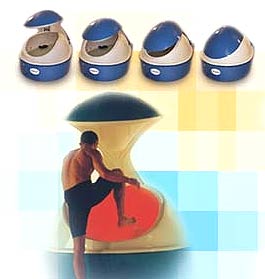
The Flotarium concept is a spaceship-looking sensory deprivation capsule full of water and salts to create optimal buoyancy so that people can float and relax.
The napmosphere
via a modular system meant to be like a cocoon providing a place of shelter.
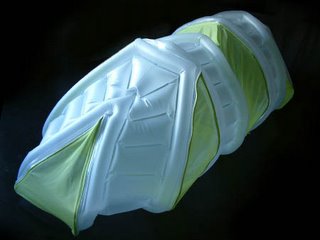
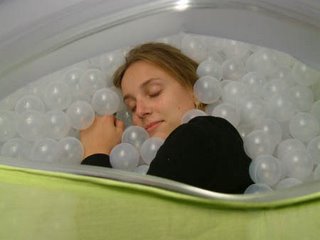
The napshell, the sleeping capsule, is also very interesting. It's powerful shape acts as eyecatcher that attracts attention to itself. A modular system allows different Areas of use: A simple variant of the object is designed for outdoor areas. The robust construction could be used within parks or in open places as public furniture. This would allow the object to reach a broad audience.
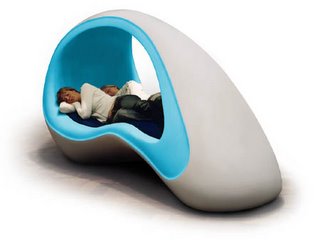
Power-Napping ...
I found this very interesting entry on Pasta and Vinegar:
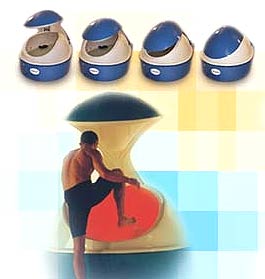
The Flotarium concept is a spaceship-looking sensory deprivation capsule full of water and salts to create optimal buoyancy so that people can float and relax.
The napmosphere
via a modular system meant to be like a cocoon providing a place of shelter.
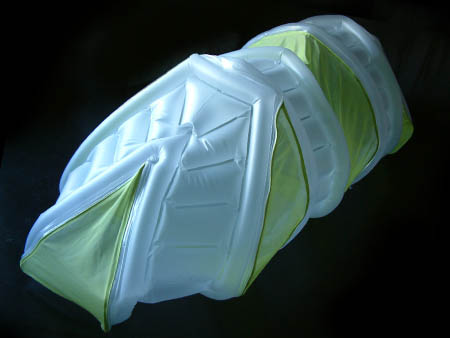

The napshell, the sleeping capsule, is also very interesting. It's powerful shape acts as eyecatcher that attracts attention to itself. A modular system allows different Areas of use: A simple variant of the object is designed for outdoor areas. The robust construction could be used within parks or in open places as public furniture. This would allow the object to reach a broad audience.

Power-Napping ...
By Cati in Research
Tuesday, February 14, 2006
Whispering Landmark : a low cost mini skyscraper
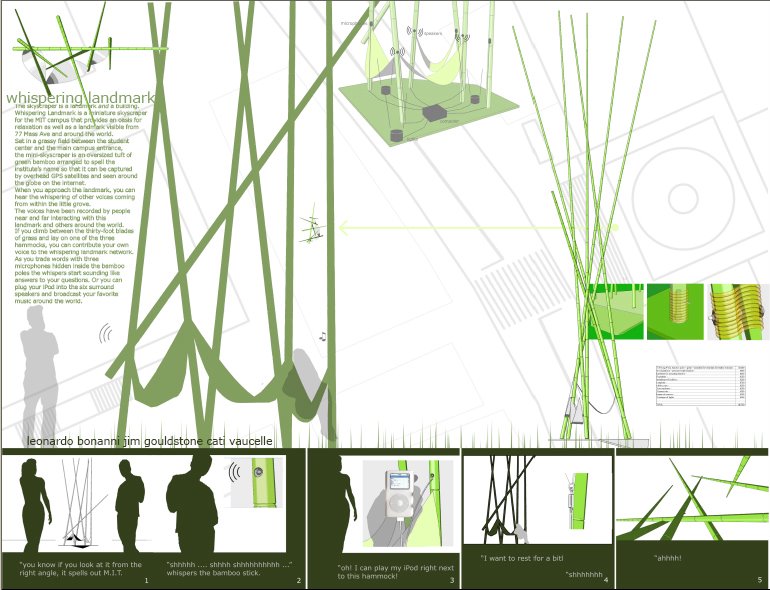
For the MIT mini skyscraper 06 competition I have designed a Skyscraper as a Landmark and a building. I made this project with students and researchers from the MIT Media Lab L.Bonanni and J.Gouldstone.
Whispering Landmark is a miniature skyscraper for the MIT campus that provides an oasis for relaxation as well as a landmark visible from 77 Mass Ave and around the world. Set in a grassy field between the student center and the main campus entrance, the mini-skyscraper is an oversized tuft of green bamboo arranged to spell the institute’s name so that it can be captured by overhead GPS satellites and seen around the globe on the internet.
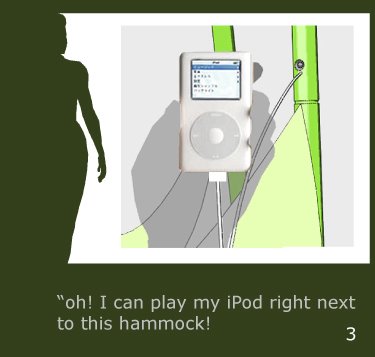
When you approach the landmark, you can hear the whispering of other voices coming from within the little grove. The voices have been recorded by people near and far interacting with this landmark and others around the world. If you climb between the thirty-foot blades of grass and lay on one of the three hammocks, you can contribute your own voice to the whispering landmark network. As you trade words with three microphones hidden inside the bamboo poles the whispers start sounding like answers to your questions. Or you can plug your iPod into the six surround speakers and broadcast your favorite music around the world.
For the competition we had a model and a working demonstration of the technology.
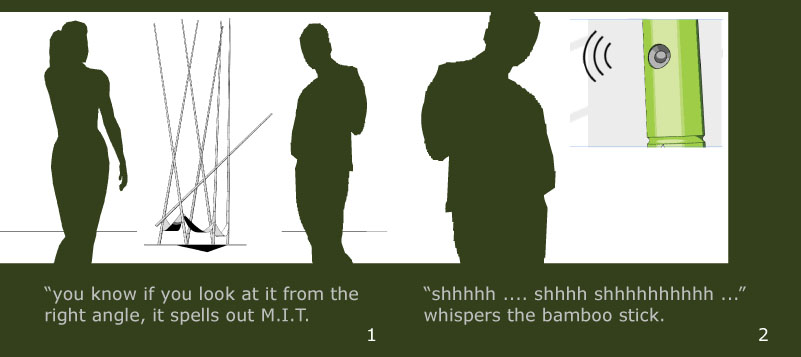
Our visual scenario of interaction


By Cati in Personal Architecture
Friday, February 10, 2006
Taptap and its next steps
The Seamless Fashion show has presented Taptap a project I team-developped for the Tangible Interface class at MIT Media Lab. Previously called Touching Memories, it is about the possibility to record memories of touch.
I cared about recording affectionate touch rather than touch used during physical therapy or learning. Trying to find a potential application for this concept, I remembered the urgency in the need of nurses during war; during such event orphans, especially young babies, need a certain amount of hugs to survive. The scarf was then an attempt to overcome this problem. It could be used as a platform for the nurse to hug many children at once and help them survive. After discussing with Leo about this application, he has found some research on baby monkeys in relationship to an artificial mother. Regarding the design and this application in mind, I wanted the sensory object to be a scarf to easily position the sensors where and when needed. The modularity also offers the potential for the scarf to be independent from the electronic as much as the electronic to differ from the scarf and have a life on its own.
We have written a work in progress paper for CHI'06 about Taptap that has just been accepted. We are now discussing with health care department about the next steps of our system.
In the meantime, Taptap has been exhibited at the Seamless Fashion Show in Boston.
The following in a slideshow presenting the pictures I took of the fashion show
Photos during rehersal and also more photos during the fashion show.

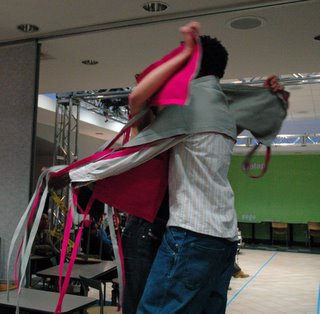
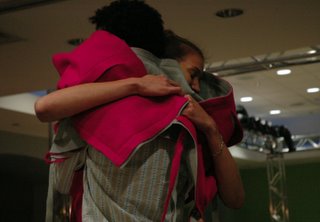
Models: Lauren and Joy
I cared about recording affectionate touch rather than touch used during physical therapy or learning. Trying to find a potential application for this concept, I remembered the urgency in the need of nurses during war; during such event orphans, especially young babies, need a certain amount of hugs to survive. The scarf was then an attempt to overcome this problem. It could be used as a platform for the nurse to hug many children at once and help them survive. After discussing with Leo about this application, he has found some research on baby monkeys in relationship to an artificial mother. Regarding the design and this application in mind, I wanted the sensory object to be a scarf to easily position the sensors where and when needed. The modularity also offers the potential for the scarf to be independent from the electronic as much as the electronic to differ from the scarf and have a life on its own.
We have written a work in progress paper for CHI'06 about Taptap that has just been accepted. We are now discussing with health care department about the next steps of our system.
In the meantime, Taptap has been exhibited at the Seamless Fashion Show in Boston.
The following in a slideshow presenting the pictures I took of the fashion show
Photos during rehersal and also more photos during the fashion show.


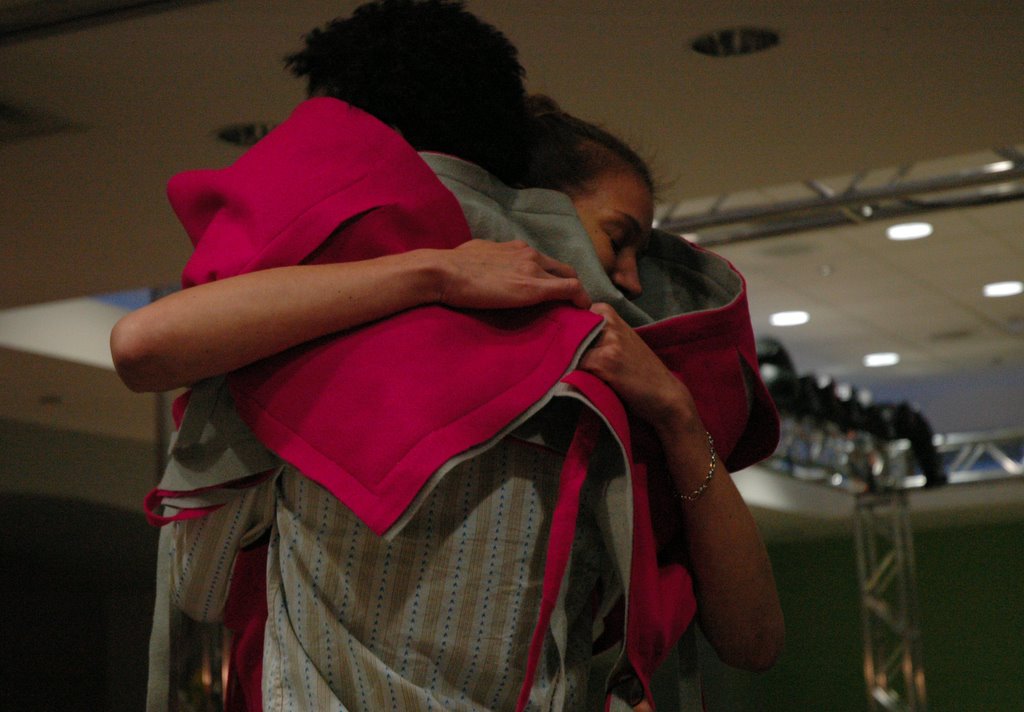
Models: Lauren and Joy
By Cati in computational product design
Subscribe to:
Posts (Atom)
