Tuesday, January 24, 2006

Research on Light as a Material


The Texture of Light is research on the lighting principles for life feed video metamorphosis in public space using the reflection of light on transparent materials.

Material Background

Research on light properties on transparent materials.

The first property of light we consider is reflection from a surface, such as that of a mirror. When light is reflected off any surface, the angle of incidence is always equal to the angle of reflection. The angles are always measured with respect to the normal to the surface. This can give us a modification in the geometry of a represented image if the normal is twisted.


I also researched on color transformation and color density of an image through transparent materials. Refraction is the bending of light as it passes between materials of different optical density. The formula of the index of Refraction of a material is the ratio of the speed of light in vacuum to the speed of light in that material: n = c/v where v is the speed of light in the material.
The more dense the material, the slower the speed of light in that material. In Texture of Light a extra piece of transparent material on top of the Plexiglas lense makes the speed of light in that material slower, then less bright. That explains the opacity of the final colors. Also the change in speed and wavelength at the boundary between two materials causes light to change direction.

I have looked at the diffraction phenomena to transform light passing through transparent materials. Diffraction is the apparent "bending" of light waves around obstacles in its path.

Diffraction of waves through a slit.

This bending is due to Huygen's principle, which states that all points along a wave front act as if they were point sources. Thus, when a wave comes against a barrier with a small opening, all but one of the effective point sources are blocked, and the light coming through the opening behaves as a single point source, so that the light emerges in all directions, instead of just passing straight through the slit.

Concept
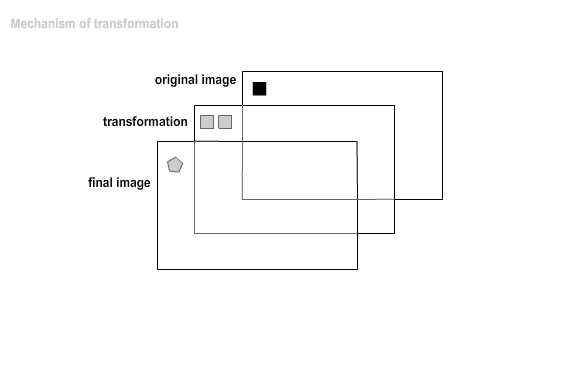
My original idea was to transform a picture by applying different transparent sheets between the captured image and the projected final image.

Inspiring research

Dr Saul Griffith who graduated from the MIT Media Lab has reconstructed magnifying lenses using liquid plastic.
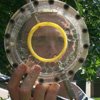
Movie presenting his implementation

This work is used by the Low Cost Eyeglasses enterprise whose goal is to design eyeglass systems that make eyeglasses inexpensive and easy to purchase.
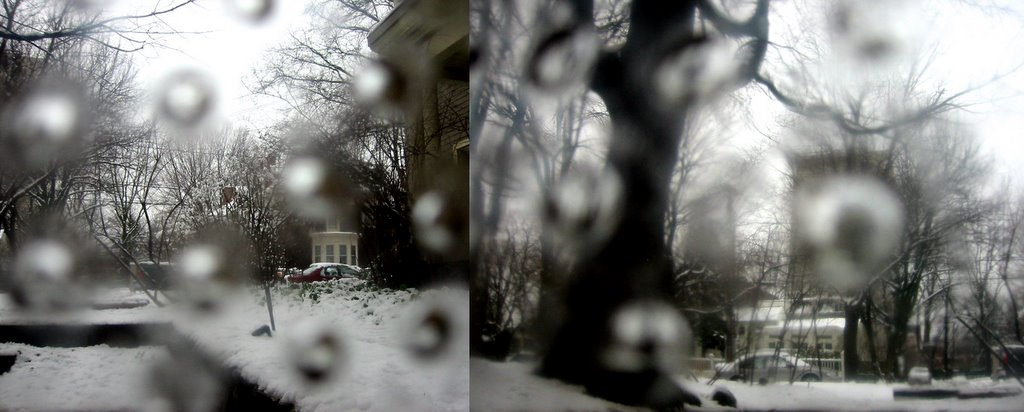
Movie maker Patrick Bokanowski seems to have used water, oil, glass material on his movies experiments as seen in Au Bord du Lac (1993). I believe that cinema offers an interpretation, a point of view of reality. What if this point of view was due to light transformation? Bokanowski experimental cinema work has inspired me to analyze this type of imagery that presents a distortion of light and offers a possible reinterpretation of its meaning.
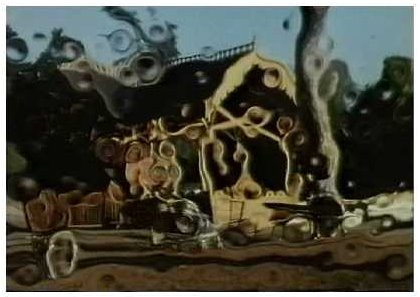

Screenshot of Au Bord du Lac (1993) by Patrick Bokanowski.

Experimentations with transparent materials
To instantly transform light on life feed video into the public space, I had the choice of applying mathematical formulas onto the captured digital visuals or re-discovering the direct use of light. The tangible potential of direct use of light onto Plexiglas lenses and transparent materials offers two main options that are key in this project. One is the collaboration in the public space facilitated by tangible means. The other one is the improvisation and experimentation space offered by such tangible and mechanical system.I also had to decide if I wanted to work on still or moving visual captures. I have realized that transforming a still image is not as powerful as the moving image metamorphosis. One can easily recompose the still image by understanding its light distortions. However, by applying lighting principles on a moving image, the mental re-composition is difficult thus the re-interpretation of the unknown is very fascinating. The reality becomes a painting, a moving painting.
A series of experiments with transparent materials allows me to analyze video metamorphosis. During these experiments, I have used water on clear plastic, shower gel, polyoptic 1410 clear plastic, crystal clear flex: clear flexible, material that melts on high temperature and dries quickly within average temperature.
The following are screenshots of videos documenting a selection of material tests.

A drop of water onto a clear rigid plastic sheet
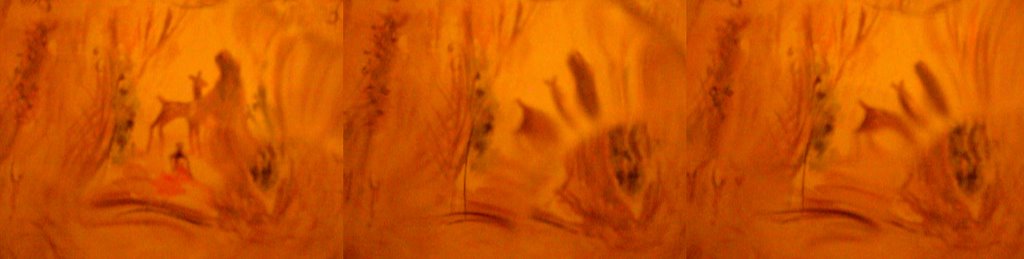
The video camera is still, the drop of water is moving

Transparent shower gel onto a clear rigid plastic sheet
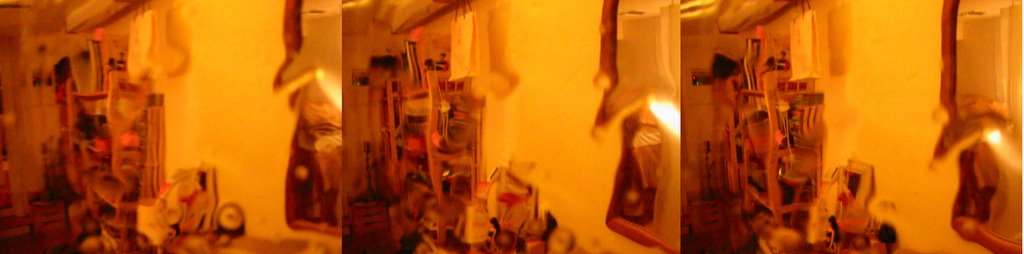
The video camera is still, the rigid clear plastic sheet moves, the shower gel stays still

Transparent shower gel onto a clear rigid plastic sheet

The video camera moves with the rigid clear plastic sheet

Polyoptic 1410 clear plastic onto a clear rigid plastic sheet

The video camera moves with the rigid clear plastic sheet

Results
The shower gel has a life on its own: moves, changes texture & density over time. This particularity allows more irregularity in the transformed image thus the final transformed image resembles a painting. Also, the mapping between the original image and its final transformation is harder to perceive. This allows more attempts in interpreting the visuals.The material that melts on high temperature and dries under an average temperature can be sculpted easily and used as silicon. However as it dries, the density of the material is so high that it is difficult to see through.The clear plastic on the other hand is more difficult to sculpt and does not allow much improvisation after being fabricated. To allow more control over light transformation, I have decided to use clear plastic molds and Plexiglas lenses. I have used Crystal Clear & Clear Flex for the patterns and lenses. I used transparent Plexiglas for the structure of the lenses.

Design of the lenses

Laser cut Plexiglas lenses as clear plastic molds
I have designed different lenses sizes, each with different pattern shapes and pattern sizes. In addition, I have used flat lenses on which I have created clear plastic patterns, e.g. drops of clear plastic, rows of lines.
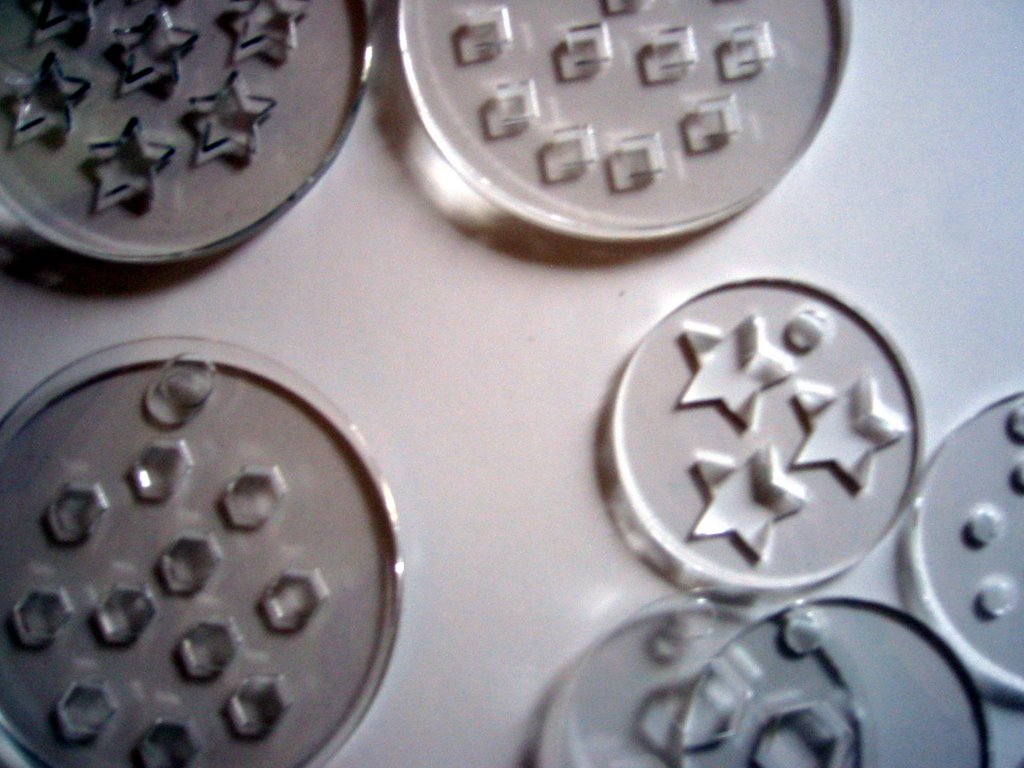

Regular patterns laser cut into transparent Plexiglas
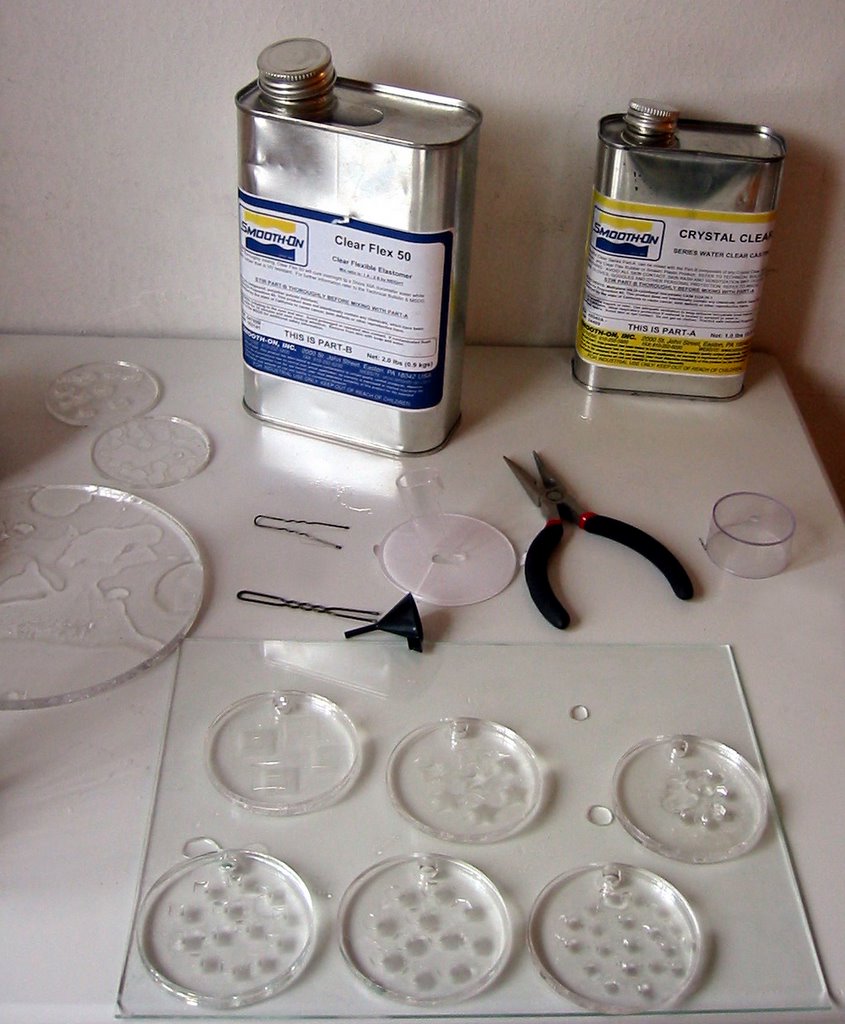

After many chemical attempts, final choice: Crystal Clear & Clear Flex
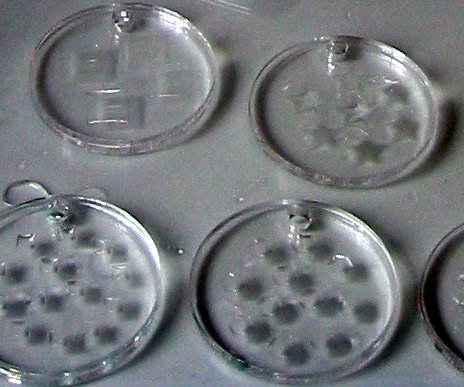

Plexiglas lenses filled with Crystal Clear & Clear Flex mix (1A:2B)


Lense with irregular patterns positioned at 2cm from the video camera
This is the research conducted to create my final project: The Texture of Lightfor the Smart Materials course taught by Michelle Addington

Paper about the project (12mb)

More links

Very interesting related research Gate Vision, found on we-make-money-not-art (blog that is part of the best european ones). The results of this project are kaleidoscopics and the mechanism is digital rather than mechanical.
I particularly liked the circular metaphor of the visuals and reminded me of one of my favorite experimental movie Lapis by James Whitney (1966)an abstract art film composed of images produced by an analog computer.


Sunday, January 22, 2006

The Texture of Light

Description
The Texture of Light is research on lighting principles and the exploration of life feed video metamorphosis in the public space using reflection of light on transparent materials. The Texture of Light is an attempt to fight the boredom of everyday life. By reconstructing reality, giving it a texture, an expressive form, this project deploys the simple use of chemistry, plexiglas, and plastic patterns. The transformation of life feed video comes from the physical plastic circles that act as different masks of reality. These masks can be moved around and swap by the public enabling collective expressions. This metamorphosis of the public space is presented in real time as a moving painting and is projected on city walls. The public can record video clips of their 'moving painting' and project them back on different city locations.

Model

The final model is composed of a set of lenses, an iSight video camera, a rotary knob and a computer. For the purpose of this project I have conceived and implemented a software piece that links the life feed video to a projection screen. This application is controlled by the rotary knob and by pressing more than two seconds the knob, the software records a video clip coming from the life feed video. By pressing on the knob, the software plays back the recorded clip and projects it onto the screen. By turning the knob, the software returns in life feed mode. The video clips are collected onto a server and can be accessed by other computers from different cities. This instantly creates a canvas of multiple transformed city video clips controlled and created by the dwellers in each city.
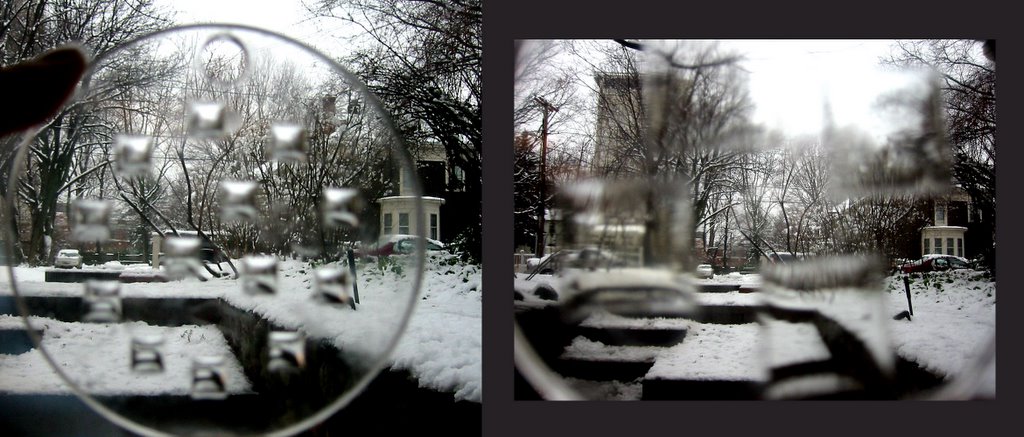
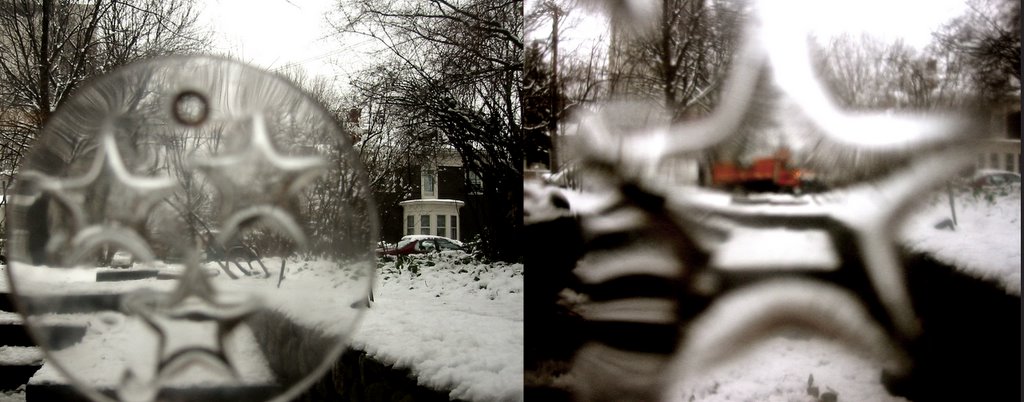
Excerpts of life feed video metamorphosis Clic on the picture for a hi-res view

Small-squares large lense


Small-circles small lense


Medium-hexagons large lense


Large-stars small lense

Future outlook for Texture of Light
I envision this project on a larger scale such as building-size panels the public could mechanically control using remote devices. Each panels will be patterns and transparent material specific. For instance, two Plexiglas sheets could embed a water fall, or viscous transparent material the user could distribute along his/her selected point of views. The software will allow media distribution among cities so that the outcomes of the public performances could be exposed on the panels of other cities.

This is my final project for the Smart Materials course taught by Michelle Addington. Some information about the research and tests involved in this project.

More about the project
. Paper about the project (12mb).
. The Texture of Light on We Make Money Not art.
. auto vision
. Publication: The Texture of Light Vaucelle, C. In Art and Design Tools. Published in the Proceedings of SIGGRAPH'06, Boston, USA. Abstract from publisher: ACM Press.
download pdf

Friday, January 20, 2006

The Breathing Wall


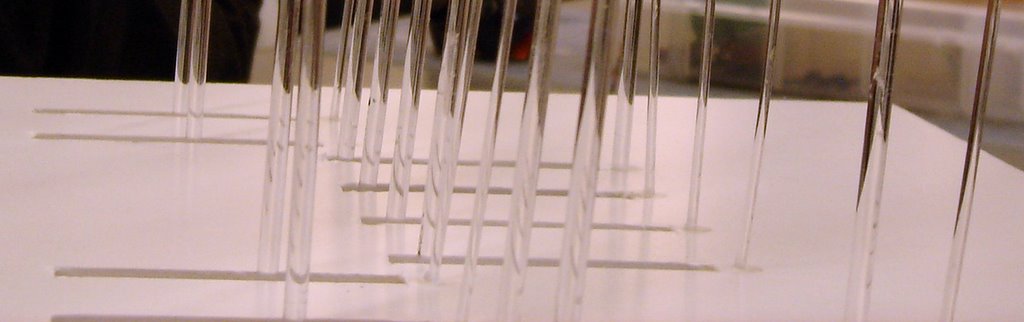
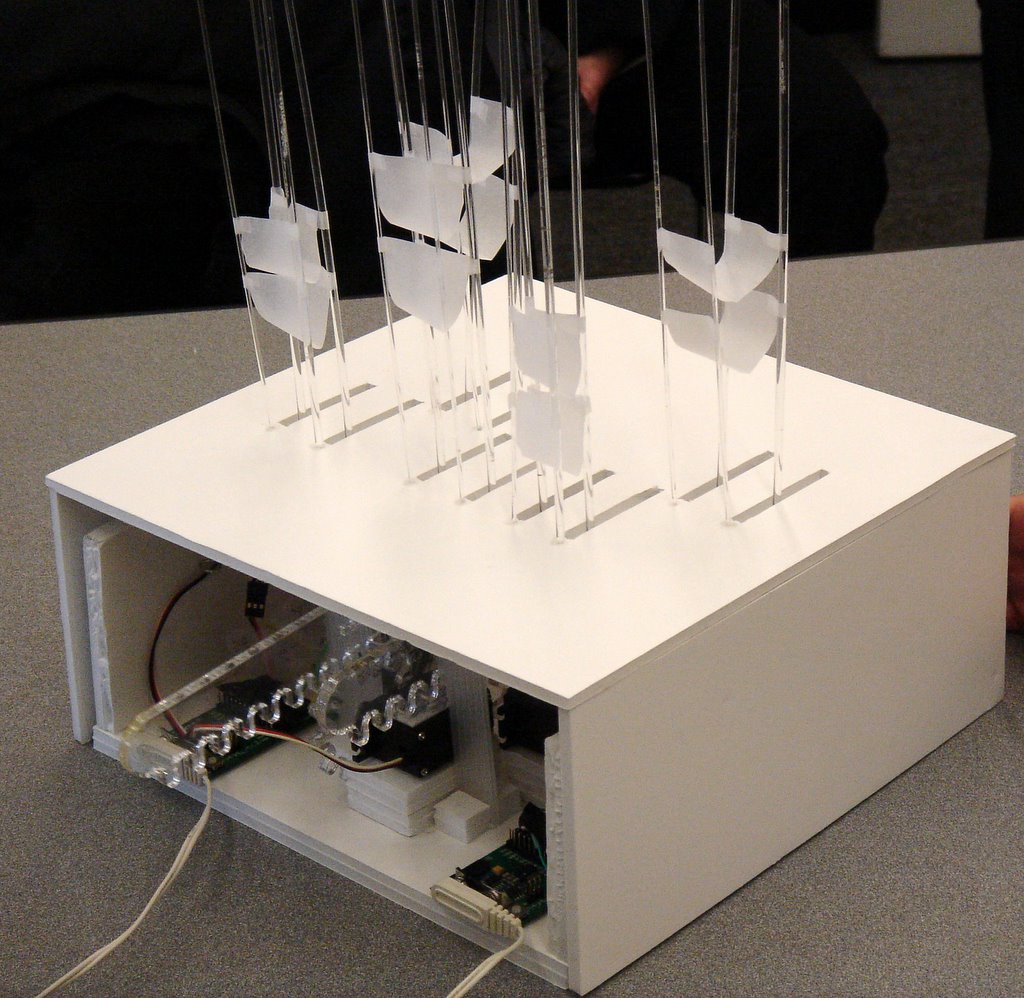
The Breathing Wall is a Kinetic Installation that shows a wall reacting to the public space. Made out of architectural objects that work independently or dependently of one another, it deploys and retracts soft fabric


This picture shows the mechanics and electronics of our Breathing Wall piece.


On this picture I create shadows on the light sensors to have the Breathing Wall react to my presence.

During our conceptual phase, we thought of an assembly of cloth cubes that would form partial transparency. When densely packed, they form a privacy cloud or mist enclosure. When they retract they close the view they were enhancing. The idea is to use these kind of elements to define more diffuse borders in architecture. Soft edges resembling the spatial limits one finds in nature and in the landscape.

Our concept


Inspiring research

We would like to think of it on a scale of a huge wall, where the experience an outsider has of the activities going on inside is shifting constantly by the affordances of the changing architectural surface.

Process of implementation
First round


Second round


I have created this kinetic piece with Ana Aleman. It is our final assignment for the Kinetic Architecture class taught by Dr Kostas Terzidis.

Review process summary

For the first assignment of this class I had designed a Memento Box as an attractive passage from door to space. The door leads to your souvenirs and is always slightly opened. A bright light shines in the back of the box clarifying a few objects and pictures around it. However, whenever your hand tries to grab what captures the eye, the door closes onto your hand in front of you and all is dark again. Whenever you go away for a tiny bit, the door opens up and more lights shine into some parts of your souvenirs and you can travel though them from far away ...


Picture of the Memento Box

For the second assignment of this class I had designed the Ambient Peacock/Chameleon explorer with Philip Vriend as a serie of mobile units connected to a headquarter that display environmental visual on each of their shell. Real time connecting to the headquarter allow the head to ask for specific data gathering and collection of the environment. This project was blogged by Pasta and Vinegar.


Picture of the 'air' mobile unit

By Cati in kinetic architecture

Wednesday, January 18, 2006

PlayPals: Tangible Interfaces for Remote Communication and Play


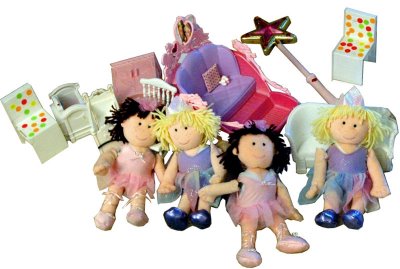
PlayPals are a set of wireless figurines with their electronic accessories that provide children with a playful way to communicate between remote locations. PlayPals is designed for children aged 5-8 to share multimedia experiences and virtual co-presence. We learned from our pilot study that embedding digital communication into existing play pattern enhances both remote play and communication

The project PlayPals is a team and class project for the Tangible Media class mid-term assignment at MIT Media Lab taught by Dr Hiroshi Ishii. It was presented as an extended Abstract of Conference on Human Factors in Computing Systems (CHI '06), (Montreal, Quebec, Canada. April 22-27, 2006) by Bonanni, L., Lieberman, J., Vaucelle, C., Zuckerman, O. (alphabetical order).

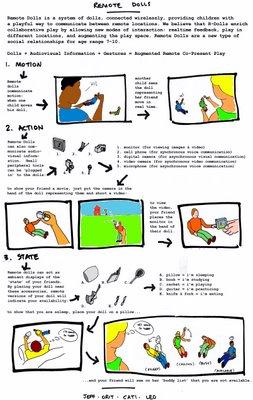
Our concept poster


On this picture I interact with the doll, Leo being on the other end


Our implementation poster


By Cati in computational toy design

Thursday, January 12, 2006

Taptap, the affectionate scarf

TapTap: A Haptic Wearable for Asynchronous Distributed Touch Therapy

I continued the development on my conceptual idea touching memories and as a team we came up with a final prototype called 'taptap'.

TapTap is a wearable haptic system that allows nurturing human touch to be recorded, broadcast and played back for emotional therapy. Haptic input/output modules in a convenient modular scarf provide affectionate touch that can be personalized.

Movie of Taptap


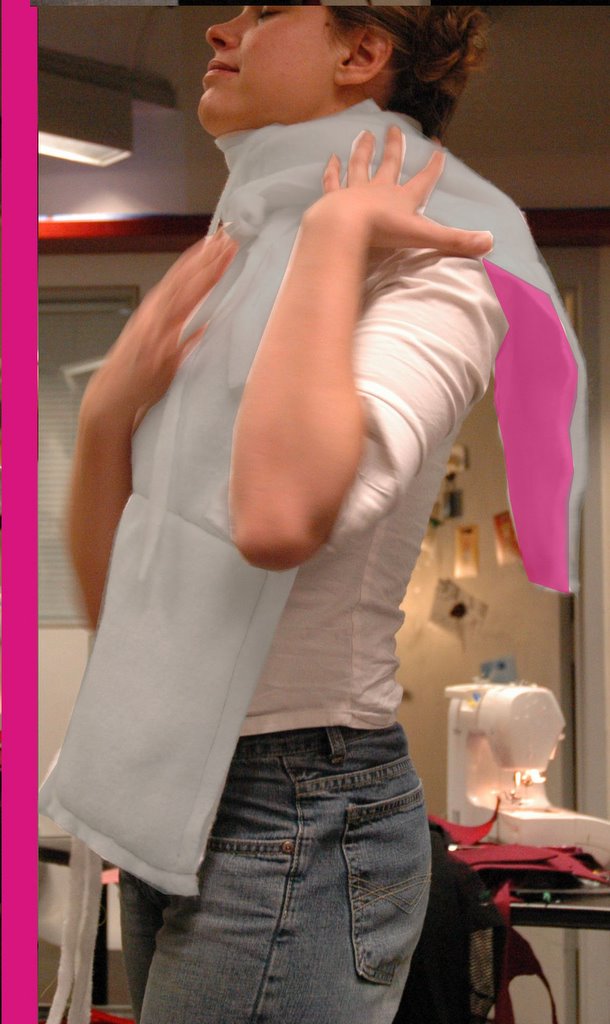
This picture shows the second prototype that is a scarf with large pockets with a power supply. The design of the scarf is intended to make it wearable in a number of ways and allow specific TapTap actuators to be mounted wherever the wearer desires. The outside of the scarf is a public color (gray) while the inside and its intimate actuators are a warm color (pink).

Based on haptic devices, taptap can be re-configured to record and play back the touch that is most meaningful to each user. It is made from felt in two layers: one grey one that faces the public and a pink layer that touches you and contains the haptic modules in specially designed pockets. Taptap can be worn as a regular scarf, and custom touch modules can be placed in powered pockets within to record and play back touch where and when you want it


Taptap was blogged by Regine Debatty on we-make-money-not-art.com with a nice summary and useful references :)

Taptap is a team and class project for the Tangible Media class final assignment at MIT Media Lab taught by Dr Hiroshi Ishii. I presented with Leo at CHi'06 as an extended Abstract of Conference on Human Factors in Computing Systems (CHI '06), (Montreal, Quebec, Canada. April 22-27, 2006) by Bonanni, L., Lieberman, J., Vaucelle, C., Zuckerman, O. (alphabetical order). Download pdf.

Taptap was part of the second Seamless fashion show, on February 1, at the Boston Museum of Science.

On this picture, I wear a second prototype

A few publications on Taptap and its next steps:
. A Framework for Haptic Psycho-Therapy Published in the Proceedings of IEEE ICPS Pervasive Health Systems Workshop, Lyon, France, 2006.
. Affective TouchCasting Published in the Proceedings of SIGGRAPH'06, Boston, USA. Abstract from publisher: ACM Press. Download pdf

Tuesday, December 27, 2005

Socially constructed materiality

As part of ARCHITECTURE SCIENCE AND TECHNOLOGY, AN INTRODUCTION, course by Antoine Picon, Harvard University.

Digital architecture is about materiality because materiality is changing.
Materiality is culturally constructed, but the problem is the definition of materiality, materiality is not nature. It is the image we have of nature. The notion of nature is also socially constructed through what we can produce, and nature can be different. Today it is basically informational. It is about movement and the definition of nature over time changes.
Materials are socially constructed: before a bone was a material, now we construct material as much as we construct nature. There is this idea that materiality is the relation we have to what seem tangible in the world. The way we perceive materials and objects when we are not sure if we touch or if it in our brain, it is a problem. With the computer, we don't know what we touch. There is an extension to us: it goes into us.

Materiality is then constructed through:
1- a sensory education To live in a culture is to learn how to perceive things in a certain way, e.g. colors differ in culture, so there is a construction of the senses.
2- tools a society with tools, e.g. lenses, microscope, sees things differently.
So people who thinks there is a problem with computers think there was a problem before. Digital architectural representation is a virtuality because it can represent everything. It occupies an impossible point of view.

Then what's new with the computer screen? Has it been close to materiality? Thre is the thickness of the computer screen; there is a layer of software much more than in the traditional pencil that transfers in the paper. Redefining pertaining objects: natural versus cultural. The semantic of words is interesting, for instance, 'poutre' in French means two different things, so it makes us see things differently depending on our culture.

There is an analogy with the car: before people thought that we had lost something essential in walking with the car. The car has forced us to redefine the world. Before the car, to experience acceleration you had to jump from the window, now it is totally inbuilt in our body, this is totally structured. The car has redefined pertaining objects and also the sensation. With the acceleration you feel in power and also the vulnerability of the body in this moment, e.g. the Starwars race computer game. This goes to an existential thing. We also use computer metaphors and our perception of our body is changing through the machine we build. The computer is something we drive like a car. The perception of landscape is changing via having experienced the car.

The computer has redefined certain things:
- deformation we can twist things
- geometry focus that explains why we have so many frozen flows project
- surface, light and texture it has drastically changed what is around us. Grain conduction, there is a return to ornament which is very different from traditional ornament and now it becomes texture. Digital architecture is one syndrome: fascination for light and texture. The computer makes a global syndrome more visible

Redefinition of materiality new pertaining objects, new sensations; however when you gain something, you loose something. There is also the problem of scale, hence the fascination for the fractale, there is a dissociation with the material where you can view infinitely. Before architecture represented bones, now architecture is boneless. This is the end of structure and information kills structure. The machine is a combination of software and hardware layers. It has influenced the way we interface the layers in architecture. We went from the gothic cathedral, e.g the Switz clock, to the layered architecture, e.g. hamburgers in Mc Donald.

Technology is about interfacing different realities, linguistic and economic use of heterogeneity. Architecture is now about deconstruction of techtonic. The classical language of techtonic is deconstructed and even worse the dissolution of the system. It is not a dematerialization of architecture, it is a shift. There is today an affinity with the baroque.
Tool: an externalization of the body function. The computer is an externalization of the mental function. We internalize while we externalize and then we become our tool. When we use for instance a hammer, we think ourselves using the hammer. Lots of people use the computer as a metaphor: my hard drive is broken. I am a 386. The machine can create even pain. The computer is not just an extension of the mind but also an extension of the body. There are plenty of experiment on senses: vision, smell, and the perception of space changes. 'Zooming' has now become a totally normal activity. Everything is zoomable now. The crisis of scale: we perceive things very accurately more from far than from close. This is the crisis of intermediary scale. The way we perceive nature today: stable and unstable. Things are constantly changing, as we live in a world of mutation; this is a qualitative transformation, a magic condition due to metamorphosis, e.g. zoom, that can apply to painting or architecture. The very very concrete becomes abstract and the very very abstract becomes concrete, e.g. if I zoom in a face it becomes skin and then the skin itself becomes landscape. Materiality was the reversed from the abstract, and the computer is not a machine in the traditional sense, but it is an environment. There are new ways of inhabiting this strange world, world with decorativeness, playing with surfaces, ornaments. Traditional ornament had a scale because it was linked to the body and the human scale. Today it is not linked to the human scale anymore. We are passing from human-body technology to technologies that can only be thought in term of landscape and is not the world around us.

Conclusion
In traditional architecture, space was a given. Today, space is not a given: it is very small or very huge. We have a human responsibility but not in the megalo-utopia. We are responsible in this redefinition of materiality.

In architecture theory
Notes taken during the Architecture Science and Technology class taught by Antoine Picon 12th Dec 2005

New materials and technologies

As part of ARCHITECTURE SCIENCE AND TECHNOLOGY, AN INTRODUCTION, course by Antoine Picon, Harvard University.

Materials and a new way to define materiality

What is the situation in the field of technology?
There are a few reflections and the idea is that we are in the middle of a revolution regarding materials. This is somewhat true, for instance 'the microcapsule' and material research for architecture. We now design materials at the molecular level and then designing structures will be less important than designing material, e.g. the evolution of concrete. It became a material and is decomposed into properties such as: needs less water, less cracks, etc... For instance, la grande arche de la Defense would have been impossible without compact concrete. Concrete is now mixed and has mechanical properties, e.g. curve, etc... then it can be used for chairs. There is a redevelopment in furniture in concrete. It is not without danger because it can produce monsters :D and cannot be destroyed.


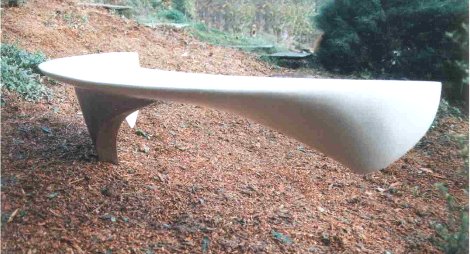
Ben Barrell beautiful bench

There is also 'glass' and the reflection on the glass using piezzo electric technology and the smart materials bluring between materials and structure, the development of composite and of smart materials which create a blur between materials and structures. There is a material revoluion, the first one was done at MASA then there is a contamination, however it has not reached architecture yet. At what level do we design today? Farbric can now be designed and there is a notion of new modernity which is not much about structure but more about material. There is then a current important question which is: how traditional design will position itself toward the material revolution?

Computer simulation
The computer simulation made possible a whole range of things: more computation, more domains. For instance, fireproofing. Before there was a big structure, an envelop to protect against fire. Now protection against fire is done dynamically. We then think of fire in a dynamic way, for instance what burns first and what burns last. This is a totally different design that takes in consideration the logic of collapse. For example, the 11th of September, the catastrophic tower collapse happened dynamically, so a protection against such catastrophes cannot be conceived as static anymore.
Computer simulation enables a lot but is not exactly the real world, so atomic tests are still needed, because no computer simulation can tell us how things edge and so on. Simulation raises a lot of questions imposed by the program and even color codes tell us how things are to be designed. The collapse of Roissy airport terminal was a good example of the limitations of computer simulation. There was a problem in the construction process that could be due to the computer simulation. The tradition simulation mode is still in use, e.g. the heat propagation in a building using a saline solution.

Structure and scale factor
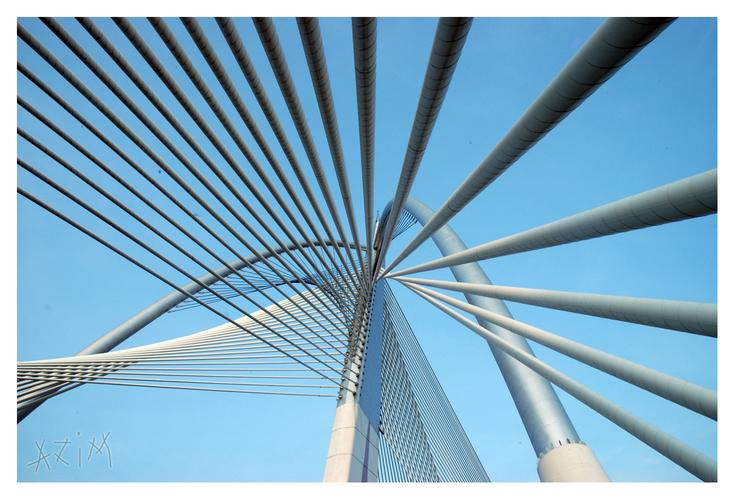
If we look at suspension bridges for instance the Washington bridge of 1 km and the Golden Gate of 1km300 and that now we reach 2km bridges, the scale of structure creates problems. The gigantism does not prevent diversity, e.g. deck can be thick, or aerodynamic deck. However the gigantism has created a specific European type of answer and now that bridges can be 2km long, we need to take in consideration the curvation of the earth, because from the start to the end of the bridge the curvation is different. The cables of such bridges are huge as well and there is no limitation for suspension bridges. The cable state bridge is an obscession from European to
Japanese because of aesthetics and engineering issues. These bridge cables are wrapped in an aerodynamic shape to resist the wind.


Examples of cable bridges

Then towers will become higher and lighter themselves and the problem is not to pile up elements but more physiological elements, for instance, ear problems. Piano's genius to to consider that gigantism works if we pay attention on other problems than just structural problems, e.g. air condition mixing gradually with hot air using the curve of the building. Performance and large scale is a major problem on what happens today.
The relation between architecture and infrastructure: The architect provides the meaning to the node of the network. The architecture itself can become the infrastructure, for instance at an airport, system of place and infrastructure. There was two movements in the 20th century: gigantism and lightness (solution like their shell that are in plywood, etc.) This movement lead to membering. The most efficient surface; wooden structure, beautiful structure. There has been research on surfaces, plastic parts, wired network. Some are pretty thick but pretend lightness and lightness can go with gigantic things, a new poetry is then emerging. We are very far from this lightness idea at an international level, for instance China does not appropriate light structures. We are not ready to live in a world of membering, lightness, however if we use tension, we can do things much lighter and stable and it can function at any scale. This is the field of 'tensegrity', e.g. arch vault in tensegrity which is a pretty sophisticated geometry compared to other type of structures.

Conclusion
We can now do everything we want. Is everything what we want?
For instance, there are ethical problems even in engineering and architecture, and if we link a continent to an island, we change the way people live on the island. There is a moral responsibility of the architect, so how to build?
We thought we knew what to build, but now it involves discovering new materials, developing material and computation. Architects used to be asked to produce a form only and education in architecture is not adapted to this movement.


By Cati in architecture

Saturday, December 10, 2005

cities: 10 lines. approaches to cities and open territory design


From Sept 2005 until now I have created the graphic design for the exhibition: cities: 10 lines. approaches to cities and open territoty design currated by joan busquets and felipe correa at harvard graduate school of design.


By Cati in 'on the side' work

Saturday, December 03, 2005

The ambient peacock explorer

The Ambient Peacock Explorer
I developed the Ambient Peacock Explorer as a framework for mobile units to document on their environment and report back to a central hub

I believe that new work in this area can physically substantiate the documentation through tagging, the incorporation of physical communities or other conceptual redefinitions of the environment one seeks to capture.

structure mobiles units + headquarter

mobile units independent from the headquarter
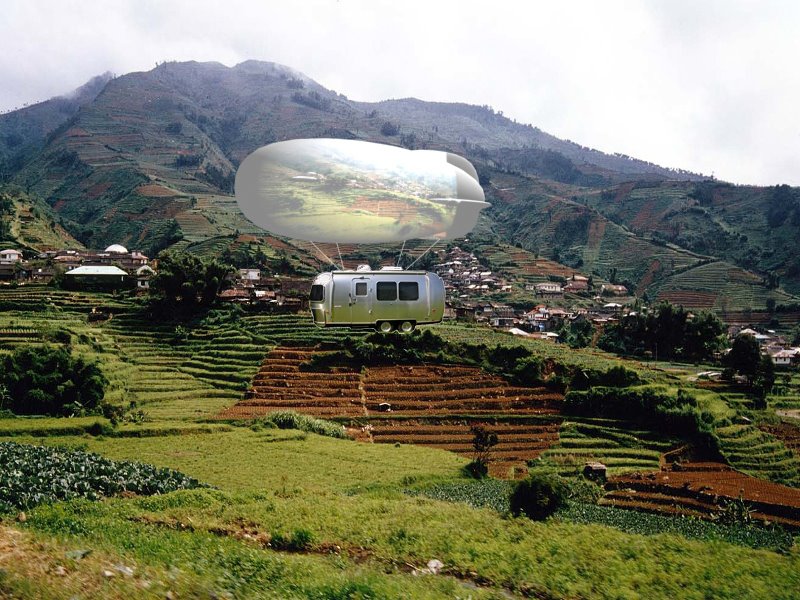
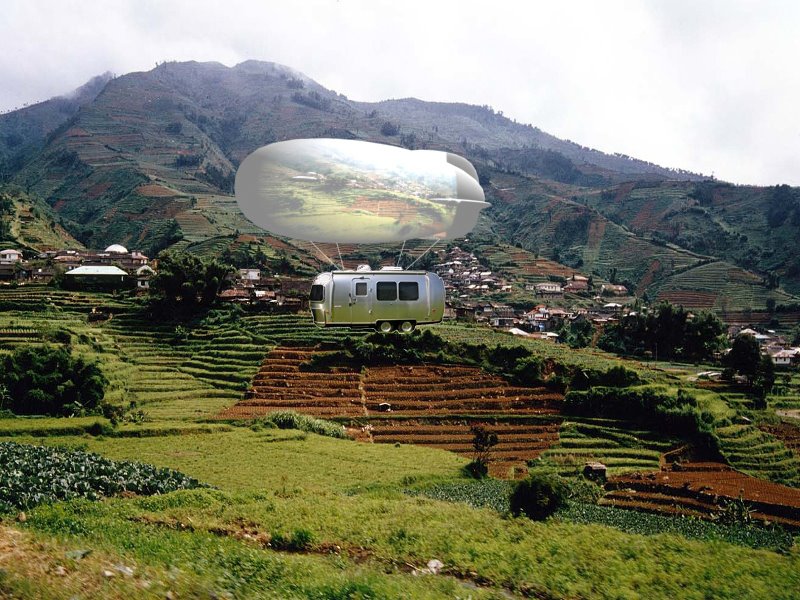
One shell per context of exploration. Shell inflated on top of the structure to indicate where the mobile unit is going.
Context based shells per unit
Water: Jelly Fish Organic Shell
Countryside: Wooden structure
City: Inflatable Concrete
Air: Blimp

headquater
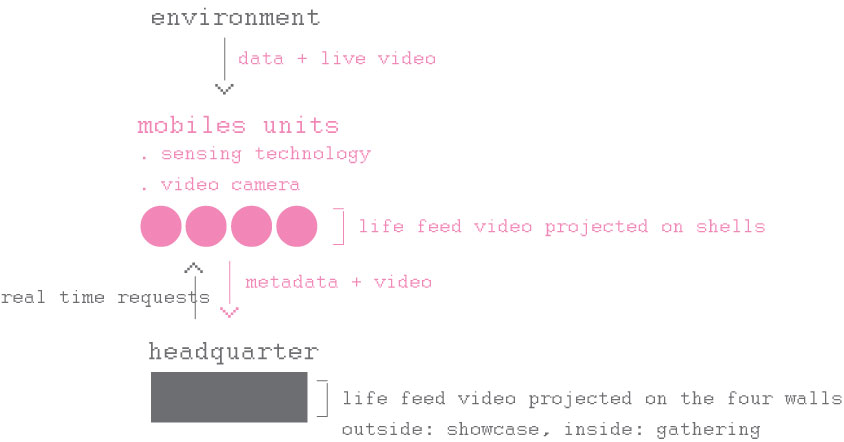
Is composed of four gathering areas: the air, the countryside, the city and the water area, a studio and an editing room. Each wall receives life feed from the mobile units based on each unit context. Environmental data from sensing mobile units are also projected on the walls as meta information. The headquarter itself retro-project on its roof the life feed of its environment and on the external walls displays the video from mobiles units. The production center also invites to discuss the documentaries and environmental issues and by that is also a showcase building.

technology specs
Live feed video camera from mobile units to headquarter. Each mobile unit is composed of one video camera connected via satellite to the headquarter. The life feed video camera is sent to the headquarter and projected onto the contextual area outside wall and inside wall (as part of the cafeteria gathering) area.
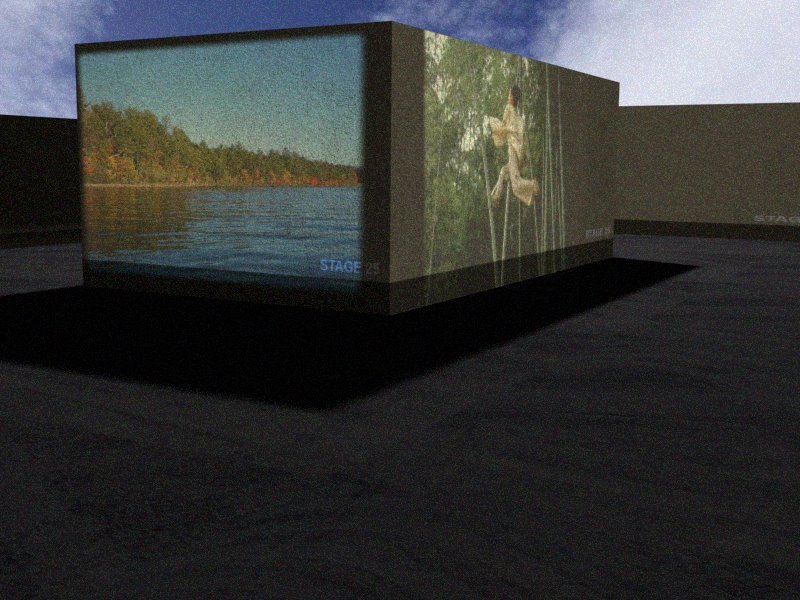
Video recording and metadata from mobile units to headquarter. Each mobile unit documents by recording visual environmental elements and use sensing technologies to combine video recorded and environmental data for later post production video retrieval. For instance GPS technology for location data retrieval, temperature, wind information and so forth. The production companies will retrieve video recordings of the mobile units and metadata associated to them.

Live feed video camera from mobile units onto mobile units. Each mobile unit would retro project their life feed footage onto their semi-transparent fabric structure to melt within its environment.

Headquarter data exchange with mobile units. Information and request coming from headquarter to define what to explore by real time exchange video footage. Scenario: if the mobile unit is in the air and crosses a bird migration, the headquarter could visualize it and request more detailed footage or more sensing environmental data coming from the bird migration.

communication system diagram


visual scenario of the ambient peacock explorer


the blimp
the air mobile unit.
The shell inflated on top of the structure indicates the mobile unit is going to document from above and in the air.


the mobile unit
common to all contexts is controlled by two people. It has real time contact with the headquarter via satellite. One person controls the mobile unit and one gathers data, exchanges information, and prepare the unit to its environmental use. The unit consists of the inflatable blimp on top, the floatation device including the organic shell at the bottom, a projector to display environmental data inside each shell.


the mobile unit going into water.

The compressor is used for the floatation device and an organic semi transparent shell is added around the structure. The environmental life feed video is projected on the shell. The mobile unit is waterproof.


external view of the headquarter as a showcase.

Four walls: the air, the countryside, the city and the water. Each wall receives life feed from the mobile units based on each unit context.

The Ambient peacock explorer is a project I made with Philip Vriend for the Kinetic Architecture class, Assignment 2, November 2005.

By Cati in kinetic architecture

The Ambient peacock explorer poster


By Cati for Kinetic Architecture, Assignment 2, November 2005